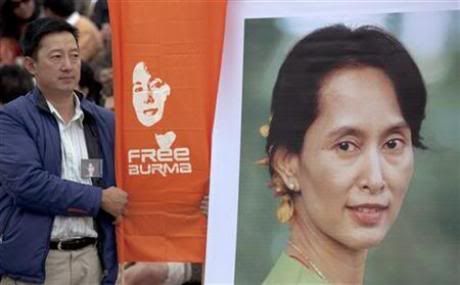
The party of Myanmar's detained opposition leader Aung San Suu Kyi decided Monday to boycott the military-ruled country's first election in two decades after the Nobel laureate blasted new electoral rules as "undemocratic."
The main opposition National League for Democracy's refusal to participate would undermine the polls' credibility in the eyes of foreign governments, which have urged the diplomatically isolated junta to ensure all groups take part in the elections.
The military, which has run Myanmar since 1962, has touted this year's elections as part of a "roadmap to democracy," but a number of rules would prevent Suu Kyi herself from participating. The pro-democracy icon has spent 14 of the last 20 years in jail or under house arrest.
Suu Kyi's party won the last election held in Myanmar in 1990 by a landslide but was barred by the military from taking power.
On Monday, her party's spokesman, Nyan Win, announced after a daylong meeting that all 113 delegates present had agreed that the party should not register for the elections.
Cheering could be heard from the delegates as they concluded their meeting.
Nyan Win said the central committee members decided not to register because — as noted in a message sent to them by Suu Kyi — the electoral laws enacted by the junta "are unfair and unjust."
Her message also called stipulations in the law "undemocratic."
Nyan Win did not elaborate, but the party had previously objected to a provision of the party registration law that requires parties to expel members who have criminal convictions, or face deregistration.
Because Suu Kyi was convicted last year of allowing an unregistered guest to stay at her home, the provision would appear not to allow her to be a member of the National League for Democracy, which she helped found.
Suu Kyi is still general-secretary of the party and its most dominant figure.
The new election laws require political parties to register before the first week in May. Parties that do not register will not be able to participate in this year's election and will cease to exist, under rules enacted this month by the military government that also bar Suu Kyi from participating in the polls.
No date has been set for the polls, which critics deride as a sham designed to cement the power of the military.
Even before the official decision, party spokesman Nyan Win indicated the party would decide not to register. Asked if that would marginalize the party, he said, "We will continue to exist politically by not registering. If we register, we will only have a name void of all political essence."
"We will survive as long as we have public support," Nyan Win said.
Security was heightened, with plainclothes police and pro-government security guards stationed around the party's compound as the delegates met Monday in Yangon.
"This meeting is a life-or-death issue. If we don't register, we will not have a party and we will be without legs and limbs," said Win Tin, a veteran party member and one of Myanmar's longest-serving political prisoners, having spent 19 years behind bars before his release in 2008.
He said the journey ahead would be difficult if the party chooses to opt out of elections but that its members could still maintain their democratic principles and spirit.
Last week, Suu Kyi was quoted by her lawyer as saying she opposed registering her party. But she stressed she would let the party decide for itself.
Suu Kyi is under house arrest and the new election laws effectively bar her both from running and voting.
Myanmar's biggest opposition party said on Monday it would not register for this year's election, meaning Nobel Peace laureate Aung San Suu Kyi's party will have no role in the military-led political process.
The National League for Democracy (NLD) party, which won the last election in 1990 by a landslide but was never allowed to rule, said the entire party leadership had agreed not to run.
"After a unanimous vote of the central executive committee, the NLD party has decided not to register as a political party because the election laws ... are unfair and unjust," the party said in a statement.
The election has been widely dismissed as a sham after nearly five decades of iron-fisted army rule in the former Burma, a strategically situated but isolated country rich with resources like natural gas, timber and gems and a Southeast Asian port.
Senior party members made the decision six days after Suu Kyi, who has spent 15 of the past 21 years in detention, said she "would not dream" of entering if the decision was hers.
The comment was widely interpreted as a veiled instruction to party members as they prepared for a ballot on whether to run.
In comments relayed from her lawyer, Suu Kyi said the NLD was not ruined and vowed to keep up her fight for democracy.
"Registering the party under the unjust and one-sidedly drawn-up laws cannot be accepted," she was quoted as saying.
"I would like to tell the people that I will continue working for the emergence of democracy."
A senior party official had earlier told Reuters some members in favor of running in the election had been urged to vote otherwise to show the party was united.
UNCERTAIN FUTURE
Divisions had emerged in the party between advocates of a boycott and modernizers who believe the NLD would be a spent force if it did not run. However, senior NLD member Win Tin said the party would live on.
"The party will not die," he told Reuters. "We will be among the people, our activities will not stop."
The party faces dissolution if it refuses to register.
After the announcement, party members were in high spirits and chanted slogans to show their support for Suu Kyi, wearing T-shirts bearing her picture.
The NLD is most angered by the military junta's restrictive election laws, which bar current and former prisoners from taking part. Many NLD members are among the 2,100 political detainees in Myanmar, the most famous of whom is Suu Kyi.
After the last election, the junta promised to hand over power to the NLD after a constitution was drafted and a probe launched into the polls. Neither happened and the NLD was never allowed to rule.
Some in Myanmar's biggest city, Yangon, disagreed with the NLD's decision and said the country's best hope for democratic change had played into the hands of the generals.
"I think the NLD has made another major policy blunder," said a retired civil servant, who asked not to be identified.
"They've walked into a trap. They could have pressed on without Suu Kyi and got something out of the election."
Experts say the junta has learned from the botched 1990 election and has drafted a constitution that ensures it will effectively remain in charge, without the need to rig the polls.
The United States and United Nations have not publicly questioned the constitution but have said the election would not be credible if political prisoners could not take part.


