Sink hole: This incredible picture shows a 200ft-deep hole in an intersection in downtown Guatemala City. In the top left of the intersection stood a three-storey building
Lucky escape: Neighbouring buildings are left untouched after torrential rain led to this huge crater forming in the capital. The area has been closed off and evacuated
Ash threat: Officials blame mudslides and sink holes in the capital on poor drainage, due to ash from the Pacaya volcano blocking drains. The volcano erupted last week, laying a blanket of ash on everything - including the runway at Guatemala City's international airport
At least one man was killed and others are missing after a three-storey building fell into a 200ft-deep sink hole in Guatemala City.
Tropical storm Agatha, the first named storm of the 2010 Pacific season, slammed into Guatemala and neighbouring El Salvador at the weekend, dumping more than three feet of rain in the region.
The body of Rodrigo Rosenberg lies next to a Guatemala City road after he was shot by a hitman last year. A video recorded before his death accused the country's President Alvaro Colom of his murder
No conspiracy: A UN commission this week cleared Mr Colom of any involvement in Rosenberg's death, concluding that he hired his own assassin
A Guatemalan lawyer hired a hitman to kill him then accused the country's president of his murder in a video made before his death and later posted on the internet.
Rodrigo Rosenberg, 47, orchestrated his own demise amid severe personal problems - but only after first recording an 18-minute video in which he claimed President Alvaro Colom was planning to kill him.
Looking into the camera while seated behind a desk, the lawyer said: 'Unfortunately, if you are watching this message it means that I, Rodrigo Rosenberg Marzano, have been assassinated by President Alvaro Colom.'
He went on to accuse the president of a corruption scandal linked to a government bank and said that his murder would be an attempt to cover that up.
Rosenberg was shot dead as he rode a bicycle in Guatemala City on May 10 last year.
His accusations were distributed to reporters on DVDs at his May 11 funeral. They immediately set the already polarised Central American country into a frenzy of protests, allegations of corruption and calls for President Colom's resignation.
He denied any involvement in the killing and arranged for a United Nations commission to investigate.
The commission this week concluded that Rosenberg had hired his own assassin after persuading two distant cousins that he needed to find a hitman to kill people who were extorting him.
In an elaborate scheme he then bought two mobile phones. One was to communicate with the hitmen and the other to deliver threatening messages to himself.
UN investigators also found that Rosenberg was driven by personal problems, including the recent death of this mother and losing custody of his children, and believed that the government was behind the murder of two close friends.
The cousins implicated in the investigation, Francisco and Estuardo Valdes Paiz, are considered fugitives from justice. Investigators allege they contacted the head of security at their pharmaceutical company to help them find someone to carry out the killing for $40,000.
His posthumous accusations of corruption became a rallying cry for members of Guatemala's dominant elite, many of whom are angry over Colom's attempts to eliminate tax loopholes for corporations and criticise his inability to reduce high rates of violent crime.
Colom is overwhelmingly backed by Guatemala's mostly Mayan Indian poor for his efforts to tax the rich and build schools and clinics for disadvantaged communities.
The president has suggested that criminal or political interests were behind the video and expressed relief on Tuesday.
He said: 'The day has arrived that I have waited for in silence and patience, where this crime finally been clarified.'
The commission's investigation has led to 11 arrests with three of those people working with investigators as protected witnesses.
Watch footage of Rodrigo Rosenberg accusing President Alvaro Colom of his murder
Alejandra Maria Torres sits bloodied on a street after being beaten, doused with petrol and set on fire during a lynching in Guatemala City.
Passengers of a public bus accused Torres and three men, who escaped on foot, of participating in an armed robbery
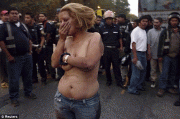
Stripped naked to the waist, she begs for mercy as she is savagely beaten by a lynch mob in the middle of the street.
Alejandra Maria Torres was part of an armed gang that tried to rob bus passengers in Guatemala City.
But as she tried to escape the passengers stripped and beat her before dousing her in petrol and setting her alight.
Police put out the flames and arrested her. Her three companions escaped.
Lynchings are common in Guatemala. In the last year, mobs have attacked more than 250 people, leaving at least 40 of them dead.
Criminals are a frequent target but officials are sometimes attacked, including a judge who issued a rape verdict thought by the public to be too lenient.
The practice stems from the civil war of 1960 to 1996 when civil defence patrols carried out many of the murders in the state-sponsored genocide of Left-wing rebels, many of them peasants.