Claims of melting Himalayan glaciers have been cited in grant applications
Rajendra Pachauri, chairman of the UN's Intergovernmental Panel on Climate Change
The chairman of the UN's Intergovernmental Panel on Climate Change (IPCC), has used bogus claims that Himalayan glaciers were melting to win grants worth hundreds of thousands of pounds.
Rajendra Pachauri's Energy and Resources Institute (TERI), based in New Delhi, was awarded up to £310,000 by the Carnegie Corporation of New York and the lion's share of a £2.5m EU grant funded by European taxpayers.
It means that EU taxpayers are funding research into a scientific claim about glaciers that any ice researcher should immediately recognise as bogus. The revelation comes just a week after The Sunday Times highlighted serious scientific flaws in the IPCC's 2007 benchmark report on the likely impacts of global warming.
The IPCC had warned that climate change was likely to melt most of the Himalayan glaciers by 2035 - an idea considered ludicrous by most glaciologists. Last week a humbled IPCC retracted that claim and corrected its report.
Since then, however, The Sunday Times has discovered that the same bogus claim has been cited in grant applications for TERI.
One of them, announced earlier this month just before the scandal broke, resulted in a £310,000 grant from Carnegie.
An abstract of the grant application published on Carnegie's website said: "The Himalaya glaciers, vital to more than a dozen major rivers that sustain hundreds of millions of people in South Asia, are melting and receding at a dangerous rate.
"One authoritative study reported that most of the glaciers in the region "will vanish within forty years as a result of global warming, resulting in widespread water shortages,"
The Carnegie money was specifically given to aid research into "the potential security and humanitarian impact on the region" as the glaciers began to disappear. Pachauri has since acknowledged that this threat, if it exists, will take centuries to have any serious effect.
The money was initially given to the Global Centre, an Icelandic Foundation which then channelled it, with Carnegie's involvement, to TERI.
The cash was acknowledged by TERI in a press release, issued on January 15, just before the glacier scandal became public, in which Pachauri repeated the claims of imminent glacial melt.
It said: ""According to predictions of scientific merit they may indeed melt away in several decades."
The same release also quoted Dr Syed Hasnain, the glaciologist who, back in 1999, made the now discredited claim that Himalayan glaciers would be gone by 2035.
He now heads Pachauri's glaciology unit at TERI which sought the grants and which is carrying out the glacier research.
Critics point out that Hasnain, of all people, should have known the claim that the Himalayan glaciers could melt by 2035 was bogus because he was meant to be a leading glaciologist specialising in the Himalayas.
Any suggestion that TERI has repeated an unchecked scientific claim without checking it, in order to win grants, could prove hugely embarrassing for Pachauri and the IPCC.
The second grant, from the EU, totalled £2.5m and was designed to "to assess the impact of Himalayan glaciers retreat".
It was part of the EU's HighNoon project, launched last May to fund research into how India might adapt to loss of glaciers.
In one presentation at last May's launch, Anastasios Kentarchos, of the European Commission's Climate Change and Environmental Risks Unit, specifically cited the bogus IPCC claims about glacier melt as a reason for pouring EU taxpayers' money into the project.
Pachauri spoke at the same presentation and Hasnain is understood to have been present in the audience.
The EU grant was split between leading European research institutions including Britain's Met Office, with TERI getting a major but unspecified share because it represented the host country.
The "Glaciergate" affair has seen Pachauri come under increasing pressure in India, prompting him to call a press conference yesterday (Saturday) where he dismissed calls for his resignation and said no action would be taken against the authors of the erroneous section of the IPCC report.
He said: "I have no intention of resigning from my position," adding the errors were unintentional and not significant in comparison to the entire report.
However, other questions remain. One of the most important is in connection with Pachauri's earnings.
In an interview with The Sunday Times he said his only income came from his salary at TERI. However TERI does not publish his salary and he refused to divulge it.
In India questions are also being asked about Pachauri's links with GloriOil, a Houston, Texas-based oil technology company that specialises in recovering extra oil from declining oil fields . Pachauri is listed as a founder and scientific advisor.
Critics say it is odd for a man committed to decarbonising energy supplies to be linked to an oil company.
The problems come at a bad time for the IPCC which is recruiting scientists for its fifth report into the science and impacts underlying global warming.
Yesterday, Pachauri said he intended to remain as director of the IPCC to oversee the fifth IPCC assessment report dealing with sea level rise and ice sheets, oceans, clouds and carbon accounting. The report is expected by 2014.
---------
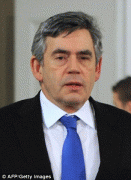
Prime Minister Gordon Brown offered to cut Britain's carbon emissions by 42 per cent - 10 times the United States' proposed level
Greenpeace activists dressed in dinner suits are led away by security staff after turning up at the official state dinner in Copenhagen last night
A demonstrator receives help as she suffers the effects of pepper spray while protesters attempt to break through police lines outside the Bella Centre
French PM gestures during meeting.President Barack Obama walks off of Air Force One at Copenhagen Airport , Kastrup, Denmark Friday, Dec. 18, 2009 to attend the United Nations Climate Change Conference.
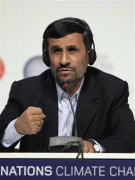
Iran's President Mahmoud Ahmedinejad gestures during a press conference at the U.N. Climate Conference in Copenhagen Friday Dec. 18, 2009. The largest and most important climate change conference is on its last scheduled day, aiming to secure an agreement on how to protect the world from calamitous global warming.
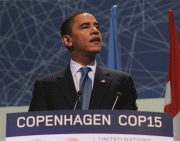
President Barack Obama speaks at the morning plenary session of the United Nations Climate Change Conference at the Bella Center in Copenhagen, Denmark, Friday, Dec. 18, 2009.U.S. President Barack Obama speaks on the podium during the plenary session at the climate summit in Copenhagen, Denmark, Friday, Dec. 18, 2009. President Obama says that the world's will to address climate change "hangs in the balance" and insists any deal must include transparency among nations.
Antti Kaartinen, center, a communications official responsible for protocol during the press conferences, is stopped by Iranian security guards as he tried to walk up to the podium, during Iran's President Mahmoud Ahmedinejad's press conference at the U.N. Climate Conference in Copenhagen Friday Dec. 18, 2009. The largest and most important climate change conference is on its last scheduled day, aiming to secure an agreement on how to protect the world from calamitous global warming.
"We have an agreement," Sarkozy told a news conference in Copenhagen after the meeting of 120 world leaders. He added: "The text we have is not perfect."
Under the accord, he said all countries including China would have to submit written plans for curbs in carbon dioxide emissions by January 2010. And he said that all countries had signed up for a plan to provide developing nations with $100 billion a year in aid by 2020.
President Barack Obama declared Friday a "meaningful and unprecedented breakthrough" had been reached among the U.S., China and three other countries on a global effort to curb climate change but said much work was still be needed to reach a legally binding treaty.
"It is going to be very hard, and it's going to take some time," he said near the conclusion of a 193-nation global warming summit. "We have come a long way, but we have much further to go."
The president said there was a "fundamental deadlock in perspectives" between big, industrially developed countries like the United States and poorer, though sometimes large, developing nations. Still he said this week's efforts "will help us begin to meet our responsibilities to leave our children and grandchildren a cleaner planet."
The deal as described by Obama reflects some progress helping poor nations cope with climate change and getting China to disclose its actions to address the warming problem.
But it falls far short of committing any nation to pollution reductions beyond a general acknowledgment that the effort should contain global temperatures along the lines agreed to at a conference of the leading economic nations last July.
Obama suggested Friday's agreement among the five key countries would be adopted by the larger summit in its closing hours.
"I am leaving before the final vote," he said. "We feel confident we are moving in the direction of a final accord."
If the countries had waited to reach a full, binding agreement, "then we wouldn't make any progress," Obama said. In that case, he said, "there might be such frustration and cynicism that rather than taking one step forward we ended up taking two steps back."
The limited agreement by the U.S., China, Brazil, India and South Africa reflected the intense political and economic obstacles that had blocked a binding accord to restrict emissions of "greenhouse gases" believed to be causing a dangerous warming of the Earth.
The accord calls for the participating countries to list specific actions they have taken to control emissions and the commitments they are willing to make to achieve deeper reductions.
There would be a method for verifying reductions of heat-trapping gases, a senior administration official said, speaking on the condition of anonymity before Obama made his comments.
Obama said the five nation's pledges would be "subject to an international consultation" that will allow each country to "show the world what they're doing."
China's resistance to a verification mechanism had been one of the major sticking points for the U.S. during the two weeks of climate negotiations here.
"We're in this together, and we'll know who is meeting and not meeting the mutual obligations that are set forth," Obama said.
As for the U.S., he said, "We will not be legally bound by anything that took place here today," pre-emptively answering congressional critics who had warned repeatedly that Congress will have the final say in any U.S. emission reduction commitments.
The deal also would provide a mechanism to help poor countries pay for dealing with climate change.
The president had planned to spend only about nine hours in Copenhagen as the summit wrapped up after two weeks. But, as an agreement appeared within reach, he added extended his stay by more than six hours to attend a series of meetings aimed at brokering a deal.
"We are running short on time," Obama had told the summit as the clock was running out on its final day. "There has to be movement on all sides."
He met with other leaders, including Chinese Premier Wen Jiabao.
Late in the evening, Obama and Secretary of State Hillary Rodham Clinton held talks with European leaders, including British Prime Minister Gordon Brown, French President Nicolas Sarkozy and German Chancellor Angela Merkel. Asked how negotiations were going as he entered the meeting, Obama replied: "Always hopeful."
The direct talks between Obama and Wen underscored efforts to resolve differences that represent one of the major roadblocks in reaching a global climate deal. The U.S. has been insisting that China, the only nation that emits more heat-trapping gasses than the U.S., make its emissions-reduction pledges subject to international review.
Hours before his announcement of the limited agreement, without mentioning China specifically, Obama said, "I don't know how you have an international agreement where we all are not sharing information and making sure we are meeting our commitments. That doesn't make sense. It would be a hollow victory."
Obama indirectly acknowledged that some nations feel the United States is doing too little to reduce greenhouse gas emissions, and he urged leaders to accept a less-than-perfect pact. Meanwhile, he offered no new U.S. concessions.
"No country will get everything that it wants," Obama said.
It's possible that Obama's biggest success here will have nothing to do with the climate. He met with the Russian president and said afterward that the United States and Russia are "quite close" to a new nuclear arms control agreement to replace an expired Cold War-era arms control treaty.
The U.S. commitment to reduce greenhouse gasses mirrors legislation before Congress. It calls for 17 percent reduction in such pollution from 2005 levels by 2020 — the equivalent of 3 percent to 4 percent from the more commonly used baseline of 1990 levels. That is far less than the offers from the European Union, Japan and Russia.
Even that target was hard-won in a skittish Congress, and Obama has decided he can't go further without potentially souring final passage of the bill, approved in the House but not yet considered in the Senate. He also could imperil eventual Senate ratification of any global treaty that emerges next year.
A protestor with a green "peace" sign painted on his face takes part in a demonstration outside Bella Center, the venue of the U.N. climate change conference, in Copenhagen Wednesday Dec. 16, 2009. The largest and most important climate change conference is underway in Copenhagen, aiming to secure an agreement on how to protect the world from calamitous global warming.
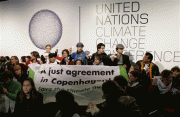
Members of NGO's stage a sit-in at the venue of the Copenhagen Climate Summit in Copenhagen, Wednesday Dec. 16, 2009. Activists, upset with the fact that many NGO's were not granted access to the meeting center, hoped to disrupt a major plenary with world leaders.UNFCCC Executive Secretary Yvo de Boer, (R), speaks with members of NGO's as they stage a sit in at the venue of the Copenhagen Climate Summit in Copenhagen, Wednesday Dec. 16, 2009. Activists, upset with the fact that many NGO's were not granted access to the meeting center, hoped to disrupt a major plenary with world leaders.
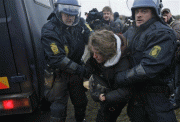
Danish riot police detain a protestor during a demonstration outside the Bella Center, the venue of the U.N. Climate Conference, in Copenhagen Wednesday Dec. 16, 2009. The largest and most important climate change conference is underway in Copenhagen, aiming to secure an agreement on how to protect the world from calamitous global warming
A member of an NGO holds up his accreditation badge as he participates in a sit in at the venue of the Copenhagen Climate Summit in Copenhagen, Wednesday Dec. 16, 2009. Activists, upset with the fact that many NGO's were not granted access to the meeting center, hoped to disrupt a major plenary with world leaders.A member of an NGO holds up his accreditation badge as he participates in a sit-in at the venue of the Copenhagen Climate Summit in Copenhagen, Wednesday Dec. 16, 2009. Activists, upset with the fact that many NGO's were not granted access to the meeting center, hoped to disrupt a major plenary with world leaders.
UN Secretary-General Ban Ki-moon, (L), meets with British Prime Minister Gordon Brown at the UN Climate Conference on Wednesday Dec. 16, 2009 in Copenhagen, Denmark. The success of the U.N. climate conference hangs in the balance as China and the U.S. deadlock over whether Beijing will allow the world to check its books and verify promised cuts in greenhouse gas emissions.Delegates from Bahrain(R) talk during a plenary session at the climate summit in Copenhagen, Denmark, Wednesday, Dec. 16, 2009. The success of the U.N. climate conference is hanging in the balance as China and the U.S. deadlocked over whether Beijing will allow the world to check its books and verify promised cuts in greenhouse gas emissions.
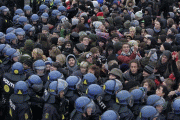
Police use pepper spray(R) to push back protestors during a demonstration outside Bella Center, the venue of the U.N. climate change conference, in Copenhagen Wednesday Dec. 16, 2009. The largest and most important climate change conference is underway in Copenhagen, aiming to secure an agreement on how to protect the world from calamitous global warming.Danish riot police(L) push back a demonstration outside Bella Center, the venue of the U.N. climate change conference, in Copenhagen Wednesday Dec. 16, 2009. The largest and most important climate change conference is underway in Copenhagen, aiming to secure an agreement on how to protect the world from calamitous global warming.
Members of NGO's stage a walkout from the venue of the Copenhagen Climate Summit in Copenhagen, Wednesday Dec. 16, 2009. Activists, upset with the fact that many NGO's were not granted access to the meeting center, hoped to disrupt a major plenary with world leaders.A demonstrator beats the drum(R) as activists stage a protest inside the Bella Center as delegates attend the plenary of the UN Climate Summit in Copenhagen, Wednesday, Dec. 16, 2009.
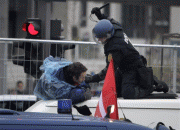
A Danish riot policeman pushes a demonstrator off a police vehicle(L) during a demonstration outside Bella Center, the venue of the U.N. Climate Conference, in Copenhagen Wednesday Dec. 16, 2009. The largest and most important climate change conference is underway in Copenhagen, aiming to secure an agreement on how to protect the world from calamitous global warming.Danish riot police scuffle with a group of demonstrators inside the secured area around the Bella Center(R), the venue of the U.N. Climate Conference, in Copenhagen Wednesday Dec. 16, 2009. The largest and most important climate change conference is underway in Copenhagen, aiming to secure an agreement on how to protect the world from calamitous global warming.
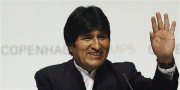
American actress Darryl Hannah(L) speaks during an interview with the Associated Press at the Copenhagen Climate Summit in Copenhagen, Wednesday Dec. 16, 2009. World leaders arrived in Copenhagen this week to forge the framework of a plan to limit the causes of global warming, seeking to prevent catastrophic changes to the climate.Bolivian President Juan Evo Morales (R)gestures during a press conference at the climate summit in Copenhagen, Denmark, Wednesday, Dec. 16, 2009. Danish police fired pepper spray and beat protesters with batons outside the U.N. climate conference on Wednesday, as disputes inside left major issues unresolved just two days before world leaders hope to sign a historic agreement to fight global warming.
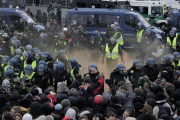
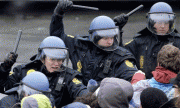
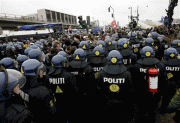
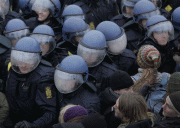
Danish riot police(L) use their batons to push back protestors during a demonstration outside Bella Center, the venue of the U.N. climate change conference, in Copenhagen Wednesday Dec. 16, 2009. The largest and most important climate change conference is underway in Copenhagen, aiming to secure an agreement on how to protect the world from calamitous global warming.The helmets of Danish riot police fog up(R) as they push back demonstrators outside the Bella Center, the venue of the U.N. Climate Conference, in Copenhagen Wednesday Dec. 16, 2009. The largest and most important climate change conference is underway in Copenhagen, aiming to secure an agreement on how to protect the world from calamitous global warming. Police gather outside the Bella Center in Copenhagen(middle), Wednesday, Dec. 16th, 2009 where they fired tear gas and swung batons to disperse crowds of protesters trying to disrupt the 193-nation climate conference. Demonstrators for days have taken to Copenhagen's streets to demand "climate justice," firm action to combat global warming. Police said 230 protesters were detained.
Police fired pepper spray and beat protesters with batons outside the U.N. climate conference Wednesday, as disputes inside left major issues unresolved just two days before world leaders hope to sign a historic agreement to fight global warming.
Hundreds of protesters were trying to disrupt the 193-nation conference, the latest action in days of demonstrations to demand "climate justice" — firm steps to combat global warming. Police said 230 protesters were detained.
Inside the cavernous convention hall, Venezuelan President Hugo Chavez, among the first leaders to address the assembly, echoed the protesters' sentiments: "If the climate was a bank, a capitalist bank, they would have saved it."
Earlier, behind closed doors, negotiators dealing with core issues debated until just before dawn without setting new goals for reducing greenhouse gas emissions or for financing poorer countries' efforts to cope with coming climate change, key elements of any deal.
"I regret to report we have been unable to reach agreement," John Ashe of Antigua, chairman of one negotiating group, told the conference.
In those overnight talks, the American delegation apparently objected to a proposed text it felt might bind the United States prematurely to reducing greenhouse gas emissions before Congress acts on the required legislation. U.S. envoys insisted, for example, on replacing the word "shall" with the conditional "should."
"A lot of things are in play," said Fred Krupp of the U.S. Environmental Defense Fund. "This is the normal rhythm of international negotiations."
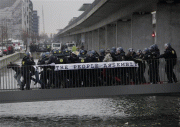
Hundreds of protesters marched on the suburban Bella Center, where lines of Danish riot police waited in protective cordons. Some demonstrators said they wanted to take over the global conference and turn it into a "people's assembly." As they approached police lines, they were hit with pepper spray, and TV pictures showed a man being pushed from a police van's roof and struck with a baton by an officer.
Tens of thousands rallied in the Danish capital last weekend, demonstrating growing public awareness of the worldwide danger of ever-rising temperatures. Scientists say global warming will lead to the extinction of plant and animal species, the flooding of coastal areas from rising seas, more extreme weather, more drought and diseases spreading more widely.
The Copenhagen talks so far have been marked by sharp disagreements between China and the United States, and between rich and poor nations. Still unresolved are the questions of emissions targets for industrial countries, billions of dollars a year in funding for poor countries to contend with global warming, and verifying the actions of emerging powers like China to ensure that promises are kept.
Addressing the full conference for the European Union, Swedish Environment Minister Andreas Carlgren, urged the U.S. and China to raise their emissions-reduction targets.
"The world needs more and we are confident that you have the ability to deliver more," he said of the two countries.
After nine days of largely unproductive talks, the lower-level delegates were to hand off the disputes to environment ministers in the two-week conference's critical second phase. Connie Hedegaard, a former Danish climate minister, resigned from the conference presidency to allow Danish Prime Minister Lars Loekke Rasmussen to preside as a higher-ranking official at the formal Wednesday-Friday segment involving heads of state and government. She was to continue overseeing closed-door negotiations.
Organizers still hope to break deadlocks that threaten to leave the meeting with no major accomplishments to be presented to President Barack Obama, Chinese Prime Minister Wen Jiabao and more than 110 other world leaders arriving for Friday's finale.
The lack of progress disheartened many, including small island states threatened by rising seas.
"We are extremely disappointed," Ian Fry of the tiny Pacific nation of Tuvalu said on the conference floor. "I have the feeling of dread we are on the Titanic and sinking fast. It's time to launch the lifeboats."
Others were far from abandoning ship. "Obviously there are things we are concerned about, but that is what we have to discuss," Sergio Barbosa Serra, Brazil's climate ambassador, told The Associated Press. "I would like to think we can get a deal, a good and fair deal."
Governments had weeks ago given up hope of concluding a finished treaty at Copenhagen and aimed instead at establishing a framework, through decisions here, for negotiating more formal agreements next year.
Much of the uncertainty in the Copenhagen talks stems from how slowly the first U.S. legislation to cap carbon dioxide emissions is moving through Congress. Passage of a U.S. climate change bill is expected no earlier than next spring — and many other nations are unwilling to make their final commitments until the U.S. does.
A sponsor of that legislation, U.S. Sen. John Kerry, D-Mass., visiting the conference, sounded undiscouraged about the fitful negotiations. "My sense is we can get this done," he told the AP.
The draft texts being debated behind closed doors hinge on four key issues, with negotiating views generally divided between rich nations and developing ones:
_ Emissions. Industrialized nations are under pressure to cut back even more on emissions of carbon dioxide and other global-warming gases, while major developing countries such as China and India are being pressed to rein in emissions growth. Environmentalists and poorer nations say richer countries should reduce their greenhouse gas emissions by 40 percent or more by 2020, compared with 1990 levels, to avoid serious climate damage. The European Union has pledged 20 percent, and possibly 30 percent. The U.S. has offered only a 3 percent to 4 percent cut.
_ Financing. Richer nations have discussed a "prompt-start" package of $10 billion a year for three years to help developing nations adjust to the impact of global warming and switch to clean energy. Developing nations want to see commitments by wealthy nations for years more of long-term climate aid financing. Expert studies say hundreds of billions of dollars will be needed each year, and the developing nations are trying to establish stable revenue sources, such as a global aviation tax.
_ Monitoring. The U.S. and developed nations want some kind of international verification of emissions actions by developing nations. China, India and others are resisting what they consider potential intrusions on their sovereignty.
_ Legal Form. For Europe, Japan and other developed nations, new, deeper emissions cuts will take the form of an extension of quotas under the 1997 Kyoto Protocol. The U.S., which rejected Kyoto and wants to remain outside it, likely to be included in a separate package that also deals with major developing countries. The level of legal obligation on each "track" may vary, particularly since the big developing countries — China and India — do not want to be bound by any international treaty to carry out their pledges of emission cuts. They prefer voluntary goals.