Showing posts with label haiti. Show all posts

Monday, February 21, 2011

Haiti earthquake children sold by their parents for less than 76p each to traffickers, say Unicef

* Over 76% of Haitians live on £1.50 a day
* Parents forced to sell children to traffickers
* They believe their young will have better life - but most don't

As Haiti continues to slowly rebuild following the earthquake which devastated the Caribbean island in January 2010, it has come to light that helpless children are being trafficked for as little as 76 pence each.

Registering 7.0 on the Moment magnitude scale, the earthquake - which struck on January 12, 2010, near capital city Port-au-Prince - killed between 100,000 and 300,000 people, and displaced well over a million.

Aftershocks were felt for weeks afterwards and, with conditions difficult to build in, there were further complications when there was a cholera outbreak in makeshift camps last year.

Over 76 per cent of the country are living on less that £1.50 a day, and just when you thought that the horror could not be any worse, charity Unicef have found that a number of children - many of whom lost their parents in the tragic earthquake - are been sold for next to nothing.


 Devastation: Men attempt the massive clean up job following the earthquake which killed up to 300,000 people.Displaced: Over one million people lost their homes after the earthquake in January 2010
Vulnerable: Young children in Haiti are being sold by their parents for as little as 76 pence


Monday, August 23, 2010

Wyclef Jean’s Haiti presidential candidacy rejected


Haiti hip-hop star Wyclef Jean greets the crowd before officially registering as a presidential candidate at an office in the Delmas neighborhood of Port-au-Prince in this file picture taken August 5, 2010.

Haiti’s provisional electoral council ruled today that hip-hop star Wyclef Jean was not eligible to run as a presidential candidate for a November 28 election.

Singer-songwriter Jean, 40, an international celebrity who is popular in his impoverished and earthquake-ravaged homeland, was left off the list of approved candidates published by the council.

A council member told Reuters yesterday that Jean did not meet several of the legal requirements to stand in the November election to choose a successor to President Rene Preval, who cannot run again after two terms.

He was among 34 candidates considered by the electoral authority, which had postponed announcing the final list of approved candidates from Tuesday.


Thursday, August 19, 2010

Wyclef Jean says threats won’t deter candidacy


Hip-hop star Wyclef Jean said yesterday he had received death threats but they would not deter him from running for president of his native Haiti.

“There are people who think I’m a threat to their power and ambitions. I’m not going to give up. My will is to serve the Haitian people, and the death threats and intimidation won’t deter me,” Jean told Reuters.

Haiti’s provisional electoral council had been due to finalise on Tuesday the list of candidates who met the legal requirements to stand in the November 28 election that will choose a successor to President Rene Preval.

The announcement was delayed until tomorrow to allow more time to decide on legal questions about several of the 34 contenders, among them Jean.


Monday, July 12, 2010

Haiti Recovery Bogged Down 6 Months After Quake-Haitians fight for better homes-Haiti's orphans still in crisis-Haiti's quake victims fear rape


Quake victims struggle in Haiti

Photobucket
Six months after the earthquake, about 1.3 million Haitians still live in tent camps

Photobucket
Haitians not NGOs must be equipped to rebuild their country

Exactly six months after Haiti was struck by a deadly earthquake, aid agencies are still struggling to care for over a million hungry and homeless people.

The 7.0 quake on January 12 - the worst in the Caribbean nation's history - killed 230,000 people, destroyed 250,000 homes and displaced millions of people.

Though countries across the globe pledged billions in aid, rebuilding shattered lives has proven to be slow and challenging.


Saturday, March 6, 2010

UN promises 10 million dollars to quake-hit Chile-Aftershocks shake Chilean city -


-------------

------

------

-----

----

chile
Residents ran to open spaces as a 6.6-magnitude aftershock rattled the city of Concepcion

chile
United Nations Secretary-General Ban Ki-moon (L) and Chile's President Michelle Bachelet attend a news conference in Santiago, capital of Chile, March 5, 2010. Ban Ki-moon on Friday pledged 10 million dolllars aid from the Central Emergency Fund of the United Nations to the quake-hit Chile

Powerful aftershocks have rattled buildings and sent terrified residents fleeing into the streets in the Chilean city of Concepcion.

Fears of of additional damage in the tremors before dawn on Friday led officials to evacuate some patients from the regional hospital.

Patricia Correa, who was overseeing the hospital's emergency ward, said her part of the five-story building was "on the point of collapsing. The walls cracked".

The strongest of the aftershocks was a magnitude 6.6.

"Some chunks of buildings that were already in bad condition fell, but nothing significant," a senior government official in quake-hit Bio Bio region told local radio.

UN support

Ban Ki-moon, the UN secretary general, arrived in the capital, Santiago, on Friday, promising support for Chile.

"The Chilean government is asking for international aid and we will give it," he said.

Meanwhile, Michelle Bachelet, the outgoing Chilean president, met with Sebastian Pinera, her successor, and they promised to try to avoid letting the March 11 hand-over of power interrupt aid efforts.

"The new government will have an immense challenge," Bachelet said.

Pinera has even before his inauguration named new governors for the six hardest-hit regions and told them to get to work.

Officials were still struggling to determine the death toll of the magnitude-8.8 quake, as well as the damage to roads, ports and hospitals.

Disaster officials announced they had double-counted at least 271 missing as dead in the hardest-hit part of the country - an error that would drop the official death toll to about 540 if there were no other mistakes.

But interior department officials said that from now on, they would release only the number of dead who had been identified: 279 as of Friday.

Uncertainty to remain

Doubts over the death toll are likely to persist, partly because an undetermined number of victims were washed out to sea in the ensuing tsunamis and some bodies may never be recovered.

"The number of disappeared is very difficult to determine," Patricio Bustos, a government forensics specialist in the city of Talca, said.

"It can take a very long time."

The government said on Friday it had removed Mariano Rojas as head of the Navy's oceanographic service over its failure to issue a tsunami warning for the Pacific immediately after Saturday's quake.

Port captains in several towns issued their own warnings, but a national alert never came, and some say that failure led to deaths.

The United Nations' Secretary General Ban Ki Moon committed the UN to giving Chile 10 million dollars from an emergency fund at a joint press conference with Chile's President Michelle Bachelet on Friday.

"The UN will authorize 10 million dollars from a central emergency response fund," Ban told journalists. "We will also establish a working group to look at Chile's most urgent needs," he said.

During the same conference, Bachelet said that she welcomed 2 million dollars' worth emergency material from China on an early Friday.

"This is a gesture that shows the excellence of the links we have had with China," Bachelet told the press conference in response to a question from Xinhua. "It has been the same with the free trade agreement and the cultural exchanges we have had," she added.

Chile experienced an earthquake measuring 8.8 magnitude on the Richter scale six days ago, which killed 279 people, at the last official count, but which may prove to have killed more than 1,000 once all the dead have been confirmed.

Chinese officials said Friday's flight represented the furthest geographical distance that the nation had sent aid and the furthest geographical distance from which Chile had received assistance. It is the first time China has sent a cargo plane to South America carrying material alone.

"It is not easy to cross the world," Bachelet told media. This really expresses the authentic willingness to support Chile, and " we are very grateful," she added.

Chile has received aid from 86 nations and 16 non-government organizations. Bachelet also highlighted aid from Bolivia, sent by both Chileans living there and Bolivia's government, even though the two nation's have not had diplomatic relations since the mid- 1980s. Ban said that 14 UN agencies are taking part in such efforts.

Ban and Bachelet said that they had already begun working with Sebastian Pinera, who will take over Chile's presidency on March 11.

Related:

Chile looks ahead at "enormous task" in rebuilding, Chilean UN envoy says

UNITED NATIONS, March 5 (Xinhua) -- Chilean UN Ambassador Heraldo Munoz said here Friday that with the "broad estimate" of damage for the quake-hit South American country being at around 30 billion U.S. dollars, Chile is planning for the "enormous task" in rebuilding.

"What we have ahead is enormous task of reconstruction," Munoz told reporters at a press conference at the UN Headquarters in New York. "But Chile is standing up -- we are recuperating." Full story

Chile announces national mourning period for quake victims

The Chilean government announced on Thursday that a three-day national mourning period will start Sunday for victims killed in last week's massive quake.

According to a law signed by President Michelle Bachelet, Chileans are asked to demonstrate national flags in front of their homes during the period, so as to pay tribute to the victims and offer condolence to their families.


Friday, March 5, 2010

Chile earthquake much stronger than Haiti's but far less damage. Why?

Photobucket
Father and son looking for food among the destrustion of chile earthquake.

Photobucket
People collect petrol at a damaged Petrol station.

Photobucket
Dog search and rescue any survivor or corpses.

Photobucket
Chile Port is destroyed with tons of containers scattered around.

The earthquake that struck Chile was far stronger than the one that struck Haiti in January.

But, initial reports show that damage was much more contained. While the death toll of 214 is only preliminary and is expected to grow, it’s still a thousand times lower than that of Haiti’s.

One emergency official quoted by Reuters said the number of deaths was unlikely to increase dramatically.

IN PICTURES: Images from the 8.8 magnitude earthquake in Chile

Because of its long history with earthquakes, which has contributed to an earthquake “consciousness” in Chile, and infrastructure that is built to higher standards, many hope that Chile will be spared the vast destruction that struck Haiti, even as it deals with one of its worst natural disasters in decades.

“Chile has a long story of earthquakes, but I think this was the worst ever,” says Paula Saez, an aid worker at World Vision in Chile.

The 8.8-magnitude quake that struck about 200 miles south of Santiago, is being billed as one of the world’s largest in a century, but it will most likely not go down as one of the deadliest. In part, that’s because Chile sits in the “ring of fire” earthquake zone and is accustomed to massive temblors, including the largest on record, which hit in 1960 and registered 9.5.
A few more days until full damage is known

The government says that it might be another 72 hours before the real extent of the damage is known, as telecommunications are down in Concepcion, the city closest to the epicenter of the quake. Also, the earthquake impacted many rural areas, where the population is dispersed and hard to account for.

In downtown Santiago, a sense of calm prevailed, after initial panic. Residents began collecting debris that had fallen on the streets and attempted to reopen businesses by midday.

Chileans are well versed in what to do during earthquakes, with drills part of every child’s schooling. “Just in case” attitudes, which might seem obsessive in other parts of the world, are the norm here. One woman says she turns off the gas valve every time she leaves the house, just in case a quake strikes when she is out.

The Chilean National Emergency Office, which coordinates emergency responses, stresses that Chile is among the world’s most seismic. On its website the agency spells out how to prepare in the event of an earthquake.

That, as well as previous experience, helped many through this quake.

Learning from previous earthquakes

Leonel Araya, a doorman in Santiago who lost a child in a 1982 earthquake, says that he has learned from past experiences. “I’ve been through three big earthquakes, including a maremoto (tsunami) in the north. You learn from them, to be more humanitarian. To think about things better.”

He says he ran to open the door, to get his family under the frame to protect them.

“Everything else can fall,” he says. “I just tried to control the family, because you know, the family, the children, my wife, are really nervous. That’s one thing I learned. You need to keep them right next to you, because once, in an earthquake in 82, a son who’s no longer with me got away from me. And when I tried to grab him, he slipped out and was crushed by a wall.”

Silvia Vidalia, an elderly woman in a neighborhood in Santiago, also stressed the need to stay calm.

“The first thing you need to do is calm each other down. My husband, for example, who is 80-something, is very nervous. So the first thing I did was calm him down. And then, after that hellish shaking ended, we went downstairs because we live on the second floor. You have to find a safe place.”
Population less dense than Haiti

Chile will undoubtedly also be helped by the fact that the earthquake did not happen in as dense an area as Port-au-Prince, Haiti, where parts of the city and several government buildings were literally flattened. It will also be helped by better-enforced building codes, one of the most significant challenges in Haiti. A US Geological Survey researcher told Reuters that a low death toll could be attributed to strong building standards.

Maria Cristina Sepulveda, a pharmacist in Santiago, says she believes she survived because of the sturdiness of the buildings around her.

“It seems like where I live is very well built, because nothing happened to it. I’ve been there for 15 years. The old buildings are well built,” she says.

One of the challenges in the hours ahead will be the damage to infrastructure. Bridges have fallen and airports closed. Some areas are only reachable by helicopter, says Ms. Saez. She says the government is reporting that up to 400,000 people could be affected. The death toll could be higher since in many rural towns there are no hospitals to report figures.

It will also be a blow to the economy, especially given damage to the copper industry, the world’s largest.

“It’s the most difficult emergency that Chile has faced in a long time,” Saez says.

And the quake has, for now, left many in the nation stunned. After all, says Ms. Vidalia, no one can ever really be prepared. “We know this is a seismic country, but one’s never prepared.”


Chile earthquake relief: How one priest provides shelter for masses


Chile
Chile earthquake relief: Rev. Felipe Berrios stands in front of a model of the emergency wooden homes built by 'A Roof for Chile', a nonprofit that builds houses for the poor with the help of college students.

Chile
Student workers comprise the bulk of the workforce at A Roof for Chile. Another function of the nonprofit: helping people obtain micro loans and extending other forms of social assistance to the communities.

Chile
New townhouses will soon be home for 47 families now in temporary homes built by A Roof for Chile. The group also helps families get access to permanent homes like these. The organization's goal: Move some 20,000 people from shantytowns into such homes by the end of this year.

Chile
Elsa Gonzalez, community leader in Ochagaria, worked with Father Barrios toward the installation of the homes. International college students assist in planning and building them.


Chile
Ochagaria, a shantytown on the outskirts of Santiago, Chile, has been one site to receive A Roof for Chile's emergency homes. A Roof for Chile has expanded its reach to 15 countries.


If anyone will play a crucial reconstruction role after the 8.8 Chile earthquake it is the Rev. Felipe Berrios, a Jesuit priest whose award-winning organization has in less than 15 years nearly gotten all Chilean families into permanent housing and expanded its work to 16 countries across Latin America.

Father Berrios, who set out to build emergency housing in Chile’s shantytowns in the late 1990s, had an ambitious goal when he founded a “Roof for Chile” in 1997: By the year 2000, he sought to construct 2,000 new homes throughout the country.

He reached the goal and kept going, expanding his organization regionally. The newer project, called “A Roof for My Country,” now aims to replace every shantytown in Chile by the end of 2010 – a goal the group still maintains is possible even after the 8.8-magnitude earthquake struck the country Feb. 27, killing more than 700, destroying more than 500,000 homes, and affecting an estimated 2 million residents.

IN PICTURES: Images from the magnitude-8.8 earthquake in Chile

“To get out of poverty you need a job, you need education and health services, but if you do not have a physical space to live in, the rest of it does not matter,” Father Berrios said in a December interview at his office on the outskirts of Santiago, which was bustling with college-age volunteers. “You need a place to be able to get a letter; you need to be able to say, ‘this is my home.’”
Rush to build emergency homes

While “A Roof for Chile” aims to find permanent housing for the 20,000 families registered as living in illegal settlements – when Berrios started the number was 135,000 – they are also rushing to build 30,000 emergency homes for those left displaced by the earthquake and tsunami in Chile.

“We have to respond to this crisis,” says Claudio Castro, the social director for “A Roof for my Country,” which also recently began working in Haiti in the aftermath of its 7.0-magnitude earthquake that left over 200,000 dead in January. The group plans to build 10,000 emergency homes in the next four years there with university students from across Latin America.

“But we will continue with the goal of having no [shantytowns] in Chile by this year,” says Mr. Castro.

What that means for Chileans is obvious in the Santiago shantytown of Ochagavia, where homes made of all shapes, colors, and materials are plunked down haphazardly. Before the earthquake, half the community was scheduled to move across the street to a little neighborhood behind a gate. There, 47 two-story brick homes neatly lined both sides of a paved road in December. A small park sat in the middle and a community center was under construction.


It wasn't possible to immediately verify whether that project had been damaged in the earthquake.


Mass migration to cities complicates things

In his mission, Berrios is helping to tackle the urban poverty that remains one of Latin America’s most stubborn problems. Continued mass rural migration over the past five decades has made the region the globe¹s most urbanized as newcomers build illegal sheet-metal shacks on the periphery of cities.

Worldwide, the United Nations estimates that 25 percent of the urban population lives in poverty, and the problem is worsening. By 2050, an additional 3 billion people will live in cities, most of whom will end up in slums.

“The demand is so monumental that there is no country in Latin America that is able to address it alone,” says Erik Vittrup at the Latin America and the Caribbean office for the United Nations Human Settlements Program in Rio de Janeiro.
Three phases

A Roof for Chile carries out its work in three phases. First, construction of temporary homes; second, bringing in education, social services, and microcredit programs while helping families find land to build permanent homes on; third, creation of sustainable neighborhoods.

On a recent day in Ochagavia, Elsa Gonzalez, a community leader here, emerged beaming from a meeting of A Roof for Chile that focused on helping half the community find land for new homes. “What I most long for is having a faucet with water running from it,” said Ms. Gonzalez, who is saving money for the small down payment, a requirement for each resident. She’s building her nest egg by selling hot dogs and snacks on street corners. “I cannot wait to be able to flush [my own] toilet,” she says.

By the bicentennial of Chile’s independence on ­ Sept. 18, 2010, ­ A Roof for Chile seeks to have each Chilean family, like the Gonzalez family, either moved into or in the process of owning legal title to their land. By year-end, the group plans to have branches in every nation in Latin America. Their newest office opened in Bolivia last year and the next on the list is Panama. They have also begun trying to raise funds in the United States, particularly among Latinos in Miami, New York, and Los Angeles.

Earlier in December, Berrios explained that after “A Roof for Chile” meets its goals in Chile, the organization plans to tackle crime and justice and other types of discrimination. The reconstruction of the country will be a first priority now, says Castro, who began working for the organization as a volunteer, and like many former college interns and volunteers, now holds a senior post. “It will be complex,” he says. “We still do not have a number of how many people are homeless.”


Taiwan quake causes millions of dollars in damage-Quake jolts Taiwan, injuring 64 people-Chile, Taiwan, Haiti, Japan - 6-plus earthquakes in the last 48 hours


----

Photobucket

Earthquake
Director Ku Kai-wen of Taiwan Seismology department at the Central Weather Bureau points to Richter Scale graphs after a 6.4-magnitude earthquake hit Taiwan on Thursday

Earthquake
Firemen put out a blaze at a textile factory in Tainan, Taiwan, on Thursday in the aftermath of a 6.4-magnitude earthquake.

Earthquake
Damage from an early morning earthquake is seen in a home in Kaohsiung county Taiwan, on March 4.

Earthquake
A local Taiwanese resident in Kaohsiung county inspects the damage to his home after an earthquake jolted the island on March 4.

Earthquake
In Chaiyi county, Taiwan, evacuated students sit outside in the playground protecting their heads after a strong earthquake shook Taiwan on Thursday.

Earthquake
A landslide occurs in Jiaxian Township, Taiwan, almost immediately after an earthquake struck the area on Thursday morning.

Earthquake
A man looks at broken statues inside a temple damaged by a quake that hit Shanlin Township, Kaohsiung County, southern Taiwan, Thursday.. An earthquake of magnitude 6.4 shook Taiwan early on Thursday, injuring 11, stopping transport and causing minor damage and fires in the southern half of the island.

Earthquake
Firemen battle a blaze at a textile factory that started shortly after a strong 6.4-magnitude earthquake jolted southern Taiwan, Thursday.

Earthquake
A woman walks inside a temple damaged by an earthquake on Thursday morning in Taiwan.

Earthquake
Smoke rises from a fire at a textile factory, which started shortly after an earthquake hit Tainan, Taiwan, early Thursday. A 6.4-magnitude earthquake shook Taiwan, injuring 11, stopping transport, and causing minor damage and fires in the southern part of the island.


A powerful earthquake that rocked southern Taiwan caused millions of dollars in damage to infrastructure and business operations, officials and companies said Friday.

At least 96 people were injured in the 6.4-magnitude quake which disrupted rail services, toppled farm houses, and momentarily cut off electricity to more than half a million homes.

A fire that broke out soon after the quake at Everest Textile and lasted for nearly a day was estimated to have caused at least 100 million Taiwan dollars (3.1 million US) worth of damage, said the company, located in Tainan county.

The tremor also disrupted operations in Southern Taiwan Science Park, a crucial component in the island's high-tech export industry, as production lines were temporarily shut down for safety evacuation.

Taiwan Semiconductor Manufacturing Co. (TSMC) and United Microelectronics Corp (UMC), the world's two largest contract chipmakers, both reported a 36-hour production delay in their facilities in Tainan.

"The impact is limited and the insurance company will cover it," said a UMC spokesman. TSMC said it was still assessing the loss.

Taiwan High Speed Rail was forced to suspend services to southern Taiwan on Thursday following a minor derailing during the quake, but it declined to say how much revenue it lost.

The company resumed some services to quake-hit areas on Friday and is expected to return to a full schedule on Monday, a spokeswoman said.

About 99 schools have reported an estimated 40 million Taiwan dollars in quake damage to buildings and classrooms, according to the education ministry.

US-based catastrophe risk modeling firm EQECAT said in a note to clients that it estimated total economic damage from the quake to stay below one billion US dollars, including losses from secondary fires and landslides.

The US Geological Survey said the tremor struck about 70 kilometres (40 miles) from the island's second-largest city Kaohsiung, but was felt as far north as the capital Taipei, several hundred kilometres away.

The quake struck in a sparsely inhabited mountainous area in Jiahsian township in Kaohsiung county, an area still recovering from a massive typhoon that triggered floods and mudslides in August, killing about 700 people.

Taiwan is regularly hit by earthquakes as the island lies near the junction of two tectonic plates.

The 6.7-magnitude earthquake that struck southern Taiwan at 8:18 a.m. Beijing Time on Thursday has left 64 people injured, according to the latest statistics from local fire department.

Those injured have been taken to local hospitals, it said, without identifying them.

A blackout caused by the earthquake affected some 540,500 households. Electricity was restored at 2 p.m..

According to a separate report from education authorities, some 340 school buildings were damaged and classes were suspended in some schools Thursday. The report did not specify on the names of the schools.

The epicenter of the earthquake, at a depth of about 6 km, was 22.9 degrees north and 120.6 degrees east, at the juncture of the southern Kaohsiung and Pingtung counties, the China Earthquake Networks Center(CENC) said.

Xinhua reporters in Taipei felt the quake when it hit and telecommunications went down for a short time after.

An official with Jiasian Township at the epicenter told local media that at least three small landslides were triggered by the quake and cracks were found in houses.

Taiwan media footage showed cave-ins, landslides, cracks in school buildings, and power cuts. Many travelers were temporarily stranded at stations due to the temporary closure of high-speed railways.

Local media in Taiwan said the military was mobilized to help in quake-relief efforts.

The tremor was also felt in the mainland's Fujian Province on the western side of Taiwan Strait.

A man who identified himself as Lin in Fuzhou, capital of Fujian Province, said he was on the seventh floor when he felt a tremor. He said computer panels rattled furiously for a brief moment.

Residents of Xiamen, Quanzhou and Zhangzhou, all in Fujian, also said they felt an intense tremor when the quake hit.

An expert with Fujian Provincial Seismological Bureau told Xinhua that the earthquake had not caused any major damage in the province.

According to Taiwan's local authorities, the quake registered 6.4 on the Richter scale and its epicenter was at a depth of about 5 km.

Figures posted on the website of China Earthquake Administration (CEA) showed that a 7-magnitude occurred nearby in 1964, leaving 106 people dead and another 229 people seriously injured.

The Chinese mainland-based Association for Relations Across the Taiwan Straits (ARATS) expressed sympathy through the Taiwan-based Straits Exchange Foundation (SEF) for Taiwan people affected by the earthquake.

The mainland was deeply concerned about the injured and financial losses in Taiwan and hoped the people affected could resume their normal lives as soon as possible, the ARATS said in a letter to the SEF.

Yang Yi, spokesman with the State Council Taiwan Affairs Office, also sent "heartfelt sympathy and solicitude" for the people affected, and hoped they would recover soon and resume their normal lives.

"It's not clear how much damage the earthquake caused, but we can sympathize with those who are affected by it," said Lin Shengzhong, vice president of the All-China Federation of Taiwan Compatriots. "We are ready to initiate donations for them."

Chile, Taiwan, Haiti, Japan - 6-plus earthquakes in the last 48 hours

Chile, Taiwan, Haiti, and Japan all have had 6-plus earthquakes in the last week, with Haiti experiencing a major aftershock after the 7.0 Haiti Earthquake. Whatever is going on, it's now clear to many that the World is experiencing large earthquakes at a greater rate.
The Taiwan Earthquake was centered in Kaohsiung and 3.1 miles below the ground. The quake disrupted train service and sent pedestrians running into the streets.

As of this writing, there's no claim that the Taiwan Earthquake is related to the giant 8.8 Chile Earthquake or for that matter the quakes in Haiti and Japan. But one element of evidence is obvious and that's the sheer timing of all of these great quakes.


Tuesday, February 2, 2010

Ten American Christians arrested in Haiti trying to take 33 orphans out of the country


Haitian authorities have questioned a group of 10 Americans who are accused of illegally trying to smuggle 33 children out of earthquake-shattered Haiti.

A prosecutor met with the Baptist church group at police headquarters in Port-au-Prince, where they have been held since they were arrested on Friday trying to cross into the Dominican Republic with a busload of children.

The Baptist missionaries deny charges that they were engaged in child trafficking and insist they were only trying to help vulnerable children left orphaned by the quake.
Haitian authorities said the five men and five women had no paperwork authorising them to take the children, who are aged between two months and 12 years.

The group, from the Idaho-based charity New Life Children's Refuge, were stopped at Malpasse, Haiti's main border crossing, after police conducted a search of their bus.

Officers said they were arrested because they did not have proof that the youngsters - many of whom were sick and dehydrated - were orphans.

The case could be diplomatically sensitive at a time when the U.S. is spearheading a huge relief effort to help hundreds of thousands of victims of the quake.

Yesterday, the U.S. military resumed medical evacuation flights of critically-injured victims to America, ending a five-day suspension caused by a dispute over where to treat patients and who would pay for their care.
Prime Minister of Haiti Max Bellerive said yesterday he was outraged by the group's 'illegal trafficking of children' in a country long afflicted by the problem.

But some parents say they would part with their children if it would mean a better life.

Adonis Helman, 44, one of some 20 Haitian parents interviewed at a tent camp yesterday said: 'Some parents I know have already given their children to foreigners.'

'I've been thinking how I will choose which one I may give - probably my youngest.'

The arrests will renew concerns about child abduction, which has blighted Haiti for years. Even before the 7.0 earthquake struck on January 12, killing as many as 200,000, around 2,000 youngsters were believed to be being taken from the streets each year.

Aid groups say 500,000 children have either been made homeless or are in orphanages following the quake, and that rumours of child trafficking are circulating. In response, Haiti’s government has imposed strict controls on adoptions amid fears traffickers could exploit the current chaos.
Although hundreds of children have been flown to the U.S. to meet new parents, most were already in the process of being adopted before the disaster.

The 33 children, aged between 2 months to 12 years, have been taken to an orphanage run by Austrian-based SOS Children’s Villages, which is trying to find their parents or close relatives.

A spokesman said: ‘One child, an eight-year-old, said she thought she was going to some sort of summer camp in the Dominican Republic.

'She was crying, and saying, "I am not an orphan. I still have my parents".'

Yves Cristalin, Haiti’s social affairs minister, said: ‘This is totally illegal. It is an abduction, not an adoption. What is important is that a child needs to have authorisation to leave the country.’

Deb Barry, a protection expert at Save the Children, which wants a moratorium on new adoptions said: 'The instinct to swoop in and rescue children may be a natural impulse but it cannot be the solution for the tens of thousands of children left vulnerable by the Haiti earthquake.'

'The possibility of a child being scooped up and mistakenly labelled an orphan in the chaotic aftermath of the disaster is incredibly high.'
But Laura Silsby, the group’s leader, insisted that they had done nothing wrong.

At a police station next to the airport in the capital Port-au-Prince, she said: ‘We came here to help and we know God will reveal the truth.

‘I was going to come back and do the paperwork. They accuse us of children trafficking. This is something I would never do. We were not trying to do something wrong - we had permission from the Dominican Republic government to bring the children to an orphanage we have there.

‘We have a Baptist minister here in Port-au-Prince whose orphanage totally collapsed and he asked us to take the children.’

Sean Lankford, whose wife and daughter are among those arrested, said the group had rented hotel rooms to house the children until an orphanage could be built.

‘It really is shocking because it really is a rescue mission for these children,’ he added.

‘They’re really hoping to save their lives.’
The charity is buying land to build a home for up to 150 orphans and provide a place for adoptive parents who want to take the children back to the U.S, he said.

Clint Henry, pastor of the Central Valley Baptist Church in Meridian, Idaho, which founded the group, said: ‘I know that there has been illegal activity down there and it’s unfortunate that we would be associated with that.

‘I don’t know what to say but God is in control and he’s got it figured out and we’re trusting him. It probably comes down to paperwork and we believed that we had done everything we needed to do.’

Max Beauvoir, head of Haiti's Voodoo Priest's Association, which represents thousands of priests and priestesses, said: 'There are many who come here with religious ideas that belong more in the time of the inquisition.

'These types of people believe they need to save our souls and our bodies from ourselves. We need compassion, not proselytising now, and we need aid - not just aid going to people of the Christian faith.'

Two-thirds of Haiti's 9 million population are said to practice Voodoo, a melange of beliefs from parts of west Africa and Catholicism.

A Haitian judge is expected to hear the case today to decide whether to bring charges against the group.

Relief workers in Haiti have begun to hand out women-only food coupons to ensure the most vulnerable receive aid supplies.

They said young men often force their way to the front of queues and even overpower women and children to get the best aid.

The UN World Food Program coupons can be exchanged at 16 sites and give a family 25kg (55lbs) of rice, which lasts a fortnight.


Image Hosted by ImageShack.us

Held: The group of missionaries insist they have done nothing wrong, despite having no paperwork allowing them to take the children out of the country

Image Hosted by ImageShack.us
 Questioned: Three of the women arrested for alleged child trafficking answer questions at police headquarters in Port-au-Prince


.Image Hosted by ImageShack.us
Held: Looters are detained at an electric appliance shop in Port-au-Prince. One man was shot dead


Image Hosted by ImageShack.us
 Arrested: More than 50 people looted an electrical appliance shop here on Friday. U.S. soldiers and Haiti policemen detained them after a gun battle


.Image Hosted by ImageShack.us
Desperate: A crowd gathers hoping to receive food distributed by U.S. Army 82nd Airborne soldiers in the Cite Soleil neighbourhood in Port-au-Prince yesterday


Image Hosted by ImageShack.us
Arrested: Eight of the accused, including leader Laura Silsby, second from right, at police headquarters in Port-au-Prince

Image Hosted by ImageShack.us

In ruins: A man balances a coffin on his head in Port-au-Prince as he passes a collapsed building

---

---


Thursday, January 28, 2010

Teenage girl who survived on just bath water is pulled alive from Haiti rubble after FIFTEEN DAYS


HaitiEarthquake
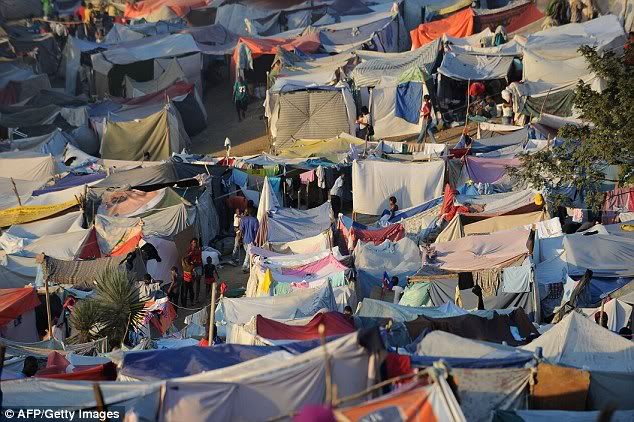
People walk through the former Petionville golf course which has been turned into a makeshift camp

HaitiEarthquake

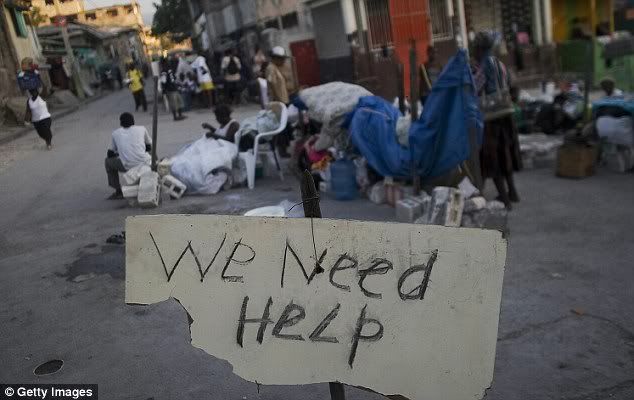
A sign written by displaced Haitians entreating for help is seen January 27, 2010 in Port-au-Prince
HaitiEarthquake

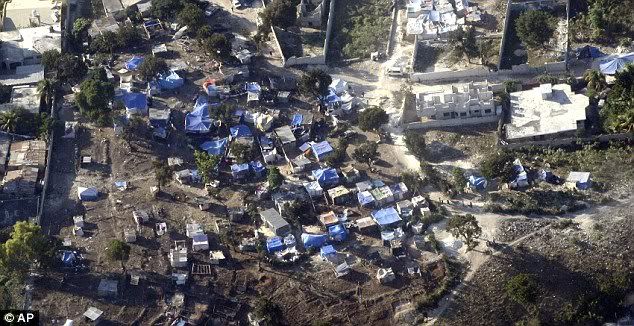
An aerial view shows one of the many tent cities seen in Port-au-Prince. Aid agencies have had great trouble reaching many of the homeless
HaitiEarthquake

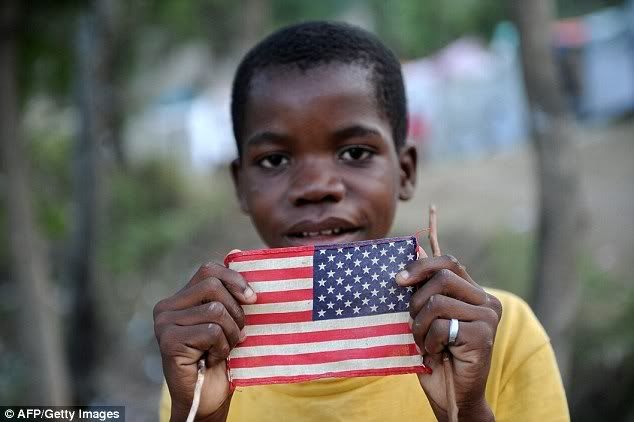
A holds up a US flag at the former Petionville golf course which has been turned into a makeshift camp in Port-au-Prince
HaitiEarthquake


HaitiEarthquake

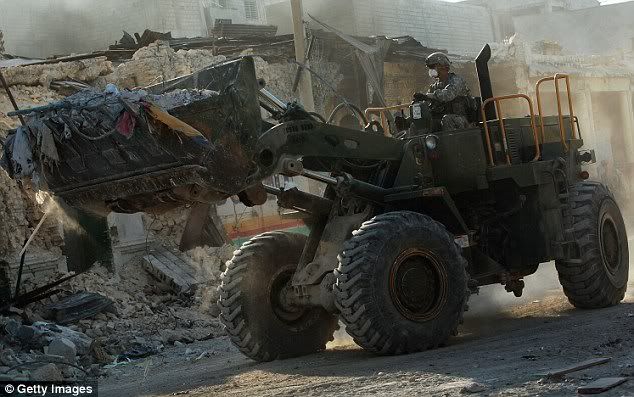
A U.S. Army soldier operated earth moving machinery as he helps clear central Port-au-Prince. According to reports approximately 250,000 structures have at least partially collapsed from the earthquake
HaitiEarthquake

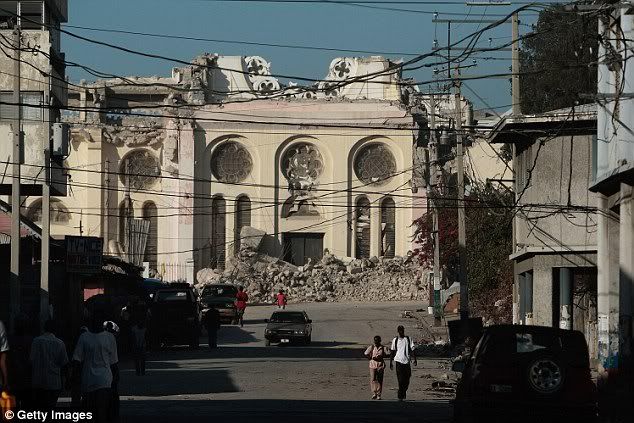
The earthquake-damaged remains of the National Cathedral are seen in central Port-au-Prince
HaitiEarthquake

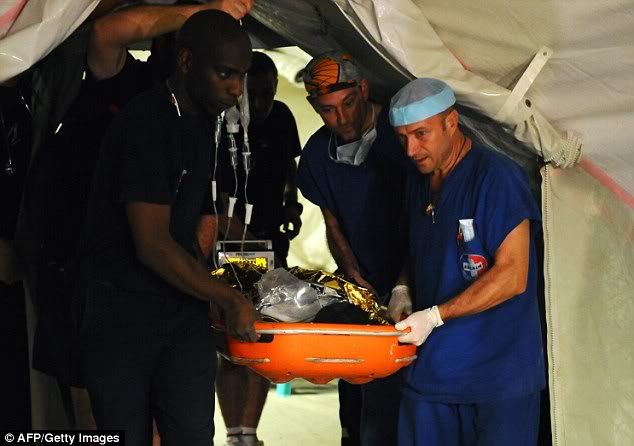
French medics carry a girl who was found alive in the rubble at the French hospital in Port-au-Prince
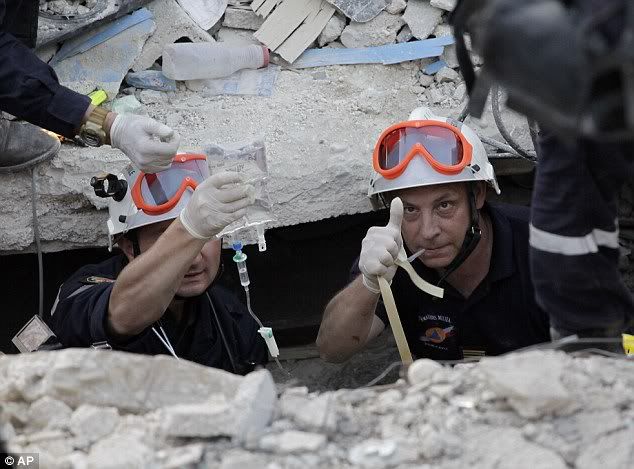
HaitiEarthquake
Saved: A French search and rescue team gestures after locating Darlene from the rubble. The official search for survivors was called off days ago
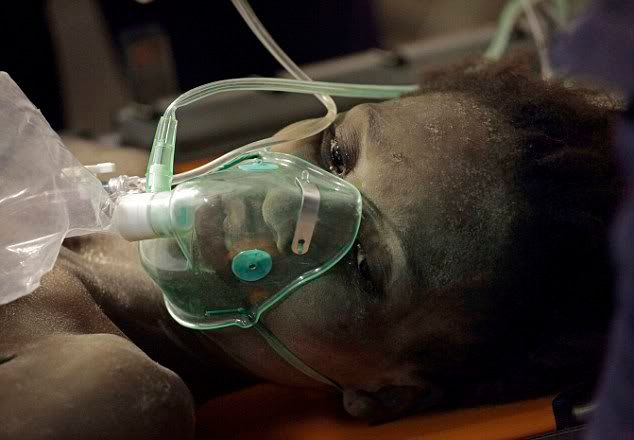

HaitiEarthquake

Survivor: Darlene Etienne, 17, was pulled alive from the rubble of a house in Port-au-Prince 15 days after the devastating earthquake
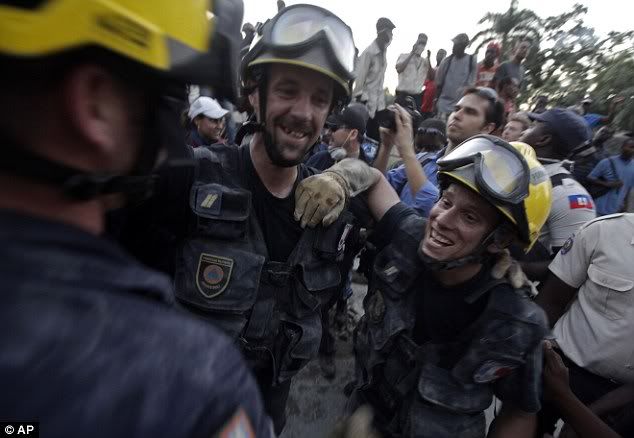
HaitiEarthquake
Exhausted but jubilant: Members of the French search and rescue team react after pulling Darlene from a building alive
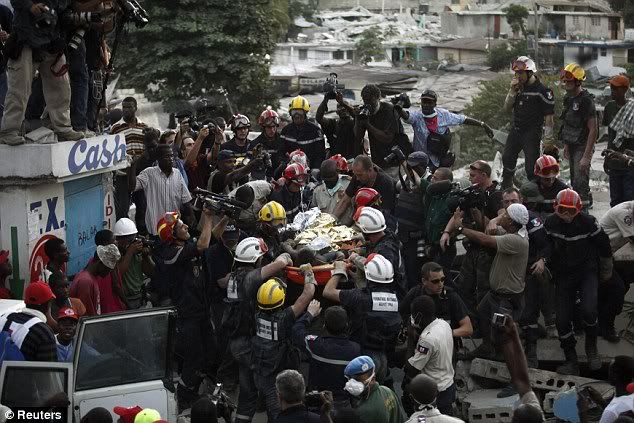

HaitiEarthquake

French Ambassador Didier le Bret praised the rescue team, which has kept looking for survivors for days after the Haitian government officially called off the search
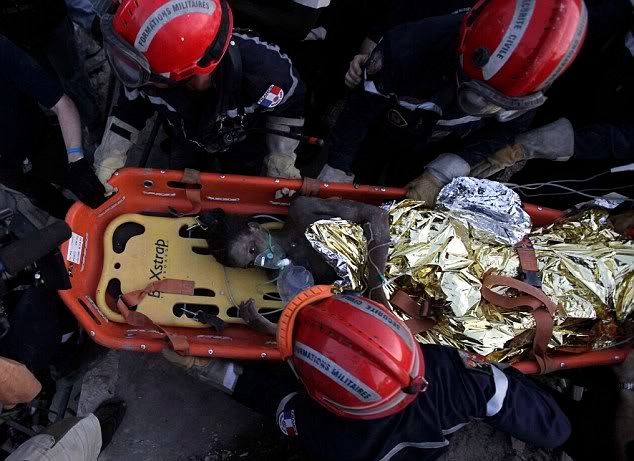
HaitiEarthquake
Safe at last: French Search and Rescue workers pull out Darlene Etienne from a building in Port-au-Prince

HaitiEarthquake

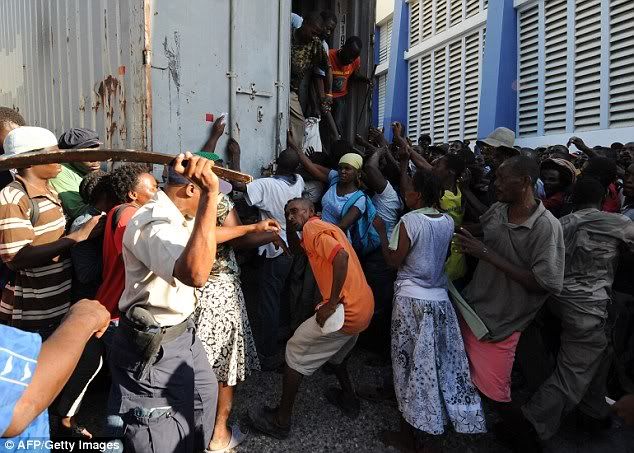
A policeman trys to control a crowd of Haitians at an aid distribution point in Port-au-Prince
HaitiEarthquake

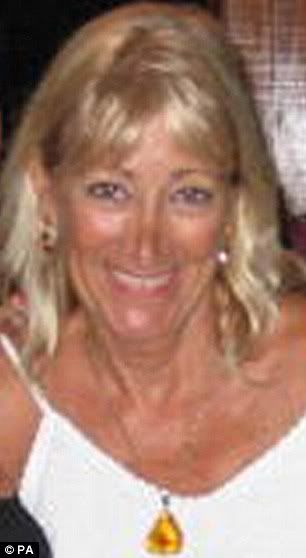
Dead: Ann Barnes, 59, was on the second floor of a building when the powerful earthquake struck


A teenage girl was pulled alive from the rubble in Port-au-Prince, 15 days after the Haitian earthquake.

Darlene Etienne, 17, was just moments from death when she was save by French rescue workers from of a home near the destroyed St. Gerard University.

The teenagers was rushed to a French military field hospital and then to the French military hospital ship Sirroco, suffering from severe dehydration and a broken left leg.
She's alive!' said paramedic Paul Francois-Valette, who accompanied her into the hospital.

Authorities say it is rare for anyone to survive more than 72 hours without water, little alone more than two weeks.

But Etienne may have had some access to water from a bathroom of the collapsed home, and rescuers said she mumbled something about having a little Coca-Cola with her in the rubble.

Her family said Etienne had just started studying when the disaster struck, trapping dozens of students and staff in the rubble of school buildings, hostels and nearby homes.

'We thought she was dead,' her cousin, Jocelyn A. St. Jules, said in a telephone call.

Then - half a month after the earthquake - neighbours on Wednesday heard a voice weakly calling from the rubble of a private home down the road from the collapsed university.

They called authorities, who brought in the French civil response team.
Rescuer Claude Fuilla then walked along the dangerously crumbled roof, heard her voice and saw a little bit of dust-covered black hair in the rubble. Clearing away some debris, he managed to reach the young woman and see she was alive - barely.

'She couldn't really talk to us or say how long she'd been there but I think she'd been there since the earthquake. I don't think she could have survived even a few more hours,' Fuilla said.

Digging out a hole big enough to give her oxygen and water, they found she had a very weak pulse.

Within 45 minutes they managed to remove her, covered in dust.

Fuilla said she was rescued from what appeared to be the porch area of the house, but a neighbour said he believed it was the shower room, where she might have had access to water.

'It's exceptional. She spoke to us in a very little voice, she was extremely weak,' Fuilla said.

'Before we stabilised her she was extremely dehydrated and weak she had a very low blood pressure.'

Another rescuer, French Lt. Col. Christophe Renou, said he had no idea how she had managed to cling to life for so long: 'Definitely she's been here for 15 days. She wasn't hurt but she was very, very weak.'

Renou said his team would probably return today with radar equipment to look for any other possible survivors.

French Ambassador Didier le Bret praised the persistence of the French rescue team, which has kept looking for survivors for days after the Haitian government officially called off the search.

'They are so stubborn because they should not have been working anymore because, officially, the rescue phase is over.

'But they felt that some lives still are to be saved, so we did not say that they should leave the country,' he said.

'To be honest we thought that the last miracle we had a couple of days ago ... would be the last miracle because the chances are so very, very slight.

'But it seems that beyond the miracle, there was another miracle.'

The last previous confirmed rescue of someone trapped by the initial quake occurred Saturday, 11 days later, when French rescuers extricated a man from the ruins of a hotel grocery store.
A man pulled from the rubble of a shop on Tuesday and treated by the U.S. military for severe dehydration and a broken leg said he had been trapped during an aftershock.

At least 135 people have been unearthed by rescue teams since the quake on January 12.

Yesterday the Foreign Office confirmed that a second Briton had been killed in the disaster.
Ann Barnes, 59, originally from Leigh-on-Sea, Essex, is believed to have been on the second floor of a building when the 7.0 magnitude tremor struck.

United Nations worker Frederick Wooldridge, 41, from Kent, was the first Briton to be confirmed dead after perishing with dozens of his colleagues.

Ms Barnes had no children and was not married but had a French partner on the island.

She was a personal assistant to the UN police commissioner and had worked for the UN for more than 20 years.

Her cousin, Christine Hart, 69, from Hornchurch, Essex, said she had refused to give up hope.

'The United Nations confirmed that the body is Ann, it is the news we feared most.'

She added: 'There is nothing I can say, her sister wants to be quiet about things too.'

Ms Barnes was thought to be in the second floor of the United Nations building when it collapsed.

Her partner Bruno has been clawing through the rubble with his bare hands since she vanished.

Mrs Hart added: 'He hasn't left the site. He went home to see what had happened to their house. The house was gone, but he got their dog.'Meanwhile, food from the world's aid agencies still isn't getting to enough hungry Haitians.

The newly homeless of the rubble-strewn Bizoton slum say they haven't gotten food, water or help with shelter in the two weeks since the earthquake.

'If it rains now, that's it,' Wilson St. Ellis, 50, a father of eight, said yesterday amid plastic sheets stretched here and there as flimsy shields against the elements.

Where donated rice, beans or ready-to-eat meals are being distributed, crowds quickly become unruly, with young men pushing ahead and grabbing food bags from women and the weak.

UN peacekeepers fire pepper spray and Haitian police swing sticks to restore control.

'These people are just hungry,' UN spokesman Vincenzo Pugliese said of the thousands thronging food distribution points, where he said UN peacekeepers were reinforcing security.

Food remains scarce for many of the neediest survivors despite the efforts of the United Nations, the U.S. military and dozens of international aid groups.
Relief experts say the scale of this disaster and Haiti's poor infrastructure are presenting unprecedented challenges, but Haitian leaders complain coordination has been poor.

'Many mistakes have to be rectified in order to bring help to the people who need it,' President Rene Preval complained to reporters.

In a bid to improve food distribution, representatives of the UN, the US, the Haitian government and private aid groups met on Wednesday.

Afterwards Donal Reilly of Catholic Relief Services said they decided to divide Port-au-Prince into zones, designating a major aid agency to be responsible for delivering UN food to each sector.

The UN World Food Program (WFP) says it has reached 450,000 people, but it urgently appealed to governments for more cash for Haiti supplies - £500 million to feed 2 million people through until December - more than quadruple the £100 million already pledged.

The food agency says rising tensions and security incidents - 'including people rushing distribution points for food' - have hampered deliveries.
But since the massive relief effort's first days, other problems have also delayed aid - blocked and congested roads, shortages of trucks, a crippled seaport and an overloaded Port-au-Prince airport.

'The unblocking of the logistical bottlenecks is an absolute priority,' the European Commission said, describing a seven-day backlog of 1,000 relief flights seeking permission to land at the single-runway airport.

The senior US officer in Haiti said Haitian families simply cannot rely on any particular location for rations.

Food is 'flooding' into the city, Lt. Gen. Ken Keen told reporters, 'but it's being delivered pretty much in terms of where we can get to and where we can distribute it,' not always in locations that are 'sustained every day.'

At some regular distribution points, such as near the Champs de Mars, the central plaza where thousands of homeless are living, daily food handouts have drawn crowds of frantic people. Desperation boiled over earlier this week and Uruguayan peacekeepers retreated as young men rushed forward to grab US-donated bags of beans and rice.

A pregnant woman collapsed and was trampled.

Elsewhere as well, the strong have preyed on the weak, prying donated food from their arms.

'These things should be done is a systematic way, not a random way,' said Dr. Eddy Delalue, who runs a Haitian relief group, Operation Hope.

'It's survival of the fittest: The strongest guy gets it.'

At one squatter settlement Julia Jean-Francois, 25, clutching a grocery bag filled with small packets of donated water, told of her encounter with food robbers.

'I lost all the rice, beans and oil that were distributed last week. A group of young men shoved me and grabbed the bags and ran away,' said Jean-Francois, whose mother was killed in the quake.

An hour later, she said, one of the men returned and offered to sell her the same food for the equivalent of £12.

She refused, relying instead on a communal kitchen she formed with homeless neighbours.
She said Haitian police patrolling nearby did nothing while people were robbed. 'We complained, and they got into their truck and left,' she said.

As she spoke, a gang of youths pushed into a queue of people waiting for water, shoving an elderly woman, who screamed and swung her bucket at their heads.

Port-au-Prince street vendors can be seen openly selling US-donated rice by the cupful from bags marked 'not for resale.'

Fears of official corruption surrounding the food aid also are surfacing.

Paul Coroleuski of the US-based Convoy of Hope, which has distributed aid in Haiti for three years, said he has more than 100 tons of food in a Port-au-Prince warehouse ready to hand out, but it has been delayed for days by Haitian officials who say they will take over distribution.

Private agencies like his worry that Haitian officials 'will do what they always have done, which is the government takes care of the government and the people are secondary,' he said.

Haitian officials denied the government plans to take over food distribution from private agencies.

Coroleuski's frustration and distrust of the government is echoed in Port-au-Prince's streets.

'If they turn it over to the Haitian government, they would take it all for themselves,' said Muller Bellegarde, 30, as he waited for food in the unrelenting tropical sun.

Haitians remember that when the government took charge of delivering international aid to the city of Gonaives after deadly hurricane floods in 2008, much of it ended up sold on the black market.


Today Top Recent Posts Here.


Blogger Widgets
Related Posts with Thumbnails

Entertainment News