


In its report, New York-based Human Rights Watch documents 234 cases which the group says represent serious abuse by US-trained marines and other security forces in several Mexican states.
Showing posts with label drug lords. Show all posts
Showing posts with label drug lords. Show all posts
Wednesday, November 9, 2011


Wednesday, June 22, 2011
La Familia leader captured without a shot fired - Mexican claims major drug 'hit'
La Familia leader, Jose de Jesus Mendez Vargas, has been arrested and Mexican authorities contend that the group's reign in the state of Michoacán has come to an end. Federal police escort one of nearly 50 suspects of two major drug cartels to a news
Tuesday, September 21, 2010
Mexico newspaper begs drug lords to spare reporters
A Mexican newspaper on the US border begged violent drug cartels for guidance on how to cover news in a way that would keep gangs from killing more journalists.
“You are the de facto authority in the city now,” El Diario newspaper said yesterday in an editorial, referring to cartels that have killed over 6,400 people in Ciudad Juarez since 2008.
“Explain what you want from us, what you want us to publish or stop publishing,” the paper said.
 Military and forensic experts inspect the body of a man in Ciudad Juarez who was handcuffed to a fence and shot several times by drug cartel hitmen outside a nightclub.
“You are the de facto authority in the city now,” El Diario newspaper said yesterday in an editorial, referring to cartels that have killed over 6,400 people in Ciudad Juarez since 2008.
“Explain what you want from us, what you want us to publish or stop publishing,” the paper said.
Monday, August 30, 2010
Mexico captures ‘La Barbie’ drug trafficker

Mexico captured major drug trafficker Edgar "La Barbie" Valdez on Monday in a second big coup for President Felipe Calderon in his battle against murderous trafficking cartels.
Federal police caught Valdez, a leader of the Beltran Leyva gang based in central Mexico, in a house in a residential area on the edge of the state of Morelos, near Mexico City, a police spokesman told Reuters. He said Valdez put up little resistance.
The attorney general's office also confirmed the US-born smuggler — nicknamed "La Barbie" for his fair complexion and blue eyes —- was caught alive.
Thursday, May 27, 2010
Colombian beauty queen accused of getting models to smuggle cocaine is arrested in Argentinian youth hostel

Valencia is escorted by police after being arrested at a youth hostel in Buenos Aires

Valencia's mother, Janeth, speaks to the press after her daughter was arrested in Buenos Aires


Sanclemente is accused of leading a drug-trafficking gang that persuaded young women to smuggle cocaine to Mexico
A Colombian model accused of leading a drug-trafficking gang that persuaded pretty young women to smuggle cocaine to Mexico was arrested yesterday after evading Argentine police for five months.
Angie Sanclemente Valencia had been hiding out in Buenos Aires since December, when airport police caught a 21-year-old Argentine woman with 121lbs of cocaine in her baggage boarding a flight to Cancun.
Thursday, February 4, 2010
Hunt for the melon felons: Police launch search for two women after worst drug smuggling attempt EVER
As sophisticated drug smuggling attempts go, it was a bit fruity.
Police are on the hunt for two women who tried to smuggle drugs into a prison using a hollowed-out melon.
Eagle-eyed officers realised something was amiss when they noticed the top of the cantaloupe appeared to have been cut out.They removed the top - and found tobacco and a bag full of Oxycodone pills, a powerful painkiller, stuffed inside.
The cantaloupe was left at a drop-off point at the Chelan County Regional Justice Centre in Washington.
Jail administrator Phil Stanley said there was a noticeable cut around the top of the fruit.
Officials were alerted to the smuggling attempt after a surveillance camera showed two women dropping of a shopping bag, containing the melon, at the prison.
The women left the bag at a drop-off point where local grocery stores donated surplus food.
Mr Stanley said it wasn't the first time people had attempted to use food to smuggle contraband into the prison, which houses about 300 inmates and is a tobacco-free institution.
Wenatchee Police Department investigators are now searching for the women involved.

Prison officials noticed a visible cut around the top of the melon before discovering the contraband inside
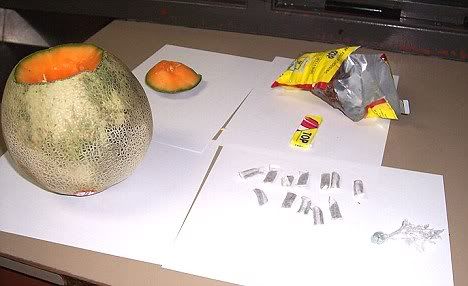
Bad fruit: A hollowed out cantaloupe containing painkillers and tobacco was intercepted at a Washington jail
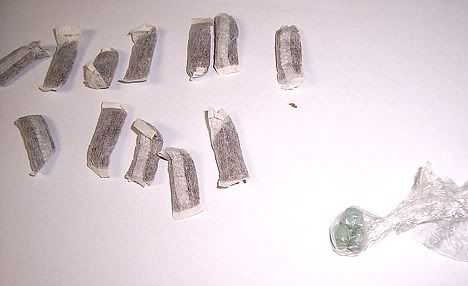
The melon contained tobacco, rolling papers and a bag of Oxycodone pills
Police are on the hunt for two women who tried to smuggle drugs into a prison using a hollowed-out melon.
Eagle-eyed officers realised something was amiss when they noticed the top of the cantaloupe appeared to have been cut out.They removed the top - and found tobacco and a bag full of Oxycodone pills, a powerful painkiller, stuffed inside.
The cantaloupe was left at a drop-off point at the Chelan County Regional Justice Centre in Washington.
Jail administrator Phil Stanley said there was a noticeable cut around the top of the fruit.
Officials were alerted to the smuggling attempt after a surveillance camera showed two women dropping of a shopping bag, containing the melon, at the prison.
The women left the bag at a drop-off point where local grocery stores donated surplus food.
Mr Stanley said it wasn't the first time people had attempted to use food to smuggle contraband into the prison, which houses about 300 inmates and is a tobacco-free institution.
Wenatchee Police Department investigators are now searching for the women involved.

Prison officials noticed a visible cut around the top of the melon before discovering the contraband inside

Bad fruit: A hollowed out cantaloupe containing painkillers and tobacco was intercepted at a Washington jail

The melon contained tobacco, rolling papers and a bag of Oxycodone pills
Tuesday, February 2, 2010
Walls stained with blood: Inside the Mexican house where druglords killed 14 teens at a high school birthday party
A gang of suspected drug hitmen burst into a high school birthday party, opening fire and killing 14 teenagers in Ciudad Juarez in the early hours of yesterday morning.
Gunmen jumped out of several 4x4s and stormed the house where students were celebrating the birthday of a classmate.
They opened fire on the party in the city across the border from El Paso, Texas, in what is believed to be a mistaken drugs hit.
Bodies lay on the street outside and pools of blood collected by nearby parked cars.
Inside the house, the walls were stained with blood and marked with bullet holes.
'The men drove up in SUVs, they were well-armed. They went into the house and shot at everyone, you could hear the gunfire all around,' a neighbour at the scene said.
Patricia Gonzalez, attorney general for Chihuahua state that includes Ciudad Juarez, said the shooting was possibly linked to drug cartels.
'We have two lines of investigation and one of them is linked to drug trafficking,' she told a news conference.
'We know from witnesses that the men arrived looking for someone.' She declined to give more details.
Over the past two years, hitmen have attacked parties in Chihuahua state, searching for rivals, and police have reported that some teenagers in Ciudad Juarez have been involved in kidnapping others.
Ms Gonzalez said the dead included three adults and 11 minors. Fourteen others were wounded, two critically.
All the victims were between 15 and 20 years old, the army said.
She denied earlier reports that the teenagers were celebrating a local sports championship victory.
'They were about 15 men, they closed off the surrounding streets and began shooting at the house as they moved inside,' said army spokesman Enrique Torres.
Ciudad Juarez is the bloodiest front in Mexico's three-year drug war as rival cartels fight over markets and control of smuggling routes into the U.S.
Violence is escalating even as federal police and soldiers patrol the streets. Some 2,650 people were killed in drug violence in Ciudad Juarez last year and cartel murders have jumped since the start of 2010.
In some of the worst attacks, gunmen have stormed at least seven drug rehabilitation clinics in the manufacturing city over the past two years, targeting rival dealers.
Two strikes in September killed 28 people.
Mexico is the key transit route for U.S.-bound cocaine from South America and a top producer of marijuana and heroin.
A military crackdown on rival cartels in Mexico has fueled a surge in drug violence that has killed more than 17,000 people since President Felipe Calderon took office in 2006, worrying Washington and investors and scaring off tourists from some cities.

Patricia Gonzalez, attorney general for Chihuahua state that includes Ciudad Juarez, said the shooting was possibly linked to drug cartels

The bloody imprint of a foot is seen on the blood-stained floor of a house in Ciudad Juarez across the border from El Paso, Texas

Soldiers stand inside a blood-stained room in Ciudad Juarez after a group of suspected drug hitmen burst into a birthday party, killing 14 teenagers

Crime scene: Bodies lay on the street outside and pools of blood collected by nearby parked cars

A surgical glove lies on a puddle of bloodied water outside a home where unknown gunmen stormed a gathering of students

Gunmen jumped out of several 4x4s and stormed the house where students were celebrating the birthday of a classmate.
They opened fire on the party in the city across the border from El Paso, Texas, in what is believed to be a mistaken drugs hit.
Bodies lay on the street outside and pools of blood collected by nearby parked cars.
Inside the house, the walls were stained with blood and marked with bullet holes.
'The men drove up in SUVs, they were well-armed. They went into the house and shot at everyone, you could hear the gunfire all around,' a neighbour at the scene said.
Patricia Gonzalez, attorney general for Chihuahua state that includes Ciudad Juarez, said the shooting was possibly linked to drug cartels.
'We have two lines of investigation and one of them is linked to drug trafficking,' she told a news conference.
'We know from witnesses that the men arrived looking for someone.' She declined to give more details.
Over the past two years, hitmen have attacked parties in Chihuahua state, searching for rivals, and police have reported that some teenagers in Ciudad Juarez have been involved in kidnapping others.
Ms Gonzalez said the dead included three adults and 11 minors. Fourteen others were wounded, two critically.
All the victims were between 15 and 20 years old, the army said.
She denied earlier reports that the teenagers were celebrating a local sports championship victory.
'They were about 15 men, they closed off the surrounding streets and began shooting at the house as they moved inside,' said army spokesman Enrique Torres.
Ciudad Juarez is the bloodiest front in Mexico's three-year drug war as rival cartels fight over markets and control of smuggling routes into the U.S.
Violence is escalating even as federal police and soldiers patrol the streets. Some 2,650 people were killed in drug violence in Ciudad Juarez last year and cartel murders have jumped since the start of 2010.
In some of the worst attacks, gunmen have stormed at least seven drug rehabilitation clinics in the manufacturing city over the past two years, targeting rival dealers.
Two strikes in September killed 28 people.
Mexico is the key transit route for U.S.-bound cocaine from South America and a top producer of marijuana and heroin.
A military crackdown on rival cartels in Mexico has fueled a surge in drug violence that has killed more than 17,000 people since President Felipe Calderon took office in 2006, worrying Washington and investors and scaring off tourists from some cities.
Patricia Gonzalez, attorney general for Chihuahua state that includes Ciudad Juarez, said the shooting was possibly linked to drug cartels
The bloody imprint of a foot is seen on the blood-stained floor of a house in Ciudad Juarez across the border from El Paso, Texas
Soldiers stand inside a blood-stained room in Ciudad Juarez after a group of suspected drug hitmen burst into a birthday party, killing 14 teenagers
Crime scene: Bodies lay on the street outside and pools of blood collected by nearby parked cars

A surgical glove lies on a puddle of bloodied water outside a home where unknown gunmen stormed a gathering of students
Tuesday, December 29, 2009
Brittany Murphy’s autopsy report leaked and graveyard Forest Lawn cemetery exposed.
As reported in the LA Now, the L.A. County coroner's office is under scrutiny following the release of confidential information about the autopsy of Brittany Murphy. The leak was made to, and published by TMZ and included “details about prescription drugs that the coroner's office found in her home.
The Los Angeles County Department of Coroner official released the following statement regarding the leaks. "The inquiry into the death is ongoing, and it is the policy and practice of the Department of Coroner to only release detailed information in cases where the final cause of death has been determined and the case investigation has been completed and closed by the deputy medical examiner."
Assistant Coroner Ed Winter said initial autopsy reports showed the cause of death may have resulted from “heart-related causes”. The autopsy - completed on 22 December - included toxicology tests that will not be available until sometime within the first 2 weeks in February 2010.
Since the death of Brittany Murphy there are over 4 million internet references to the autopsy and over 35,000 sites referencing the autopsy photos – and increasing in numbers. There is no indication that the confidential autopsy information leaked included any photos, yet the curious continue to search. The lack of photos and increased searching by web users has resulted in numerous “scam” sites, some that launch computer viruses on the unexpected.
However, funeral photos labeled as those of Brittany Murphy, by PacificCoastNews.com., were posted today on zimbo.com. Additional photos were also posted on view.picapp.com.
Brittany Murphy's husband and mother made a frantic attempt to revive her before paramedics arrived ... this according to notes written by an investigator from the L.A. County Coroner's office. And, there were a shocking number of strong prescription meds on Brittany's nightstand.
TMZ has reviewed the documents, written by Investigator Blacklock. According to his notes, Brittany Murphy "had been complaining of shortness of breath and severe abdominal pain" for 7 to 10 days prior to her death. According to the notes, Murphy went into the bathroom at around 7:30 AM Sunday and shut the door.
A half hour later Brittany's mother, Sharon Murphy, went to check on her daughter, opened the bathroom door and "discovered the decedent lying on the floor unresponsive." According to the notes, Sharon yelled for help. Brittany's husband, Simon Monjack, who was in bed, heard the screams and ran to the bathroom.
According to the notes, Sharon called 911 and Simon "attempted to revive the decedent by placing her in the shower and running the water."
The notes continue -- "The decedent remained unresponsive and purged her stomach contents prior to the arrival of the paramedics."
When the paramedics arrived, Brittany was "without signs of life."
Paramedics moved Brittany from the bathroom to the master bedroom, where they found a slew of prescription drugs -- "A check of the nightstands revealed large amounts of prescription medication in the decedent's name. Also noted were numerous empty prescription medication bottles in the decedent's husband's name, the decedent's mother's name and unidentified third party names."
According to the notes, the medications included Topamax (anti-seizure meds also to prevent migraines), Methylprednisolone (anti-inflammatory), Fluoxetine (depression med), Klonopin (anxiety med), Carbamazepine (treats Diabetic symptoms and is also a bipolar med), Ativan (anxiety med), Vicoprofen (pain reliever), Propranolol (hypertension, used to prevent heart attacks), Biaxin (antibiotic), Hydrocodone (pain med) and miscellaneous vitamins.
The notes say, "No alcohol containers, paraphernalia or illegal drugs were discovered."
According to the notes, "The night prior to her death, the decedent had consumed some noodles, leftover Thai food, Gatorade, water and tea with lemon."
The notes also say Brittany had a history of hypoglycemia and was hospitalized in April 2009 for low blood sugar while on location in Oregon."
Monjack told the investigator during the 7 to 10 days prior to her death, Brittany complained of shortness of breath and severe abdominal pains but he was not overly alarmed because "she often suffered from severe menstrual pains."
Summary of Autopsy
The autopsy report for Brittany Murphy indicated “there was ‘no evidence of trauma’ and Murphy’s body appeared to be of ‘normal’ weight and not overly thin”. Reports also place her weight at 115 pounds and height at 65 inches.
BMI is a good indicator of a healthy weight and a person with a height of 65 inches at 115 pounds would indicate a healthy weight range. However there is debate using BMI over Ideal Body Weight. According to healthdiscovery.net the ideal body weight range for a female at 65 inches would be 117-130 pounds for a thin frame, 127-141 pounds for a medium frame and 137-155 pounds for a large frame. Ideal body weight has also been described as - average weight that other people of the same gender, age, height and weight would describe as their ideal weight. In her last interview 2½ weeks before her death and posted on the Fox News Network; Brittany Murphy described her weight as “a bit thinner now than what I would like to be."
As previously reported, Brittany dismissed rumors of an eating disorder.

Photo: Brittany Murphy at Fashion Week, Feb. 5, 2008, in New York.

The church of the hills, located in Forest Lawn cemetery, where Brittany Murphy's funeral service is set to take place. Brittany, 32, was reportedly found collapsed in the bathroom of her Hollywood home by her mother, Sharon, at around 8am on Sunday December 20 2009. She was then transported to Cedars-Sinai Medical Center where she was declared dead around 10 am.
The church of the hills, located in Forest Lawn cemetery, where Brittany Murphy's funeral service is set to take place. Brittany, 32, was reportedly found collapsed in the bathroom of her Hollywood home by her mother, Sharon, at around 8am on Sunday December 20 2009. She was then transported to Cedars-Sinai Medical Center where she was declared dead around 10 am.


Brittany Murphy's unmarked grave located in Forest Lawn Memorial Park in the Hollywood Hills. The memorial service for the young actress was held yesterday and attended by only a few close friends and family members. Murphy's family announced that a bigger memorial is going to be schedule for next year. The official cause of Murphy's death has been identified as cardiac arrest.


RELATED POSTS:-
- Friends, colleagues gather at church for Kennedy's funeral
- Boston prepares for days of mourning for Kennedy
- Tribute to Kennedy , The Kennedy Camelots
- The last of the Kennedy - Ted Kennedy dies at 77 uear old.
- Lion of Senate - Ted Kennedy dies at 77 years old - Brain cancer
- Gordon Brown leads furious outcry as China executes British drugs mule by lethal injection
- Raid targets Mexican cartel; 303 arrested,Largest US sting on drug cartel
- Jackson to be interred Aug. 29 at Forest Lawn in Glendale
- Ex President of Cyrus vandalised and body stolen on eve of anniversary of his death.Police is baffled.
- Authorities Raid Office of Jackson's Doctor , Dr Conray Murray
- Brittany Murphy’s autopsy report leaked and graveyard Forest Lawn cemetery exposed.
- Coroner says 6 women whose bodies were found at home died violently
- Why Are Michael Jackson Autopsy Results Taking So Long?
- Celebrity Brittany Murphy dies at age 32 , acted in 8 Mile,Just Married,Sin City,Clueless and others.Dies of Heart Attack.
- Female Force to be reckoned with: Princess Diana is immortalised in a 'glowing' comic book
- Michael Jackson's 'This Is It' is yet to prove a blockbuster-Celebrity scandal death drugs overdose
- Micheal Jackson last concert This is it Premier.Scandal celebrity deaths.
- Jackson tomb remains a mystery at LA-area cemetery
- Andhra Pradesh Chief Minister Reddy died in tragic helicopter crash while touring poor villages. Sudden surge in suicides cases.
- Michael Jackson's Final Resting Place Among Greats- Quiet and Peaceful Forest Lawn
Gordon Brown leads furious outcry as China executes British drugs mule by lethal injection


Executed: Akmal Shaikh was put to death this morning after being convicted of heroin smuggling
(left).Soohail Shaikh, left, and Nasir Shaikh, cousins of Akmal Shaikh, pictured together this morning in a street in Urumqi where the Briton was held

Supporters of British national Akmal Shaikh hold a vigil at the Chinese Embassy in London

Anger: Gordon Brown attacked Mr Shaikh's execution in the 'strongest' terms

Death prison: Shaikh was held and executed at Xishan detention centre in western China's Urumqi province

Father-of-three Mr Shaikh was arrested in Urumqi in September 2007 and charged with smuggling almost 9lbs of heroin
Gordon Brown today led condemnation of China for executing a mentally ill British man who had been convicted of drug smuggling.
Akmal Shaikh, 53, was put to death by lethal injection just after 4am at Xishan detention centre in the western Urumqi province.
The father-of-five was buried immediately. He was the first European citizen to be put to death in China for 50 years.
In a statement shortly after Mr Shaikh's death, the prime minister said he condemned the exeuction 'in the strongest terms'.
He said he was 'appalled and disappointed' that persistent requests for clemency have not been granted.
'I am particularly concerned that no mental health assessment was undertaken,' he said.
'At this time our thoughts are with Mr Shaikh's family and friends and I send them our sincere condolences.'
David Cameron has also attacked the execution, saying he found the decision deplorable.
The British government has made 27 representations to the Chinese authorities about Mr Shaikh's case in the past two years.
A last ditch appeal from Foreign Office minister Ivan Lewis also fell on deaf ears.
Beijing, however, remained defiant.
Spokesman for the Chinese foreign ministry Jiang Yu said Britain's robust response risked souring diplomatic relations.
'No one has the right to to comment on China's judicial sovereignty,' she said.
'It is the common wish of people around the world to strike against the crime of drug trafficking.
'We express our strong dissatisfaction and opposition to the British Government's unreasonable criticism of the case.
'We urge the British to correct their mistake in order to avoid harming China-UK relations.'
The Chinese embassy in London said Mr Shaikh had 'no previous medical record' of mental illness and that his rights and interests had been properly respected.
In a statement, officials said the Briton had been convicted of 'serious' drug trafficking, adding: 'The amount of heroin he brought into China was 4,030g, enough to cause 26,800 deaths, threatening numerous families.'
Mr Shaikh, from Kentish Town, North London, was arrested in September 2007 and convicted of trying to smuggle 9lb of heroin, worth £250,000, into the remote western Chinese city of Urumqi, 2,000 miles from Beijing.
He insisted he was tricked into carrying the drug but was convicted in 2008 after a half-hour trial.
Despite being sentenced to death, Mr Shaikh was not told about his impending execution by the Chinese authorities.
Instead, his cousins Suhail and Nasir Shaikh had to break the news yesterday when they visited him in prison.
In a statement after Mr Shaikh's execution, they said: 'We are deeply saddened, stunned and disappointed at the news of the execution of our beloved cousin, Akmal,' they said.
'This was carried out this morning despite repeated requests for clemency and a proper appraisal of Akmal's mental state.
'We are astonished at suggestions that Akmal himself should have provided evidence of his own fragile state of mind.
'We find it ludicrous that any mentally ill person should be expected to provide this, especially when this was apparently bipolar disorder, in which we understand the sufferer has a distorted view of the world, including his own condition.
'That this was regarded as sufficient grounds for refusal by the judicial authorities to order any mental health assessment is shocking to us.
'Despite our own and other pleas, the Chinese authorities have maintained their refusal to investigate Akmal's mental health.
'We are comforted that the authorities have confirmed that Akmal has been buried in accordance with his own and his family's wishes.'
His daughter Leilla Horsnell added: 'I am shocked and disappointed that the execution went ahead with no regards to my dad's mental health problems, and I struggle to understand how this is justice.'
The Chinese have also ignored repeated pleas from British-based prison charity Reprieve, who had worked on behalf of Mr Shaikh.
Speaking after his execution, the organisation's director Clive Stafford Smith said: 'Sad to say, I have watched six people die in execution chambers, and it is as ghastly as it is pointless.
Read more: http://www.dailymail.co.uk/news/worldnews/article-1238454/A'Is the world somehow a better place today because China refused to show compassion for an obviously ill man?
'Of course not. China's refusal to even allow a proper medical evaluation is simply disgusting.'
Reprieve's legal director Sally Rowen had described Mr Shaikh as a 'gentle man who suffering from a tormenting illness.
'He fell through the cracks... as many people with mental illness do,' she added.
Mr Shaikh's case attracted support from mental health campaigners as well as those opposed to the death penalty.
'At this time our thoughts are with Mr Shaikh's family and friends and I send them our sincere condolences.'
Robert Westhead, spokesman for MDF, the Bipolar Organisation, described the execution as 'medieval rough justice' and an 'absolute tragedy'.
'How a society treats people affected by mental illness is always a good indicator of how civilised it is.
'The way the Chinese authorities have stubbornly failed to take account of this poor man's severe mental illness shows that China is still stuck in the dark ages.
'This execution is medieval rough justice gone badly wrong.'
Mr Shaikh's cousins visited him in jail for the last time yesterday.
Speaking exclusively to the Mail, Suhail said: ‘Akmal had lost some weight but he was in high spirits when we first met him because he still believed he could appeal one more time and have his sentence overturned and be saved.
‘He did not know a date had been set for his execution, and he said he was still waiting for an imminent change of heart from the Chinese who would overturn his death sentence and pardon him.’
'We had to break the news to him and tell him that he was to be executed within 24 hours.
‘He did not seem to believe us but we told him the final decision had been passed, and that we had done all we could as a tight-knit, heartbroken family to save him.
‘It was apparent to us that he was suffering from a mental illness. The things he was saying were not the things you’d expect a normal person facing the death sentence to say.
'He was a little tearful at the end. He said he appreciated us being there. We had to be strong for him. We said we had not given up hope.’
The brothers looked solemn as they emerged from the prison hospital into falling snow. They were carrying Mr Shaikh's personal effects in a plastic bag.
As night fell in London, supporters held a candlelit vigil outside the Chinese embassy.
Tom Scott, a freelance theatre director from Catford, said he had become aware of the case through a Facebook group called Stop the Execution of Akmal Shaikh.
He said: 'I am appalled by this case. I am against the death penalty any way in all circumstances but I think this is a particularly bad case - where a man who from all reports, clearly is mentally ill and suffers from delusions was duped by a drugs gang into taking a case which contained heroin into China.
Maya Farr, an 18-year-old customer services representative was also present at the vigil. She said 1,600 people had signalled their support for the Facebook campaign.
'I am personally against the death penalty, but there are so many aspects to this case which we are really opposed to. His mental history has not been assessed.'
Reprieve said new witnesses had emerged following publicity about the case who backed up the defence claim about his mental illness.
Mr Shaikh was obsessed with recording a song that would usher in world peace, the organisation said.
Two British men, Paul Newberry and Gareth Saunders, both quoted by the organisation, said they had helped Mr Shaikh record a song in Poland and that it was clear that he was mentally ill.
Mr Newberry, a British national who lives in Poland, told Reprieve that Mr Shaikh was a 'very, very ill' person.
He said in a statement issued by the organisation: 'I was probably one of the last people who saw Akmal before he left Poland in August 2007.
'I met Akmal in spring 2007 when he started hanging around the tent city that protesting nurses had set up outside the Polish prime minister's offices in Warsaw. The protest attracted a range of 'colourful' characters and he was one of them.
'As I was British and was with a British friend, Akmal latched on to us. Immediately it was clear that he was mentally ill, although he was a very likeable person, friendly and very open.
'However, he was clearly suffering from delusions and it seemed to me he was a particularly severe case of manic depressive.
'I told him a number of times that he should see a doctor, that he was ill, but he just laughed.
'Any person would have been offended had he been a normal person not in the middle of a psychosis.'
He said Mr Shaikh had shown them lyrics to the song 'Run Little Rabbit' written on a paper napkin and tried to convince them it would be a hit.
He said: 'For a few weeks he pestered us until finally we agreed to record it with him.
'I have no idea who paid for the recording studio but I think he used his charm and persistence to persuade the owner to let him record the song.
'I can't imagine anyone singing worse than he did on that recording and we told him so, but he was on such a high, convinced that he would have a huge hit.
'We told him that he was crazy, that it was the worst thing we had ever heard, but he just laughed in our face and repeated that it would be huge.'
CHINA'S DEADLY RECORD
China accounts for nearly three quarters of the world's executions every year, according to human rights campaigners.
Figures from Amnesty International show a minimum of 7,000 death sentences were handed down in China in 2008, with 1,700 executions taking place.
Amnesty International said the Chinese authorities refused to make public national statistics on death sentences and executions and the real figure was 'undoubtedly higher'.
Steve Ballinger, a spokesman for Amnesty International, said: 'China accounts for 72% of the world's executions and China executes far more than any other country by an awfully long way.'
Under Chinese criminal law, a mental patient who commits a crime, and has not completely lost the ability to recognise or control his own conduct at the time, still has criminal responsibility but may be given a lighter punishment.
Mr Ballinger said Amnesty, which campaigns against the use of the death penalty, was concerned that trials in China fall below international fair trial standards.
He said Akmal Shaikh was 'very unlikely' to have received a fair trial.
Other areas of concern to Amnesty in China include restrictions on freedom of expression, and the frequent use of torture in custody - although he said there was no evidence that Shaikh had suffered this.
Although there was still a 'long way to go', he said there had been some gradual improvement, with China earlier this year stating that the Supreme People's Court had to review all death penalty cases.
According to Amnesty International, the Chinese authorities stated their intention in 2008 to increase the use of lethal injection as a 'more humane' method of execution than firing squad.
The organisation said China voted in December 2008 against a UN General Assembly resolution calling for a worldwide moratorium on executions.
------
-------
----------
RELATED POSTS:-
- Meet the king of the Tweeters: Unknown tops power list for Twitter .
- Firefighters cut free seriously injured passengers free from overturned double-decker bus as lorry driver is arrested
- Prince William to help Queen daily works as Queen is 83 years old.Sign William will succeed father to be King.
- Hillary Clinton getting touchy with new young British Foreign Secterary David Miliband.Almost like flirtation.
- Scandal brewing as Lord Mandelson , Cherie and host billionaire financier Lord Rothschild invite Qaddafi son to shot out at mansion. Released Lockierb
- Did Young Jesus visited England for educations?
- Kicked out aged four for ‘belting’ teachers,beat other kids,sent hour 4 times in 2 months
- Gordon Brown leads furious outcry as China executes British drugs mule by lethal injection
- Analysis: Liu Xiaobo case reveals a more assertive China-Leading China dissident to be tried Wednesday: family
- China city to open gay bar to promote safe sex promote condoms.
- China says 42 dead, 66 trapped in mine explosion
- Obama brings broad agenda to meeting with China's Hu-US owns $1 trillion in debts to China.Obama in a barrel.
- China, NKorea reaffirm relations-Premier Wen visit to NKorea fruitful-NKorea will to continue nuclear talks.-USA target banks using illicit NKorea $$
- Obama, China vow urgent action on climate change,Clinton Climate conference New York.LEader gather to talk about reduce world pollution
- President Obama increase tire tariff from China.- May cause Trade war from China.
- 5 Killed In China Protests Over Syringe Attacks
- Syringe attacks spark new protest in XinJiang Chinese city
- Taiwan Says 500 Feared Dead in Typhoon Mudslides ,Taiwan military rescues some 300 typhoon victims
- Taiwan Mudslide May Have Buried 600 Villagers-Up to 400 people missing in Taiwan as Typhoon Morakot hits Asia
- Solo sailing girl, 14, arrives back in the Netherlands... to face a police interrogatio
Friday, October 23, 2009
Raid targets Mexican cartel; 303 arrested,Largest US sting on drug cartel

Federal police present alleged members of the Mexican drug cartel "La Familia Michoacana," detained in a recent police operation, as they are presented to the press in Mexico City, Thursday, Oct. 22, 2009. Suspects from from left to right are Rogelio Rivera, Orlando Tafoya, Juan Estrada Rodriguez, Jose Roberto de la Sancha, Juan Gabriel Cortez and Julio Enrique Aguilar.


Attorney General Eric Holder, second from left, speaks during a news conference at the Justice Department in Washington, Thursday, Oct. 22, 2009, to announce the largest single strike at a Mexican drug cartel operating in the U.S. _ the arrest of more than 300 people in a series of drug raids across the country. From left are, FBI Director Robert Mueller, Holder, Acting Drug Enforcement Administrator (DEA) Michele Leonhart and Acting Bureau of Alcohol, Tobacco and Firearms (ATF) Director Kenneth Melson.

Map shows U.S. cities in which a series of drug raids resulted in the arrests of more than 300 people


Federal police escort handcuffed suspect Jose Roberto de la Sancha as he his presented to the press in Mexico City, Thursday, Oct. 22, 2009. De la Sancha, detained along with five others in a recent police operation, is an alleged member of the Mexican drug cartel "La Familia Michoacana," according to police.

Federal police stand by handcuffed suspects Jose Roberto de la Sancha, right, and Juan Estrada Rodriguez as they are presented to the press in Mexico City, Thursday, Oct. 22, 2009. De la Sancha and Rodriguez, detained along with four others in a recent police operation, are alleged members of the Mexican drug cartel "La Familia Michoacana," according to police.
U.S. authorities arrested 303 people Wednesday and Thursday in a nationwide sweep targeting the distribution network of La Familia, a fast-rising Mexican drug cartel known for its violence, messianic culture and control over the methamphetamine trade, Attorney General Eric H. Holder Jr. announced Thursday.
More than 3,000 federal, state and local agents participated in the U.S. law enforcement operation, the largest mounted against a Mexican cartel, Holder said.
The raids "dealt a significant blow to La Familia's supply chain," Holder said, netting cash, drugs, weapons and vehicles in 19 states. But U.S. officials did not say whether any cartel leaders were caught. "With the increases in cooperation between U.S. and Mexican authorities in recent years, we are taking the fight to our adversaries," Holder said.
Arrests took place in 38 cities, from Boston to Seattle, with 77 made in Dallas. The effort involved the Drug Enforcement Administration; the FBI; the Bureau of Alcohol, Tobacco, Firearms and Explosives; and U.S. Immigration and Customs Enforcement. Charges include drug and gun trafficking and money laundering.
Analysts said the operation appeared designed to allay skepticism among Mexico's political leaders about the U.S. government's commitment to Mexico's crackdown on cartels. The drug-related violence has taken about 15,000 lives since President Felipe Calderón entered office in 2006. Mexican authorities have arrested 80,000 drug suspects, and Washington has responded with $1.4 billion in aid under the Merida initiative, but some in Mexico have grown frustrated with the U.S. market's continuing demand for illegal drugs.
"Many Mexican leaders have viewed the Merida initiative as too little and too late," said George W. Grayson, a Mexico specialist at the College of William and Mary who has written about La Familia, "and so Washington is trying to make clear that we are good faith, genuine partners in the war against drugs."
La Familia, the newest of Mexico's five major cartels, has become entrenched in many U.S. cities after flourishing in Mexico through entrepreneurial zeal, brutality and promises to spin drug profits into "divine justice," or social benefits for its impoverished home state.
La Familia opposes the sale of methamphetamine to Mexicans, for example, but is responsible for the "vast majority" of the lucrative drug entering the United States from Mexico, said Michele M. Leonhart, acting DEA administrator.
The cartel, based in the southwestern Mexico state of Michoacan, has also benefited from a splintering of older cartels, and its effort to gain social legitimacy is combined with a savage program to kill, coerce and corrupt security and government personnel, Mexican analysts said.
In Washington, Holder said that U.S. authorities have targeted La Familia for 44 months. Under the effort, called Project Coronado, the federal government has arrested 1,186 people and seized $32.8 million, 2,710 pounds of methamphetamine, 1,999 kilograms of cocaine, 29 pounds of heroin, 16,390 pounds of marijuana, 389 weapons and 269 vehicles.
U.S. authorities indicted, but did not arrest, La Familia's operational chief, Servando Gomez-Martinez -- known as La Tuta.
In the largest single strike at Mexican drug operations in the U.S., authorities arrested more than 300 people in a sting that demonstrates an upstart cartel's vast reach north of the border.
The tentacles of "La Familia" extend coast to coast and deep into America's heartland, with arrests announced Thursday in 38 cities from Boston to Seattle and from St. Paul, Minn., to Raleigh, N.C.
Drug deals went down in Oklahoma parking lots, suppliers were advised to weld drugs into tire rims for transport, and in the Dallas and Seattle areas, dozens of children were removed from houses where authorities found drugs, guns or cash derived from drug sales.
Perhaps more than any other cartel, La Familia projects a Robin Hood image. The Drug Enforcement Administration said the group is "philosophically opposed to the sale of methamphetamine to Mexicans, and instead supports its export to the United States for consumption by Americans."
Mexican police say the gang uses religion and family morals to recruit. The gang has hung banners in towns saying they do not tolerate drug use, or attacks on women or children.
One of the gang's alleged recruiters, detained last spring, ran drug rehabilitation centers, helping addicts to recover and then forcing them to work for the drug gang or be killed, according to Mexico Public Safety Secretary Genaro Garcia Luna.
La Familia is rarely mentioned in the same breath as the handful of other Mexican gangs that control the flow of drugs into the United States, fueled by Colombian cocaine suppliers. The Sinaloa, Juarez, Gulf and Tijuana cartels have roots that go back many years, even decades.
But in its short history, La Familia is believed to have emerged as the biggest supplier of methamphetamine to the United States and, increasingly, a peddler of cocaine, marijuana and other drugs.
Complaints that were unsealed across the country portray an organization that spread deep into Middle America, down to small-time sales.
In Colorado, authorities seized 8 kilograms of cocaine, 3 pounds of methamphetamine and $313,785.
A federal grand jury has indicted 11 members or associates of La Familia from the Western Slope in Colorado, and six of them have been arrested so far, prosecutors said.
In Oklahoma, authorities seized about 20 pounds of methamphetamine, two pounds of cocaine, six weapons and several thousand dollars. They identified Ruben Garcia, 29, as a major supplier in the northeast part of the state.
Agents spotted Garcia and his partners dealing drugs over several months at restaurants, grocery stores and Wal-Mart parking lots in the Tulsa area, according to court documents. In one tapped phone call Oct. 9, Garcia counseled a supplier in Mexico who helped arrange a shipment in McAllen, Texas, that the easiest way to smuggle drugs is welded inside tire rims of vehicles.
Court records do not list an attorney for Garcia.
In North Carolina, targeted cells operated from the Raleigh area to the eastern cities of Rocky Mount and Greenville, a region with a large Hispanic population to help the targets blend in and quick access to three interstate highways. They made four arrests Wednesday but totaled 49 arrests over the past year.
In Nashville, after more than a year of surveillance, agents converged on a home when two people arrived in a Toyota Camry from Atlanta Aug. 14, according to a complaint. A search of the vehicle discovered hidden compartments that "contained nine similarly wrapped packages, each of which were the size of a kilogram of cocaine." One package tested positive for cocaine.
Inside the home, agents found drug ledgers, a money counter and a loaded pistol. At another home, they found about 50 pounds of marijuana, several loaded handguns and two bulletproof vests.
Texas Child Protective Services removed 20 children from houses in the Dallas area when authorities executed 44 search warrants, said James Capra, the DEA's special agent in charge in Dallas. All the homes where children were found had drugs, guns or cash derived from drug sales.
The sting reached into small towns hundreds of miles from Mexico.
Nine arrests were made in Monroe, Wash., with a population of about 16,000 and home to the state's largest prison about 25 miles northeast of Seattle. None seemed to be doing any retail drug dealing, Monroe police Cmdr. Steve Clopp said.
"I would say that they were well-integrated members of the community," Clopp said. "A lot of them keep up the everyday appearance of work and family."
In the Inland Empire, a cluster of east Los Angeles suburbs where 25 people were arrested and 156 pounds of methamphetamine seized, most suspects are illegal immigrants from Mexico who came to the United States to work for La Familia, said Stephen Azzam, DEA assistant special agent in charge in Riverside, Calif.
Methamphetamine was shipped from the Inland Empire, an area with three interstate highways, to cities including Atlanta and Chicago, Azzam said.
La Familia is known as unusually violent, even by Mexico's standards.
After the arrest of one of its leaders in July in Mexico, the cartel launched an offensive against federal forces, killing 18 police officers and two soldiers over a weekend. In the worst attack, 12 federal agents were slain and their tortured bodies piled along a roadside as a warning for all to see.
"They are one of the most violent, if not the most violent, cartel in Mexico right now," said Michael Braun, who retired as the DEA's chief of operations last year.
La Familia operates methamphetamine "superlabs" in Mexico that produce up to 100 pounds of the drug in eight hours, a sharp contrast to small-time labs in the United States that have supplied American addicts, said Braun.
The organization was founded around 2004 and really took off in 2006, Braun said.
The arrests in places such as Atlanta, Dallas and Los Angeles suggest that its U.S. distribution network is sophisticated, said Scott Stewart, an analyst at the Stratfor consultancy in Austin, Texas, who follows the Mexican drug trade.
"Those are beautiful interstate (highway) hubs," Stewart said. "It's looking they have ramped up very quickly."
-----------
------------
-----------
-----------------
Subscribe to:
Posts (Atom)


