


he Afghan intelligence agency says the reclusive leader of the Taliban has disappeared from a suspected hideout in Pakistan and has been out of contact with his commanders for days - adding further questions about Mullah Mohammad Omar after a media ....
Kabul—Afghan Taliban leader Mullah Mohammad Omar was killed in Pakistan, a private Afghan television channel reported on Monday. “Mullah Omar was killed on his way from Quetta to North Waziristan,” TOLO television said in its news bulletin. ...
The Taliban says its spiritual leader, Mullah Omar, is alive and well. Western diplomats, as well as Pakistani tribal and intelligence sources, also downplay reports that Omar — who gave shelter to Osama bin Laden after 9/11 — is dead.
Afghanistan's intelligence services on Monday confirmed that the one-eyed Taliban leader Mullah Omar, with a US$10 million bounty on his head, had disappeared from his Quetta hideout in Pakistan. "We can confirm about the disappearance of Omar five ...
Showing posts with label Taliban leader. Show all posts
Showing posts with label Taliban leader. Show all posts
Monday, May 23, 2011


Tuesday, May 17, 2011
US deepens engagement with Afghan Taliban to end war
The United States has stepped up direct talks with the Afghan Taliban for a political settlement of the 10-year-old war, the Washington Post reported today, a move analysts said earlier had been made easier with the death of Osama bin Laden.
A US representative attended at least three meetings in Qatar and Germany, including one “eight or nine days ago” with a Taliban official considered close to the group’s leader, Mullah Mohammad Omar, the report said, citing an Afghan official.
It said Washington was hoping to make progress in these talks before July, when President Barack Obama announces the first troop withdrawals from Afghanistan, part of a process of handing over responsibilities to Afghan forces by 2014.
Saturday, December 25, 2010
Karzai warms to idea of talking to Taliban in Turkey

President Hamid Karzai said yesterday the Afghan government would welcome any offer by Turkey to facilitate talks with the Taliban that could help bring an end to the conflict in his homeland.
More than 700 foreign troops have been killed in Afghanistan so far this year — nearly a third of the total in over nine years of war.
While US-led Nato forces have applied a surge strategy there is also a search on for ways to bring about a political solution as a countdown begins for the withdrawal of troops.
US President Barack Obama has promised to begin pulling out US forces in 2011, and Nato has agreed to end combat operations and hand security responsiblity to the Afghan army by the end of 2014.
Speaking in Istanbul at the end of a trilateral summit between Turkey, Afghaninstan and Pakistan, Karzai said “dignitaries” close to the Taliban had suggested Turkey could become a venue for talks if the Taliban were allowed to establish some kind of representation there.
“The idea of Turkey serving as a place where gatherings can take place, where representation can be established in order to facilitate reconstruction and reintegration has been discussed,” Karzai told a joint news conference with his counterparts from Turkey and Pakistan.
Wednesday, October 6, 2010
Driver killed and two dozen Nato fuel tankers are torched as gunmen launch sixth attack on stranded Afghan convoy
Gunmen killed a driver today and torched more than two dozen stranded tankers carrying fuel from Pakistan to Nato troops in Afghanistan.
It was the sixth attack on convoys since Pakistan closed a key border route almost a week ago after a Nato helicopter attack left three of its troops dead.
Last week's closure of the Torkham crossing along the fabled Khyber Pass has left hundreds of trucks stuck on the country's highways, causing a bottleneck heading to the one route into Afghanistan from the south that has remained open.
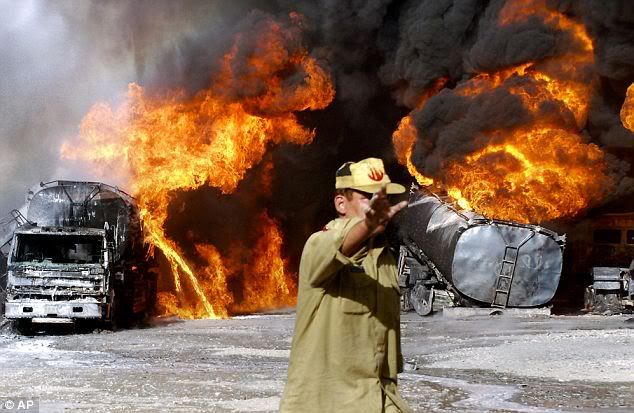
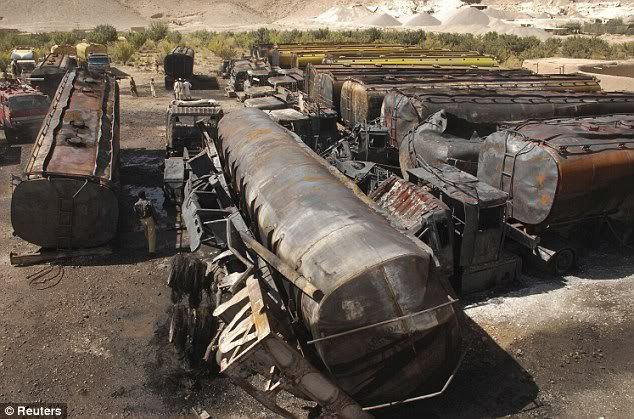
It was the sixth attack on convoys since Pakistan closed a key border route almost a week ago after a Nato helicopter attack left three of its troops dead.
Last week's closure of the Torkham crossing along the fabled Khyber Pass has left hundreds of trucks stuck on the country's highways, causing a bottleneck heading to the one route into Afghanistan from the south that has remained open.


Taliban in 'secret talks' with Karzai's government to end the war in Afghanistan
The Taliban and President Hamid Karzai's government have started secret peace negotiations to end to the war in Afghanistan, the Washington Post has reported.
The newspaper quoted unnamed Afghan and Arab sources who believe the Taliban representatives are authorised to speak for the Pakistan-based Quetta Shura and its leader, Mohammad Omar.
Talks are only in the preliminary stages, according to the Post following inconclusive meetings hosted by Saudi Arabia that ended more than a year ago.
President Karzai's spokesman Waheed Omer declined to confirm or deny the report.
The newspaper quoted unnamed Afghan and Arab sources who believe the Taliban representatives are authorised to speak for the Pakistan-based Quetta Shura and its leader, Mohammad Omar.
Talks are only in the preliminary stages, according to the Post following inconclusive meetings hosted by Saudi Arabia that ended more than a year ago.
President Karzai's spokesman Waheed Omer declined to confirm or deny the report.

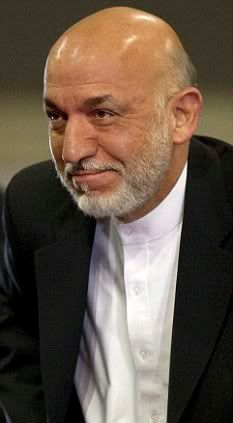
Peace overture: President Hamid Karzai

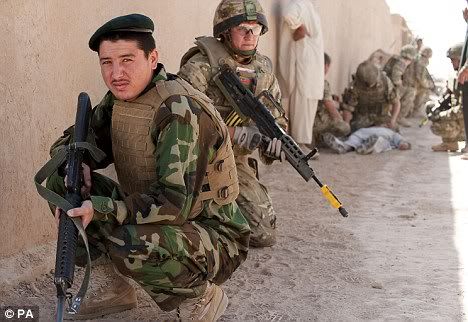
Training: An Afghan serviceman is taken through a replica village alongside a British soldier
Saturday, October 2, 2010
Militants set fire to NATO tankers in Pakistan
Suspected militants in Pakistan set fire to more than two dozen tankers carrying fuel for NATO troops in Afghanistan today, officials said, a day after three soldiers were killed in a cross-border NATO air strike.
Angered by repeated incursions by NATO helicopters over the past week, Pakistan has blocked a supply route for coalition troops in Afghanistan.
Pakistan is a crucial ally for the United States in its efforts to stabilise Afghanistan, but analysts say border incursions and disruptions in NATO supplies underline growing tensions in the relationship.
 Firemen extinguish a fire on a burning oil tanker on a highway near Shikarpur, about 39km from Sukkur in Pakistan's Sindh province, October 1, 2010
Angered by repeated incursions by NATO helicopters over the past week, Pakistan has blocked a supply route for coalition troops in Afghanistan.
Pakistan is a crucial ally for the United States in its efforts to stabilise Afghanistan, but analysts say border incursions and disruptions in NATO supplies underline growing tensions in the relationship.
Monday, September 6, 2010
US commander seeks 2,000 new troops for Afghanistan
US commander seeks 2,000 new troops for Afghanistan
The US and NATO commander in Afghanistan has requested another 2,000 troops for the foreign force fighting the Taliban insurgency, despite waning support for the war in troop-contributing nations, NATO officials said.
NATO officials said the request by General David Petraeus to bolster the International Security Assistance Force (ISAF) was made last week and included a call for about 750 more personnel to train the Afghan security forces.
“It has been determined that around 2,000 forces will be required,” a NATO official said, speaking on condition of anonymity. “There is an ongoing discussion on this issue.”

Sunday, August 29, 2010
Obama says Iraq war is ending, his promise is kept
US President Barack Obama said today Iraq could “chart its own course” and told Americans the drawdown of US troops helped fulfil a promise he made during the 2008 presidential campaign.
Obama, who is vacationing on the Massachusetts island of Martha’s Vineyard, declared in his weekly radio and Internet address that “the war is ending” and pledged to take care of troops who are returning home.

A worker gives directions to load up a Humvee as US troops prepare to leave Iraq at Balad Base, 80km (50 miles) north of Baghdad, yesterday, August 27, 2010.
Sunday, August 1, 2010
Hundreds of British troops launch Operation Black Prince in fresh surge to clear Taliban

Talking tactics: Troops conducting final planning preparations for Operation TOR SHEZADA (Black Prince)
British troops launched a massive push against Taliban insurgents yesterday.
In the biggest offensive of the summer, hundreds set out by land and air on Operation Tor Shezada - Black Prince - before dawn.
Led by 1st Battalion, The Duke Of Lancaster's Regiment, the operation aims to seize the rebel-held town of Saidabad in Nad-e Ali district in southern Helmand Province.
Wednesday, June 9, 2010
Copter shot down in Afghanistan; 4 Americans dead

Canadian soldiers with 1st RCR Battle Group, The Royal Canadian Regiment, rush to reinforce troops after one of their comrades got injured by an IED during a patrol outside Salavat, in the Panjwayi district, southwest of Kandahar, Afghanistan, Monday, June 7, 2010. IEDs have been the single biggest cause of death among Canadian troops in Afghanistan. Seven out of nine Canadian deaths this year were the result of IED blasts.

A medic with the U.S. Army comforts an injured Canadian soldier with the 1st RCR Battle Group, The Royal Canadian Regiment, after landing for his medical evacuation outside Salavat, in the Panjwayi district, southwest of Kandahar, Afghanistan, Monday, June 7, 2010. The Canadian soldier was injured from an IED during a patrol earlier. IEDs have been the single biggest cause of death among Canadian troops in Afghanistan. Seven out of nine Canadian deaths this year were the result of IED blasts.

U.S. marines provide security during a government function to lay the foundations for a government administrative department building at Musa Qala in Helmand, Afghanistan, Tuesday, June 8, 2010.
The U.S. military say the four NATO troops killed when a helicopter was shot down in Afghanistan were Americans.
NATO said earlier that hostile fire brought down the helicopter Wednesday in southern Helmand province, where the Taliban have a strong presence. The militant group claimed responsibility for the downing.
U.S. military spokesman in Kabul, Lt. Col. Joseph T. Breasseale, later confirmed the four NATO troops killed were Americans.
Tuesday, June 1, 2010
Qaeda says top leader Yazid dead-Possible killed by Pakistan drone attack.

Al-Qaeda number two Ayman al-Zawahiri

Top Al-Qaeda leader in Afghanistan, Mustafa Abu al-Yazid, has died, SITE reported
Al-Qaeda has announced the death of Mustafa Abu al-Yazid, regarded as its number three and Osama bin Laden's one-time top money man, in what would be a major blow to the global terror network.
US monitoring groups said the death of Yazid, who was most recently the leader of Al-Qaeda in Afghanistan and its liaison with the Taliban, was announced by the group in a message to jihadist websites on Monday.
In Washington, a US official said there was "strong reason" to believe that the Egyptian militant was dead and that he was killed recently in Pakistan's tribal areas, a hotbed of Islamist militants.
"In terms of counterterrorism, this would be a big victory," the official said.
Sunday, May 23, 2010
Afghan Nato base comes under attack -Taliban Claims Responsibility for Assault on Kandahar Air Base

The attack came days after a Kabul car bombing killed 18 people, including six foreign troops
Suspected fighters have launched a rocket and ground attack on Nato's main military base in southern Afghanistan, days after a similar assault on the coalition's military base in Bagram.
Monday, May 3, 2010
Pakistan Taliban chief threatens US - Mehsud surfaces on video to threaten strikes on U.S.

The new video shows Hakimullah Mehsud threatening attacks on the US
Four months after he was believed killed in a U.S. drone strike, Pakistan Taliban leader Hakimullah Mehsud has appeared in a new video, vowing revenge attacks against major American cities.
Mehsud threatened to carry out strikes against the US within a month for killings of the Taliban and Al-Qaeda leaders as he surfaced in a nine-minute video apparently made on April 4, U.S. monitoring groups reported.
“The time is very near when our fidayeen will attack states in major US cities,” Mehsud warned on the video where he was shown flanked by two armed masked men.
This is the first time that Taliban have directly threatened to carry out suicide attacks on the US soil, on the pattern of their close allies Al-Qaeda.
The video comes in the wake of an attempted car bombing in New York’s Times Square on Sunday and follows another video released by Tehreek-e-Taliban (TTP) in which the group claimed responsibility for the failed strike. The U.S. investigative agencies have however ruled out the attack being handiwork of any Islamist terror organisation.
Wednesday, March 10, 2010
'Jihad Jane's' Arrest Raises Concern About Homegrown Terrorists-American blonde accused of terror plot
The arrest of a suburban Pennsylvania woman known by the alias Jihad Jane, who allegedly plotted with Islamic radicals abroad to kill a Swedish cartoonist, has raised concerns about homegrown terrorists in the United States who may be difficult to spot.
"This woman might as well have advertised in the Washington Post," former White House counterterrorism official and ABC News consultant Richard Clarke said on "Good Morning America" today. "It was easy for the FBI to find her but there are other people who are much more covert.
"There will likely be more attacks," Clarke added. "Hopefully, they will be small and hopefully we can catch them early."
Colleen R. LaRose, 46, of Montgomery, Pa., was arrested in October 2009 and charged with trying to recruit Islamic fighters and plotting to assassinate a Swedish cartoonist who made fun of prophet Mohammed, according to a federal indictment unsealed today.
The FBI had kept the case secret while it looked for more suspects in the United States and abroad. The case was made public after seven men were arrested in Ireland this week, suspected of plotting to kill the Swedish cartoonist.
LaRose's case is rare, Clark said, but it shows the capability of international dissident groups to reach out to Americans via the Internet.
"This is a very rare case of a disturbed woman," he said, but it signifies how "the Internet not only allows them to communicate, it allows them to recruit."
Their persuasive speeches and sermons, which have been effective in recruiting men and women in the Middle East, are "beginning to work for some misfits in the United States," he said.
A blonde American woman who went under the online alias "Jihad Jane" has been accused of plotting to murder a Swedish cartoonist for drawing a picture of the Prophet Muhammad with the body of a dog, it emerged today.
Colleen LaRose, a 46-year-old Muslim convert from Pennsylvania, was said by prosecutors to have used the internet to make contact with jihadists overseas and was persuaded to use the fact that she was a white American to get through security surrounding the artist, Lars Vilks.
A US Justice Department official said last night that the case "shatters any lingering thought that we can spot a terrorist based on appearance".
Ms LaRose was arrested in Philadelphia in October last year, but her indictment remained sealed until after the arrest in Ireland yesterday of seven people - three women and four men - involved in a suspected plot to murder Mr Vilks.
The cartoonist has been holed up in a rural hideout since his cartoon appeared in a Swedish newspaper in 2007, a year when the publication of similar cartoons in Denmark sparked violent protests across the Islamic world.
Islamic law generally opposes any depiction of the Prophet - even favourable - for fear that it could lead to idolatry, and al-Qaeda put a bounty of $100,000 on Mr Vilks's head.
Three Swedish papers reprinted his image today in a gesture of solidarity. One, Dagens Nyheter said in an editorial that "Vilks doesn’t stand alone in this conflict. A threat against him is, in the long term, also a threat against all Swedes."
A federal indictment charges that Ms LaRose, who also called herself Fatima Rose, agreed to kill Mr Vilks on orders from the unnamed terror contacts and went to Europe to carry out the killing.
It also alleged that Ms LaRose, who has blond hair and blue-green eyes, indicated in her online conversations that she thought her appearance would help her move freely in Sweden to carry out the attack.
The indictment says that Ms LaRose posted a YouTube video as JihadJane in June 2008 saying she was "desperate to do something somehow to help" Muslims.
Within months, she was in contact with Jihadists in Europe and Asha and agreed to marry a South Asian man to get him into Europe.
In March last year the same man told her via e-mail to go to Sweden, find Mr Vilks "and kill him".
According to the indictment, Mr LaRose replied: "i will make this my goal till i achieve it or die trying."
Ms LaRose is said to have used the name JihadJane to create a MySpace page on which she described herself as a woman who had "reverted to Islam".
"I live in Pennsylvania, originally from Texas. I have recently (a couple months) reverted to Islam and I can safely say that of all the things I have ever done in my lifetime, becoming Muslim is what I am the proudest of," she wrote.
Elsewhere, the user lists her heroes as "Skeikh OBL", an apparent reference to Al-Qaeda leader Osama Bin Laden, and "The brothers in... Jihad".
The indictment and material released by SITE, a US group that monitors extremists, suggest that Ms LaRose had an active online presence, despite being repeatedly banned from websites including YouTube and despite her fears that she was under surveillance.
Michael Levy, a US Justice Department attorney, said that the case "demonstrates that terrorists are looking for Americans to join them in their cause, and it shatters any lingering thought that we can spot a terrorist based on appearance".
David Kris, an assistant attorney general at the Justice Department’s National Security Division, said that the government would have to remain vigilant.
"Today’s indictment, which alleges that a woman from suburban America agreed to carry out murder overseas and to provide material support to terrorists, underscores the evolving nature of the threat we face," he said.

Ms LaRose is accused of planning to use her appearance to help Jihad

Colleen LaRose, as shown in a police mugshot

Jihad Jane: a photograph from a web page set up by the terror suspect
Saturday, March 6, 2010
Hidden enemy delays advance in Marjah-he Taleban’s most important opium-growing centre in Helmand, the country’s most violent province.

The troops are fighting over an area of less than 100 square miles, with a population of 80,000

The massive offensive in Marjah involves about 15,000 US, British and Afghan troops

Under the rules, troops cannot fire at people unless they commit a hostile act or show intent

US Marines said their ability to fight back has been tightly constrained by strict new rules of engagement that make their task more difficult and dangerous

US officers said the fighting on the first day of the operation was as intense as any that the same unit faced during the infamous clearance of Fallujah in Iraq in 2004

Multiple firefights broke out in different areas in and around Marjah, the last militant stronghold in the country's most violent province, Helmand
US Marines and Afghan troops were bogged down by sniper fire and home-made bombs on the third day of their biggest offensive since the overthrow of the Taleban in 2001.
Nato and allied forces were meeting fierce resistance in their battle to seize the Taleban’s main stronghold in southern Afghanistan, and were able to advance only 500 yards yesterday.
Multiple firefights broke out in various areas in and around Marjah, the Taleban’s most important opium-growing centre in Helmand, the country’s most violent province.
The US troops leading Operation Moshtarak (Togetherness) twice tried to capture the town’s central bazaar only to be pushed back by wellorganised insurgents. Coming under heavy fire and sniper attacks, and confronted by booby-trapped buildings, the US Marines were forced to call in Harrier jets and attack helicopters armed with Hellfire missiles.
Captain Abraham Spice, a US Marines spokesman, said: “In many parts of Marjah, we have seen very little opposition. There are areas where Marines have met with stiff resistance, but they’re making steady progress.”
US officers from Bravo Company 1st Battalion 6th Marine told The Times that the fighting on the first day had been as intense as any the unit faced during the infamous clearance of Fallujah in Iraq in 2004.
The skill displayed by Taleban insurgents showed high levels of tactical awareness and training — including “walking” mortar fire on to the Marines and persistent and accurate sniper fire.
The unit has lost one Marine and five have been injured. Many others have had near misses, including one soldier who was hit yesterday by a Taleban bullet between the eyes, but an inch above the rim of his helmet.
The offensive in Marjah involves 15,000 US, British and Afghan troops. It is the biggest joint operation since the 2001 invasion that ousted the Taleban. The troops are fighting over an area of less than 100 square miles, with a population of 80,000.
The slow progress strongly suggests that the campaign to capture insurgent-held areas before the troop withdrawal date of 2011 set by President Obama could slip.
US Marines said they are constrained by strict new rules of engagement that make their task more dangerous. Under the rules, troops cannot fire at people unless they commit a hostile act or show intent.
Corporal Travis Anderson, 20, from Iowa, said his platoon had repeatedly seen Afghan fighters dropping their guns into ditches before melting away into the civilian population.
“It’s hard to fight a war like this,” he said. “They’re using our rules of engagement against us.”
There was further fallout from the Nato missile strike that killed 12 civilians, including six children, on Sunday, a tragic error that dismayed General Stanley McChrystal, the US and Nato ground commander. He has emphasised that a failure to win over the civilian population will doom the military campaign to failure.
Hamid Karzai, the Afghan President, called for an investigation. Three more civilians died in the operation yesterday.
Major-General Nick Carter, commander of Nato forces in southern Afghanistan, said: “You won’t know how successful you’ve been probably for about eight weeks. The measure of it will be the extent to which the population is entirely on our side.” Afghan security chiefs were more optimistic, saying government troops faced “sporadic resistance”.
The Defence Minister Abdul Rahim Wardak said most insurgents had “hidden or escaped”. Three suspected bombmakers were identified via biometric tests and arrested trying to escape disguised as civilians.
Five Afghan civilians were accidentally killed and two others injured in an airstrike in Kandahar province, unrelated to Operation Moshtarak, Nato said yesterday.

Wednesday, February 17, 2010
Pakistani government backs down in judge dispute

----
Pakistan's prime minister says the government will not be appointing two judges to new posts after the move was opposed by the country's Supreme Court.
The clash over the appointments had added to existing tensions between the government and the judiciary. It threatened to distract Pakistan as it wages offensives against Taliban-led militants in its border regions.
But Prime Minister Yousuf Raza Gilani has tried to defuse those fears in the days since.
The court decided to reject the president's recommended appointments late Saturday.
Gilani said Wednesday that three judges recommended by the Supreme Court would be added to its bench. Two judges who would have been elevated to new posts within the judiciary would stay in their current spots.
THIS IS A BREAKING NEWS UPDATE. Check back soon for further information. AP's earlier story is below.
ISLAMABAD (AP) — Pakistan on Wednesday confirmed for the first time that it has the Afghan Taliban's No. 2 leader in custody, and officials said he was providing useful intelligence that was being shared with the United States.
Mullah Abdul Ghani Baradar was arrested earlier this month in a joint operation by CIA and Pakistani security forces in the southern port city of Karachi, U.S. and Pakistani officials said on condition of anonymity Tuesday. The army on Wednesday gave the first public confirmation of the arrest.
"At the conclusion of detailed identification procedures, it has been confirmed that one of the persons arrested happens to be Mullah Baradar," chief army spokesman Maj. Gen. Athar Abbas said in a written message to reporters. "The place of arrest and operational details cannot be released due to security reasons."
Baradar was the second-in-command behind Taliban founder and supreme leader Mullah Mohammad Omar and was said to be in charge of the day-to-day running of the organization's leadership council, which is believed based in Pakistan. He was a founding member of the Taliban and is the most important figure of the hard-line Islamist movement to be arrested since the U.S.-led invasion of Afghanistan in 2001.
The White House has declined to confirm Baradar's capture. Spokesman Robert Gibbs told reporters the fight against extremists involves sensitive intelligence matters and he believes it's best to collect that information without talking about it.
Baradar, who also functioned as the link between Mullah Omar and field commanders, has been in detention for more than 10 days and was talking to interrogators, two Pakistani intelligence officials told The Associated Press on Tuesday.
One said that Baradar had provided "useful information" to them and that Pakistan officials had shared it with their U.S. counterparts. A third official said Wednesday that Baradar was being held at an office of Pakistan's most powerful spy agency, the Directorate of Inter-Services Intelligence, in Karachi.
The officials spoke on condition of anonymity because they were not authorized to speak to the media.
Baradar's arrest suggests the Pakistani intelligence services may be ready to deny Afghan militant leaders a safe haven in Pakistan — something critics have long accused them of doing.
Foreign Minister Shah Mahmood Qureshi called the arrest important and rejected suggestions that Pakistan was not cooperating with the United States against militants, citing as evidence recent military operations against Taliban strongholds in the Swat Valley and Waziristan tribal region.
"Our cooperation is beyond doubt," Qureshi told the British Broadcasting Corp. from Brussels.
The arrest may also push other insurgent leaders thought to be sheltering in Pakistan toward reconciliation talks with the Afghan government — a development increasingly seen as key to ending the eight-year war.
The arrest came shortly before U.S., Afghan and NATO troops launched a major offensive against militants in the Taliban stronghold of Marjah in the southern province of Helmand, one of the regions that Baradar was believed to control. It is the biggest joint operation of the war and the first offensive since President Barack Obama ordered a "surge" of 30,000 more U.S. troops to Afghanistan.
Washington has pressed Islamabad to crack down on Afghan Taliban believed to be staying in Pakistan, and to go after Pakistani Taliban groups who have strongholds in the country's northwest regions bordering Afghanistan. The CIA also has stepped up a campaign of missile strikes from unmanned planes that have killed dozens of suspected militants in recent months.
The latest strike came Wednesday, when a suspected U.S. drone aircraft fired two missiles at a home in the northwestern village of Tabbi Tool Khel in the North Waziristan tribal region, killing at least three people and wounding some others, two intelligence officials said on condition of anonymity because they were not authorized to speak to media.
Taliban's most senior military commander captured by the CIA in Pakistan raid
The arrest of the Afghan Taliban's top military commander in Karachi has raised concern about militants in the city but security analysts said Pakistan's commercial capital was unlikely to become an Islamist bastion.
U.S. and Pakistani officials said on Tuesday Mullah Abdul Ghani Baradar had been captured in a joint raid by Pakistani and U.S. spy agencies.
While investors have grown used to violence in Pakistan's ethnic Pashtun northwest on the Afghan border, trouble in Karachi has a more direct impact on financial markets.
A city of 18 million people, Karachi generates 68 percent of government revenue and 25 percent of Pakistan's gross domestic product.
"The initial reaction to the news of Mullah Baradar's arrest was 'oh no! not in Karachi!', but the fact that he has been arrested is good news in itself," said Khalid Iqbal Siddiqui, director of research at brokers Invest and Finance Securities.
"While the presence of such high-profile militants in the city is a concern, incidents of violence worry investors more and so far the feeling is that the fears of Talibanization here are exaggerated," he said.
The stock market did not react to Baradar's arrest on Tuesday and the index was up 1.13 percent at 9,880.25 at 0825 GMT on Wednesday.
The Taliban presence in the city has become a hot political issue in the city where rivalry has often sparked bloody clashes between party activists.
The Muttahida Qaumi Movement (MQM), Karachi's dominant political force, has been a vocal critic of the Taliban and has raised fears about the "Talibanization" of the city.
Karachi is home to the largest concentration of Pashtuns outside North West Frontier Province. Most members of the Taliban, both in Afghanistan and Pakistan, are Pashtun.
"TEMPORARY REFUGE"
Many of Karachi's Pashtuns back a Pashtun-dominated party that competes with the MQM and analysts say the MQM's warnings of Taliban infiltration are at least partly a political ploy.
Nevertheless, the Pashtun presence is believed to provide militants such as Baradar with networks of support and a big population pool in which to melt away and hide.
Karachi mayor Syed Mustafa Kamal, a member of the MQM, told Reuters in an recent interview the city was the Taliban's "revenue engine".
But analysts and officials say while the Taliban may be raising funds and hiding in Karachi, they were not able to impose their austere rule and turn neighborhoods into bastions.
"They can take temporary refuge here but Karachi is certainly not a place for them to create a base," said retired army general Moinuddin Haider, a former federal interior minister and governor of the Sindh province, of which Karachi is the capital.
"The intelligence agencies are very active here and it's not easy for them to come here and hide," Haider said.
Liberal political parties, including the country's biggest party led by President Asif Ali Zardari, also have strong grassroots support in Karachi.
Because of that, the Taliban are unlikely to find a fertile recruiting ground although they have sympathizers in some radical madrasas, or religious schools.
"They can come here when under pressure in other parts of the country but there can't be safe havens and safe bases for them here," Haider said.
Though far from immune to militant violence, Karachi has seen fewer attacks over the past couple of years compared with other cites such as Peshawar and Lahore.
"The danger of the Taliban in Karachi is only as big as in any other city in Pakistan. In fact, I would say it is less prone to such danger which is evident from the fewer attacks," said a senior security official who declined to be identified.
"I'm not saying that there are no Taliban here, but the hype of them taking over is probably more political than factual."
---
---
----
----
---
---
Sunday, February 7, 2010
UK troops get ready for biggest battle with Taliban since 2001

Preparation: British and Afghan soldiers practice their operation drills at Military Operating Base Shorabak in Helmand today

U.S. soldiers on top of their armoured vehicles load their 50-calibre machine guns as they train in Helmand province, southern Afghanistan, today

Some 4,000 UK troops will take part in bloody fighting this week alongside the biggest air assault since the first Gulf War of 1991 is launched

Gen McChrystal, right, today spoke alongside NATO's new civilian chief, former British Ambassador Mark Sedwill, 2nd right, who started his new job with a briefing at NATO headquarters in Kabul

Afghan families flee their homes today ahead of the largest offensive in the eight-year Afghanistan war
Defence Secretary Bob Ainsworth warned the public to be braced for casualties last night as troops prepared to launch the biggest offensive in the eight-year Afghanistan war.
A strike force of 15,000 British, U.S. and Afghan troops will mount airborne raids in the most dangerous areas of central Helmand province.
Some 4,000 UK troops will be involved in Operation Moshtarak - which means 'together' in the local Dari language.
It aims to reassure ordinary Afghans by driving the Taliban out of their strongholds and destroying their bomb factories.
Mr Ainsworth said: 'We shouldn't deny or pretend to people that casualties are not a very real risk on these kind of operations and people have to be prepared for that.
'This is not a safe environment and it doesn't matter how much kit and equipment we provide for them, we cannot entirely make these operations risk-free.
The Defence Secretary also revealed that British forces were engaged in direct talks with some Taliban fighters.
He said: 'There's no need for us to wait until some end point before we start talking to those elements of the Taliban who don't share all of the ideological aims of some of their leaders. Those talks have already been going on for some time.'
His casualty warning was echoed by General Sir David Richards, chief of the general staff, who said: 'There are inevitably risks but the gains are considerable.
'Offensive operations like Moshtarak are a key part of any counter-insurgency campaign.'
Colonel Richard Kemp, who commanded forces in Afghanistan in 2006, warned: 'There will be heavy fighting.
'The Taliban know the area very well and will have prepared escape routes through tunnels, alleyways or buildings. They will fire on our troops and then run.
There will be a lot of IEDs (improvised explosive devices), a lot of snipers and a lot of hit and run. We will probably have to brace ourselves for a large number of casualties.'
He said the Taliban were already using children to lay IEDs and throw grenades.
The scale of the offensive, whose start date is being kept secret, will dwarf Operation Panther's Claw, in which ten British soldiers died last summer.
British commanders are worried that troops being flown to the battlefield by helicopter could come under heavy fire from Taliban fighters.
One senior officer said: 'Our real concern is that we could lose one or more Chinooks filled with soldiers - that would come close to being catastrophic.
'The British public needs to steel itself for these casualties. We need the people in the UK to show a great deal of resilience. This is about delivering what could amount to a decisive blow to the Taliban in Helmand province.'
One of the soldiers preparing for the attacks, Lance Corporal Nick Richards, 22, from Llanelli, said: 'People are saying that this is the biggest assault of this kind since Vietnam, so everyone wants to be a part of it.
'We are proud to be part of the big picture of change in Afghanistan. It's definitely going to have a big impact on Helmand in getting rid of the Taliban and bringing stability to the area. The locals are under a lot of stress and we will try and help them out to relieve that pressure.'
The offensive comes a month before the start of the usual 'fighting season' in Afghanistan and is expected to continue throughout the summer.
British military spokesman Major General Gordon Messenger-said there had been a 'conscious decision' to reveal it in advance, despite losing the element of surprise.
He said: 'The purpose is to give the Taliban a choice - either to put down their weapons and become part of legitimate society or to fight.
'If they choose to fight, they will be subjected to overwhelming force and will be defeated.'
But villagers fleeing the target areas said the Taliban were ignoring the coalition warning.
'They are bringing in people and weapons and planting mines,' said one man. 'We know there is going to be a big fight.'
* Taliban fighters are stealing ammonium nitrate fertiliser sent by aid organisations to help farmers and using it for roadside bombs, it was revealed yesterday. The aim is to foil coalition metal detectors.

Saturday, January 30, 2010
Forces mistakenly exchange fire in Afghanistan

Violence flares in Afghanistan amid reports that Taliban commanders met with U.N. officials.
As talk emerged about a secret meeting of U.N. and Taliban officials, the battlefield lit up in Afghanistan, with a joint Afghan-international force and Afghan soldiers exchanging fire when both sides mistook the other for enemy combatants.
The violence flared as a widely circulated news report said that senior Taliban commanders met in Dubai earlier this month with Kai Eide, the U.N. special representative for Afghanistan. The meeting reportedly dealt with the prospect of peace talks with the Afghan government.
The United Nations won't comment on the reports, and the Taliban issued a flat denial of what it called "futile and baseless rumors."
But they surfaced on the heels of this week's London Conference on Afghanistan, where President Hamid Karzai pushed a reconciliation plan to attract "disenchanted brothers" into law-abiding society, a reference to Taliban foot soldiers who fight to earn wages.
Such breakthrough diplomacy would be welcomed by many Afghans weary and caught in the middle of the daily fight between Taliban and al Qaeda militants and Afghan security forces, backed by NATO's International Security Assistance Force.
ISAF said small arms fire targeted a joint Afghan-international security force conducting an operation in Sayed Abad district of Wardak province that apparently originated from an Afghan National Army combat outpost.
ISAF said the "subsequent air support called by the joint force likely killed at least four ANA soldiers." Wardak is near Kabul in the eastern part of the country.
"We work extremely hard to coordinate and synchronize our operations. This is a regrettable incident and our thoughts go out to the families of those killed and wounded," said Brig Gen. Eric Tremblay, ISAF spokesman.
The Afghan Defense Ministry said the clash occurred in the Akakhil village of Maydan in Wardak province, pointing out that it was a "joint operation of international forces" conducting a mission in an area where Afghan forces had been stationed.
Both sides thought the other was the enemy, the ministry said. The airstrike killed four Afghan soldiers and wounded several others, the ministry said.
Shahidullah Shahid, the Wardak governor's office spokesman, didn't mention the airstrike. He said four Afghan soldiers died and seven were wounded in what he said was an exchange of fire in the province's Sayed Abad district.
The incident infuriated the Afghans, with the ministry saying "the people responsible for this incident will certainly be punished according to military law."
In another part of Afghanistan, Ghazni province in the eastern region, two Afghan civilians died when NATO-led forces fired on a vehicle barreling toward troops, ISAF reported on Saturday.
The vehicle moving at a high speed "failed to heed several warning signs to stop" on Friday and troops firing at the engine block killed the two Afghans and injured one more. A fourth person in the car was not injured.
The incident, which occurred in the province's district, represents one of the trends bedeviling the international fight against the Taliban -- civilian deaths in the course of the war that have strained relations between Afghanistan and the United States and its allies.
The numbers of civilian casualties have fallen off in recent months, since Gen. Stanley McChrystal took over as U.S. commander in Afghanistan. But escalation-of-force incidents at checkpoints, air bombings and accidents that have led to civilian deaths have undermined international and Afghan efforts to win wider civilian support.
Earlier this week, a NATO convoy fired "on what appeared to be a threatening vehicle" and killed an imam, prompting angry demonstrations and an ISAF statement conveying regrets about the incident, which took place outside a U.S. military base on the outskirts of Kabul."
"Despite all the measures that we put in place to ensure the safety of the Afghan people, regrettable incidents such as this one can occur," Tremblay said about the Thursday shooting of the imam.
"On behalf of ISAF, I express my sincere regrets for this loss of life and convey my deepest condolences to his family."
International troops continue to endure violence, and the latest occurred on Friday in Wardak province.
A NATO official who asked not to be identified said two U.S. service members were killed by an Afghan interpreter, who was then killed. Initial inquiries by authorities have determined that the interpreter was disgruntled for work reasons and not a Taliban infiltrator.
As for the London Conference on Thursday, a central focus was a $500 million pay-for-peace proposal to bring Taliban fighters into the civilian fold if they promise to renounce violence. The money would create jobs and housing in an effort to moderate the Taliban fighters, helping them return to civilian life. Major international donors are expected to pledge money for the effort.
Karzai also said he would establish a national council for peace reconciliation and integration, followed by a "peace jirga" -- a traditional gathering of Afghan tribal leaders -- and said he hoped Saudi Arabia's King Abdullah would play a "prominent role."
Karzai has suggested that high-level Taliban commanders could take part in the Afghan government in the future. This week, the United Nations removed several members of the Taliban from a blacklist, suggesting negotiations could take place in the not-too-distant future.
--------
------
-----
Thursday, January 28, 2010
Afghan conference a propaganda ploy: Taliban-Saudi Arabia sets firm conditions for Afghan role

Hamid Karzai and Gordon Brown in Downing Street this morning.Hamid warn that Afganishtan require 15 years of help to recover and rebuild.

The Taliban have been unmoved by talk of peace overtures . Said it is war mongers meeting to deceive and continue to occupy Afganisthan.

Security, reconciliation and withdrawal of foreign forces by 2015 were key policy announcements

Whether Taliban would accept an invitation to a 'peace jirga' is a mute point.
The Afghan Taliban on Thursday dismissed the London conference on Afghanistan as a propaganda ploy and said the summit will fail to produce results, the SITE monitoring service reported.
"The war-mongering rulers under the leadership of (US President Barack) Obama and (British Prime Minister Gordon) Brown want to deceive the people of the world by holding the London conference to show that people still support them," SITE quoted an Internet statement as saying.
If the decision is taken to "once again try to prolong the military, economic, cultural and political occupation of (Afghanistan), this conference will be a mere eye-wish like other conferences."
The London conference, which aims to chart the way forward in Afghanistan, opened on Thursday with nearly 70 countries and organisations taking part.
The Taliban must deny sanctuary to Osama bin Laden before Saudi Arabia will agree to act as a mediator in any Afghan peace deal, the kingdom's foreign minister said on Thursday.
Prince Saud al-Faisal was responding to Afghan President Hamid Karzai who had called on Saudi Arabia, which has hosted talks between Afghan government and Taliban representatives in the past, to help bring peace to Afghanistan.
"Unless the Taliban give up the issue of sanctuary (to bin Laden) I don't think the negotiations with them will be possible or feasible to achieve anything," Prince Saud told reporters on the sidelines of a London conference.
"We have two conditions for Saudi Arabia's involvement: that the request comes officially from Afghanistan and the Taliban has to prove its intentions in coming to the negotiations by cutting their relations with the terrorists and proving it," he said.
"By keeping their contacts with bin Laden they won't be coming to any negotiations with a positive attitude.
POLICY CHANGE
Saudi Arabia froze ties with the Taliban in 1998 over the group's refusal to hand over bin Laden, who had been stripped of his Saudi citizenship for militant attacks in the oil-producing kingdom and activities against the al-Saud royal family.
"I think the important theme in this conference is the intention to change policy in Afghanistan, a recognition first that the settlement in Afghanistan is not going to be a military question alone but there has to be a political and economic side to the settlement," Prince Saud said.
"If peace is brought between Afghans and the terrorists are isolated then the war against the terrorists would be successful," he added.
The United States has insisted that insurgents can only be included in a political settlement if they sever all ties with al Qaeda, renounce violence and respect the Afghan constitution.
Karzai said that Afghanistan needed the support of its neighbours, particularly Pakistan, to secure peace.
Pakistan, Saudi Arabia and the United Arab Emirates were the only three countries to recognise the Taliban government before it was ousted in the U.S.-led invasion in 2001.
Asked whether Saudi Arabia shares the concern of the West and other allies that Iran's nuclear programme is aimed at building an atomic bomb and not for creating electricity as Tehran claims, Prince Saud said:
"If they are working on a peaceful nuclear programme they certainly have a strange way of showing it. All the countries that are working on a peaceful programme are not acting like Iran.
"There is one sure way of stopping that, that is to take a decision at the Security Council that no weapons of mass destruction, nuclear or otherwise will be allowed in the Middle East and that includes Israel."
Control over some of Afghanistan's provinces is to be handed over to the Afghan government by the end of 2010, according to foreign ministers attending a one-day international conference in London.
UK Foreign Minister David Miliband said on Thursday that 2010 was a "decisive" year because a new government was in place, adding that security of all provinces would be under Afghanistan leadership within five years.
Miliband also announced a new fund to allow the Afghan government to woo Taliban fighters away from the conflict.
"Today alone there have been over 140 million dollars worth of commitments for the first year of the national reintegration programme and we are committed to seeing that through," Miliband said.
In a communique published at the end of the conference that was attended by delegates from 70 countries, support was also offered for the continued growth and expansion of the Afghan National Army and police force.
Delegates agreed a target of recruiting some 171,600 soldiers and 134,000 police officers by October 2011.
But Hillary Clinton, the US secretary of state, said that plans to gradually transfer Afghan security from international to domestic forces was "not an exit strategy".
"We . . . support the NATO transition plan," Clinton said. "But I want to make clear - to Afghans, to our partners, to our citizens, and to the extremists who hope for our failure: This is not an exit strategy."
Taliban reaction
Taliban dismissed the London conference as a propaganda ploy, saying the summit would fail to produce results, according to the AFP news agency, quoting an internet statement.
"The war-mongering rulers under the leadership of [US President Barack]Obama and [British Prime Minister Gordon] Brown want to deceive the people of the world by holding the London conference to show that people still support them".
If the decision is taken to "once again try to prolong the military, economic, cultural and political occupation of [Afghanistan], this conference will be mere wishful thinking like other conferences."
The statement also dismissed a plan by Hamid Karzai, the Afghan president, to woo Taliban moderates with offers of money and jobs.
"They announce that they will provide money, employment and opportunity to have a comfortable life abroad for those mujahedeen who agree to part ways with jihad," the statement said.
"This is baseless and futile," it said. "Had the aim of the mujahedeen of the Islamic Emirate been obtainment of material goals, they would accept dominance of the invaders in the first place."
Presidential view
Earlier on Thursday, Karzai said that his country must reach out to its "disenchanted brothers" in an effort to stabilise the war ravaged nation, saying fighters who are "not part of al-Qaeda or other terror groups" must be reconciled with the government.
The Afghan leader said his government would set up a national council for peace and reconciliation, and has asked Saudi Arabia to help guide the process.
Karzai was seeking support for a $1 billion plan that would offer cash, jobs and other incentives to the Taliban and fighters in other armed groups, in an attempt to bring them back into mainstream society.
Taliban fighters have also been invited to a "peace jirga", or a traditional gathering of tribal elders, expected to be held early this year, a government spokesman confirmed.
Saudi role?
Hamid Elmi, Karzai's deputy spokesman, said: "We are using all kinds of possibilities - our neighbouring countries, the international community, the king of Saudi - to encourage the Taliban to come".
However, Saudi Arabia said on Thursday that it would only take part in Afghan peace efforts if the Taliban denies sanctuary to Osama bin Laden, the al-Qaeda leader, according to the kingdom's foreign minister.
"Unless the Taliban give up the issue of sanctuary (to bin Laden) I don't think the negotiations with them will be possible or feasible to achieve anything," Prince Saud al-Faisal told reporters on the sidelines of a London conference.
"We have two conditions: that the request comes officially from Afghanistan and the Taliban has to prove its intentions in coming to the negotiations by cutting their relations with the terrorists and proving it."
But Haroun Mir, deputy director for the centre for research and policy studies in Kabul, told Al Jazeera that Karzai's proposal could be hampered by plans to increase the number of foreign troops in Afghanistan.
"Karzai has been talking for a long time for reaching out to the Taliban.
"But ... the US military surge and additional Nato forces in Afghanistan in the coming months [will see] the intensity of fighting increase.
"I don't know how president Karzai could implement his own strategy of reaching out to the Taliban if there is increased fighting going on in Afghanistan," he said.
Secret talks
And Abdullah Abdullah, the presidential candidate who withdrew from last August's fraudulent elections, said obstacles remain to implementing such a policy.
"I don't think the Taliban at this stage are willing to enter negotiations. Also, their association with terrorist organisations, like al-Qaeda - that's the main issue at the moment - and they are working like one organisation."
Thursday's conference comes nearly a week after a meeting between Afghan government officials and members of an armed opposition group fighting alongside the Taliban.
Al Jazeera's David Chater, reporting from Kabul, said the talks were held with the group Hezb-e-Islami, in the Maldives islands, between January 23-24.
He said a Taliban leader had been due to attend the meeting but dropped out in the last minute citing health reasons.
President Karzai of Afghanistan warned today that his country's security forces would require another 15 years of Western support before they are able to sustain themselves.
Ahead of the opening of the London Conference on Afghanistan, Mr Karzai told the BBC that he foresaw a gradual reduction in support over a lengthy timeframe.
“With regard to training and equipping the Afghan security forces, five to 10 years will be enough,” he said. “With regard to sustaining them until Afghanistan is financially able to provide for our forces, the time will be extended to 10 to 15 years.”
His comments were at odds with the tone of Gordon Brown’s opening address to the conference, which sought to stress a timeframe of less than a year until Western forces begin a transition of responsibility to their Afghan counterparts.
The Communique that will end the conference, a document already leaked to The Times, forsees a gradual transfer starting late this year or early next in the more benign provinces. Afghan forces will be in the lead of the majority of provinces within three years and overall control will pass to Afghan forces within five years.
Concurrent with the military surge, led by 30,000 new US troops, the Prime Minister set out details to leaders from more than 60 countries of a complementary “civilian and political surge” that will include a drive to reconcile and reintegrate Taliban fighters.
After a bloody year for Nato forces in Afghanistan, during which 520 troops died including 108 from Britain, Mr Brown told delegates: “By the middle of next year, we have to turn the tide in the fight against the insurgency.”
Standing alongside Mr Karzai, the Prime Minister went on to detail plans that Western leaders hope will lead to the reintegration of what the Afghan President called the “disenchanted brothers” of the Taleban.
The Prime Minister detailed a new £500million fund that is to offer inducements to Taleban fighters who promise to lay down their arms and sever their ties with Al-Qaeda and other terrorist networks.
The exact nature of the proposed engagement remains unclear, with Afghan officials and some British officials appearing to push a more conciliatory line than is coming from Washington.
Speaking at the start of the conference President Karzai told leaders that he wished to “reach out to all” and asked that the Saudi leader King Abdullah act as an intermediary in a process of engagement with the Taleban leadership. Saudi Arabia, one of only three countries to recognise the original Taleban government, has played a discreet role in previous unofficial talks between the Karzai government and representatives of the Taleban
The Pentagon spokesman Geoff Morrell said yesterday that any reconciliation with the Taleban leader Mullah Mohammad Omar was "probably a bridge too far" after he gave safe haven to al-Qaeda to launch the September 11, 2001, attacks on the United States.
"He has the blood of thousands of Americans on his hands," he told reporters in Washington.
But Mark Sedwill, the former British Ambassador and newly appointed Nato civilian representative in Afghanistan, suggested that talks with the Taleban would inevitably lead to engagement with “unsavoury characters.”
"If we are going to bring conflicts like Afghanistan, civil conflicts, to an end, that means some pretty unsavoury characters have to be brought within the system," he said.
The Taleban has been dismissive of suggestions that fighters can be “bought” by the new plan and today restated on its website that the withdrawal of Western forces is a precondition to any negotiation with the leadership. However, the insurgent movement has been careful in recent months to distance itself from Al-Qaeda’s agenda stressing that it poses “no threat to the West”.
Among the measures that are to accompany the reconciliation drive as part of a concurrent “civilian surge” in Afghanistan are plans for a new training programme for some 12,000 Afghan bureaucrats, a key deficiency in a country beset by both literacy rates of less than 30 per cent and endemic corruption. Agriculture, the mainstay of the Afghan economy, is to receive another £72 million from the British taxpayer.
As the West tries to accelerate a transition to Afghan control that will provide an ultimate exit strategy, Mr Brown said that the proportion of development money channelled through the Afghan government is to be increased to 50 per cent of the total, a move matched by Afghan government commitments to clamp down on endemic corruption. The International Monitory Fund and the World Bank are to announce further debt relief for Afghanistan totalling $1.6 billion.
British police training and mentoring teams are to be doubled from April, Mr Brown said, as part of an international effort to build Afghan forces that will see the Afghan Army expanded from 134,000 this October to 171,600 by October 2011. The Afghan police are to grow in number from 109,000 in October to 134,000 by October 2011.
-----
-----
------
-------
--------
------
Subscribe to:
Posts (Atom)


