Saturday, January 1, 2011
Russia’s Khodorkovsky sentenced, West concerned
Former tycoon Mikhail Khodorkovsky’s jail term was extended until 2017 yesterday when he was convicted of theft and money-laundering in a trial condemned in the West as politically motivated.
With Khodorkovsky and co-defendant Platon Lebedev watching from a glass-walled courtroom cage at the close of their trial, the judge said there was no way they could be reformed without “isolation from society.”
Monday, October 18, 2010
Jailed China Nobel winner asks wife to collect prize
“Xiaobo told me he hopes I can go to Norway to receive the prize for him,” Liu Xia said by telephone from her house where she is under virtual house arrest.
“I think it will be very difficult,” she added, when asked if she thought the government would allow her to go.
Liu Xia said the government had not yet explicitly told her she would not be allowed to go to Norway. The prize will be formally bestowed on December 10 in Oslo.
China said today that giving the Nobel Peace Prize to a jailed dissident showed a lack of respect for its legal system, in further criticism of an award that has stirred tensions over human rights.
Liu Xia, the wife of Chinese dissident Liu Xiaobo, holds a photo of her husband during an interview in Beijing October 3, 2010. She has been asked by her husband to collect the prize on his behalf
China slams Nobel prize for dissident as ‘disrespectful’
Foreign Ministry spokesman Ma Zhaoxu said that the prize, awarded to Liu Xiaobo, would not affect the direction of China’s political system, and repeated that it had damaged relations with Norway, where the peace prize committee is based.
“Giving the Nobel Peace Prize to a criminal serving a prison sentence shows a lack of respect for China’s judicial system,” Ma told a regular news briefing in Beijing.
China has condemned the Norwegian government, which has no say over the prize, and cancelled a planned meeting with a Norwegian fisheries minister.
A security officer gestures at the entrance of a residential compound where Liu’s wife lives in Beijing October 8, 2010
Thursday, October 14, 2010
China still at war over Nobel Peace Prize
"Can anyone expect a country to stay silent when its sovereignty and dignity are violated?" Foreign Ministry spokesman Ma Zhaoxu demanded Thursday.
He told reporters that giving Liu the prize "is equivalent to encouraging crimes in China," and "a violation of China's judicial sovereignty."
And, just hours after Japanese Prime Minister Naoto Kan joined the ranks of world leaders, including Prime Minister Stephen Harper and U.S. President Barack Obama, calling for Liu's release, Ma questioned their motivation.
"I wonder what their true intention is?" he demanded. "Is it because they resent China's development path and hate China's political system?"

Monday, September 13, 2010
Iran ready to free detained American woman on bail
The Tehran prosecutor told state television Sarah Shourd would be freed on US$500,000 (RM1.55 million) bail and permitted to leave the country.
Shourd was detained near Iran’s border with Iraq in July 2009 along with two male companions, Shane Bauer and Josh Fattal. Their families say the three were on a mountain hike in northern Iraq at the time.
Friday, August 27, 2010
Myanmar opposition in disarray as polls approach
Boycotts, draconian election laws and resignations of opposition figures have put Myanmar’s ruling generals within easy grasp to sweep the first polls in two decades, just two weeks after setting an election date.
Myanmar’s politically marginalised opposition appears in total disarray in the run up to the much-criticised November 7 polls, experts say, playing into the hands of a military regime with no intention to give up its 48-year grip on power.
“Than Shwe’s (above) only political strategy is divide and rule and a weakened opposition is just what he needs
U.S. citizen freed from North Korean jail after former President Jimmy Carter flies to Pyongyang to negotiate release

Protest: Aijalon Gomes is pictured in January near the disputed border between North and South Korea during a peace rally, days before his trespass offence and subsequent imprisonment
Aijalon Gomes, 31, had been sentenced to eight years' hard labour for trespassing and committing a 'hostile act' in the isolated dictatorship.
But former President Carter personally intervened, flying to North Korea's capital Pyongyang to negotiate with representatives of the state's reclusive leader Kim Jong Il.
Gomes - who is believed to have entered North Korea in support of another jailed American citizen - was pardoned by the 'supreme leader'.

Saturday, August 14, 2010
Reclusive Myanmar to hold elections on Nov 7
Myanmar will hold its first parliamentary elections in two decades on Nov. 7, state media said on Friday, ending speculation over the timing of a poll criticised by rights groups as a sham to entrench military power.
As of this week, at least 40 parties had registered to take part in the first civilian government in almost half a century in the reclusive, army-ruled country of 48 million people.
The United States, Britain and human rights groups have said the elections would be illegitimate if the military junta denies a role to thousands of political opponents now in prison, including detained Nobel Peace Prize-winner Aung San Suu Kyi.
Monday, March 29, 2010
Myanmar opposition party to boycott elections

The party of Myanmar's detained opposition leader Aung San Suu Kyi decided Monday to boycott the military-ruled country's first election in two decades after the Nobel laureate blasted new electoral rules as "undemocratic."
The main opposition National League for Democracy's refusal to participate would undermine the polls' credibility in the eyes of foreign governments, which have urged the diplomatically isolated junta to ensure all groups take part in the elections.
The military, which has run Myanmar since 1962, has touted this year's elections as part of a "roadmap to democracy," but a number of rules would prevent Suu Kyi herself from participating. The pro-democracy icon has spent 14 of the last 20 years in jail or under house arrest.
Suu Kyi's party won the last election held in Myanmar in 1990 by a landslide but was barred by the military from taking power.
On Monday, her party's spokesman, Nyan Win, announced after a daylong meeting that all 113 delegates present had agreed that the party should not register for the elections.
Cheering could be heard from the delegates as they concluded their meeting.
Nyan Win said the central committee members decided not to register because — as noted in a message sent to them by Suu Kyi — the electoral laws enacted by the junta "are unfair and unjust."
Her message also called stipulations in the law "undemocratic."
Nyan Win did not elaborate, but the party had previously objected to a provision of the party registration law that requires parties to expel members who have criminal convictions, or face deregistration.
Because Suu Kyi was convicted last year of allowing an unregistered guest to stay at her home, the provision would appear not to allow her to be a member of the National League for Democracy, which she helped found.
Suu Kyi is still general-secretary of the party and its most dominant figure.
The new election laws require political parties to register before the first week in May. Parties that do not register will not be able to participate in this year's election and will cease to exist, under rules enacted this month by the military government that also bar Suu Kyi from participating in the polls.
No date has been set for the polls, which critics deride as a sham designed to cement the power of the military.
Even before the official decision, party spokesman Nyan Win indicated the party would decide not to register. Asked if that would marginalize the party, he said, "We will continue to exist politically by not registering. If we register, we will only have a name void of all political essence."
"We will survive as long as we have public support," Nyan Win said.
Security was heightened, with plainclothes police and pro-government security guards stationed around the party's compound as the delegates met Monday in Yangon.
"This meeting is a life-or-death issue. If we don't register, we will not have a party and we will be without legs and limbs," said Win Tin, a veteran party member and one of Myanmar's longest-serving political prisoners, having spent 19 years behind bars before his release in 2008.
He said the journey ahead would be difficult if the party chooses to opt out of elections but that its members could still maintain their democratic principles and spirit.
Last week, Suu Kyi was quoted by her lawyer as saying she opposed registering her party. But she stressed she would let the party decide for itself.
Suu Kyi is under house arrest and the new election laws effectively bar her both from running and voting.
Myanmar's biggest opposition party said on Monday it would not register for this year's election, meaning Nobel Peace laureate Aung San Suu Kyi's party will have no role in the military-led political process.
The National League for Democracy (NLD) party, which won the last election in 1990 by a landslide but was never allowed to rule, said the entire party leadership had agreed not to run.
"After a unanimous vote of the central executive committee, the NLD party has decided not to register as a political party because the election laws ... are unfair and unjust," the party said in a statement.
The election has been widely dismissed as a sham after nearly five decades of iron-fisted army rule in the former Burma, a strategically situated but isolated country rich with resources like natural gas, timber and gems and a Southeast Asian port.
Senior party members made the decision six days after Suu Kyi, who has spent 15 of the past 21 years in detention, said she "would not dream" of entering if the decision was hers.
The comment was widely interpreted as a veiled instruction to party members as they prepared for a ballot on whether to run.
In comments relayed from her lawyer, Suu Kyi said the NLD was not ruined and vowed to keep up her fight for democracy.
"Registering the party under the unjust and one-sidedly drawn-up laws cannot be accepted," she was quoted as saying.
"I would like to tell the people that I will continue working for the emergence of democracy."
A senior party official had earlier told Reuters some members in favor of running in the election had been urged to vote otherwise to show the party was united.
UNCERTAIN FUTURE
Divisions had emerged in the party between advocates of a boycott and modernizers who believe the NLD would be a spent force if it did not run. However, senior NLD member Win Tin said the party would live on.
"The party will not die," he told Reuters. "We will be among the people, our activities will not stop."
The party faces dissolution if it refuses to register.
After the announcement, party members were in high spirits and chanted slogans to show their support for Suu Kyi, wearing T-shirts bearing her picture.
The NLD is most angered by the military junta's restrictive election laws, which bar current and former prisoners from taking part. Many NLD members are among the 2,100 political detainees in Myanmar, the most famous of whom is Suu Kyi.
After the last election, the junta promised to hand over power to the NLD after a constitution was drafted and a probe launched into the polls. Neither happened and the NLD was never allowed to rule.
Some in Myanmar's biggest city, Yangon, disagreed with the NLD's decision and said the country's best hope for democratic change had played into the hands of the generals.
"I think the NLD has made another major policy blunder," said a retired civil servant, who asked not to be identified.
"They've walked into a trap. They could have pressed on without Suu Kyi and got something out of the election."
Experts say the junta has learned from the botched 1990 election and has drafted a constitution that ensures it will effectively remain in charge, without the need to rig the polls.
The United States and United Nations have not publicly questioned the constitution but have said the election would not be credible if political prisoners could not take part.
Friday, February 12, 2010
Row with Winnie forces 'frail' Nelson Mandela to skip celebrations marking 20th anniversary of his release from prison
Former South African president Nelson Mandela has called off a historic return to the prison from which he walked to freedom 20 years ago.
The decision to abandon his appearance at the celebrations outside the Victor Verster Prison came after a row with his family - including ex-wife Winnie - over how to manage the 91-year-old's movements.
Local media suggested the family were concerned at how 'frail' the leader is. His absence from the event is certain to spark speculation about Mr Mandela's health.
The former African National Congress leader was released from prison on this day in 1990 in a decision that heralded the South Africa's decision to dismantle Apartheid.
Mr Mandela, who was 71 at the time, had spend 27 years behind bars on Robben Island.
Today South Africans are celebrating how far they have come since he took his first steps out of the prison.
Thousands gathered for commemorations at what was known in 1990 as Victor Verster Prison, near Cape Town.
A re-enactment had been planned of the moment Mandela, hand-in-hand with his then-wife Winnie, walked free.
But now Winnie Mandela, with other leaders of the ANC including current South African president Jacob Zuma, are set to lead the 500-yard march from the gates of the prison instead.
Reports claimed that the row over Mr Mandela's appearance was betwen Winnie, her daughter Zindzi, and other members of the family including his current wife Graca Machel.
'Something very strange has been going on,' The Times quoted a source as saying.
'Wild horses would not keep WInnie away from an event like that.
'Everyone knows that if Mandela himself went, front-page news was guaranteed.
'Others would be jealous, but he is very frail, and it is difficult to stage-manage an event like that - whereas to manoeuvre him into the National Assembly is relatively easy in comparison.'
Mr Mandela is still due to appear at the National Assembly for the official opening of Parliament, timed to coincide with the celebrations, tonight.
Cyril Ramaphosa, a leader in Mandela's African National Congress, said: 'We knew that his freedom meant that our freedom had also arrived.'
Just four years after Mandela's release, South Africans held their first all-race elections, making Mandela their first black president.
His ANC has reduced poverty, built houses and delivered water, electricity and schools to blacks who had been without under apartheid.
But needs remain great.
The celebrations came as a senior Labour MP and former trade union leader today called on David Cameron to apologise for his visit to Apartheid-era South Africa.
Mr Cameron acknowledged his party's 'mistakes' over South Africa when he visited former President Mandela in 2006.
But a biography published last year disclosed that he visited the country as the guest of anti-sanctions lobbyists in 1989, when the ANC leader was still in jail.
Conservative spokesmen said at the time that the visit was a chance for Mr Cameron to 'see for himself' what conditions in South Africa were like, and noted that he met anti-Apartheid campaigners and opposition politicians while in the country.
But former anti-Apartheid campaigners including Sheffield Central MP Richard Caborn and ex-TUC general secretary Norman Willis today wrote to the Tory leader to demand an apology.
'Your trip, paid for by lobbyists against sanctions, was a long time ago,' they wrote.
'But it was then, and is now, a question of values and judgement.
'Since the details of this trip became public, you have refused to comment on it, refused to explain why you had to keep it quiet and refused to apologise for your actions.
'We hope that on the anniversary of Nelson Mandela's release, you will set the record straight and do what is right.'

A pedestrian passes a handprint mural of Nelson Mandela in Cape Town today

adiba Day: South Africans wearing T-shirts emblazoned with Mandela's image celebrate today - but Mandela himself was forced to cancel his appearance

A crowd of ANC supporters celebrates outside the gates of Drakenstein Correctional Centre (formerly Victor Verster Prison) today

ANC supporters cheer outside the prison today - but they are set for disappointment with Mr Mandela cancelling his appearance


Celebrations: ANC supporters raise their fists in an imitation of Mandela's victory salute as they stand beneath a statue of the leader outside the prison where he spent 27 years

The end of apartheid: Left, the historic moment that Mandela was to re-enact today as he walked to freedom from prison in 1990. It was this re-enactment that was cancelled today after the row with Mandela's family over his health. Right, Mandela with current wife Graca Machal in April last year


Get books about Nelson Mendela.
Monday, January 25, 2010
Australians to learn of their convict ancestry as details of people sent down under 200 years ago are released

Criminal acts: A drawing of soldiers inspecting convicts arriving in Sydney in the 18th Century

An Irish family re-enacting the experiences of early convict settlers in New South Wales in the TV series 'The Colony'. Many Australians will be able to trace the details of their ancestry on Tuesday
The dark details of their family histories are to be revealed to thousands of Australians this week following the release of details of the convicts Britain sent to the new colony more than 200 years ago.
The British government has released the details to coincide with Australia Day on Tuesday, allowing individuals to search through an online data base to check if they are descended from criminals.
If they do find they have convict ancestors, most Australians are unlikely to be perturbed - surveys have revealed that many regard having a convict as an early family member as an interesting talking point at dinner parties.
Many of the convicts sent to Australia in the 1700s and 1800s were transported for minor crimes such as stealing bread or riding off with someone's horse.
Included among the records being released through the British website Ancestry.co.uk, which will be free to be logged on to until January 30 - taking in Australia Day - are the Convict Registers of Conditional and Absolute Pardons from 1791 to 1846.
It details more than 21,000 convicts who were set free in New South Wales and who ended up with plots of land given to them by the government or who made names for themselves in setting up businesses.
Also detailed are 34,000 New South Wales Certificates of Freedom which were handed out in the mid-1800s to convicts who had served prison terms of between seven and 14 years.
Mr Dan Jones, international content director of the data base, says about one in three Britons are believed to have a convict ancestor - and that would include present day Australians whose ancestry dates back to the years following Captain Cook's voyages of discovery to the lands on the other side of the world.
'While Australia's convict history itself has been well documented, there are thousands of individual stories in the collection just waiting to be told,' said Mr Jones.
Australians are now hoping that when they begin searches, they will be able to find someone in their early family who has had such an interesting life that it is worth repeating to everyone prepared to listen.
Among those transported from British and Irish shores were John Kelly, an Irish convict who was the father of a very famous son - bushranger Ned Kelly.
There was also William Chopin, a convict who became a chemist at a hospital in New South Wales - but who was later sent back to jail after being convicted of being an abortionist.
One of the most feared convicts, who escaped custody, was Alexander Pearce who became a cannibal, eating one of his fellow escapers.
Friday, December 25, 2009
Analysis: Liu Xiaobo case reveals a more assertive China-Leading China dissident to be tried Wednesday: family

There have been attempts to protest outside the court in Beijing

Chinese dissident Liu Xiaobo (L) and his wife Liu Xia in Beijing in 2002.

A lone protester displays his forehead after taking off a cap to reveal "oppose the dictators" in support of Liu Xiaobo

A protester holds a picture of Chinese writer Liu Xiaobo at a demonstration in Hong Kong in November

Xiaobo's wife Liu Xia reacts as she reads the court's official verdict outside the office of her husband's lawyer in Beijing today

Protesters hold pictures of Liu Xiaobo during a protest in Hong Kong
China may be a giant, but it is one with pygmy tendencies.
Beijing’s sentencing of its most prominent dissident to 11 years for his writings calling for political reform highlights the combination of fear and swagger that characterises the ruling Communist Party.
At every turn, the party demonstrates an almost pathological terror of its own people. That it can be afraid of a 53-year-old literature professor who is virtually unknown among his 1.3 billion fellow Chinese is a show of weakness.
At the same time it is a demonstration of the party’s self-confidence. As the world’s third-largest economy and a growing force on the international stage, it feels able to ignore protests from the European Union to the United States.
The sentencing shows how China feels less and less in thrall to the outside world as it treads a path towards superpower status.
Jailing Liu Xiaobo is the latest in a series of actions that reflect a China emboldened.
It was China’s “No” in Copenhagen that finally defanged a draft treaty that was in any case almost toothless. It was the first time Beijing – which usually prefers a low-profile role – had so overtly forced its stance on the rest of the world. It has consistently rebuffed Western calls to revalue the renminbi.
That Beijing feels comfortable with a more assertive role was underscored again just this week when it unveiled draconian new internet regulations that will create a “whitelist” of approved websites. That could place most of the internet off-limits to Chinese.
The authorities no doubt position this as part of a crackdown on pornography. In effect, they feel under no obligation to allow their people free access to the Internet lest they run across items deemed subversive – the charge on which Liu Xiaobo was convicted.
Beijing has ignored international criticism of its crackdown on Tibetans who rose up in protest last year. The Internet, mobile phone messaging and international calls remain inaccessible for residents of mainly Muslim western Xinjiang after a bloody anti-Chinese riot in July. A Xinjiang blogger has been detained without charge by the security.
There is every likelihood that in a China increasingly unruffled by international criticism and ever more in fear of its own people, more dissidents will follow Mr Liu behind bars.
Leading Chinese dissident Liu Xiaobo will be tried Wednesday on subversion charges, his wife and lawyer said, more than a year after he was detained following his role in a bold pro-democracy petition.
"He will be tried on Wednesday," wife Liu Xia told AFP by phone on Monday.
"I have no hope whatsoever, I can't even attend the trial," she added.
The trial will take place at the Beijing Number One Intermediate People's Court, according to Liu Xia, who said she planned to wait outside the courthouse if she is denied entry.
"Under normal circumstances, the trial will be over in half a day," Liu's lawyer Shang Baojun said, putting the start time at 9:00 am (0100 GMT).
Shang explained that the defendant's wife could enter the courthouse only as a witness, and she had yet to be summoned.
Rights groups in China have said they fear that officials will rush the case through the courts during the Western holiday season in a bid to attract less global attention.
"We are seriously concerned that Liu will not get a fair and open trial, and his legal rights will not be respected," said Jiang Yingying, a researcher for China Human Rights Defenders, a network of activists.
Both the United States and European Union have urged China to free Liu and end the harassment and detention of political dissidents. Beijing says the calls are "unacceptable."
"We oppose any foreign forces using this as an excuse to interfere in China's internal affairs and judicial sovereignty," foreign ministry spokeswoman Jiang Yu told reporters last week.
The 53-year-old writer, who was jailed for his involvement in the 1989 Tiananmen pro-democracy protests, was arrested last December after co-authoring Charter 08, a widely circulated petition that called for political reform.
Shang said his client would face the charge of "inciting subversion of state power" -- related both to Charter 08 and to articles posted on the Internet after 2005.
The charge, which according to Shang carries a maximum jail term of 15 years, is routinely brought against those who voice opposition to the ruling Communist Party.
Rights groups accuse Beijing of abusing such charges to silence critics.
Charter 08, which was circulated online last year, calls for human rights protection and the reform of China's one-party communist system.
It has been signed by more than 10,000 people, including leading intellectuals, writers and dissidents, according to Chinese Human Rights Defenders.
Liu has spent much of the time since 1989 either in prison or under various forms of house arrest or tight monitoring. But he has still remained an irritant to Beijing with his writings calling for democratic pluralism.
Another prominent dissident, Ding Zilin -- the head of an activist group called the Tiananmen Mothers, who lost loved ones in the 1989 crackdown -- called for signers of Charter 08 to go to the court on the day of Liu's trial.
"Charter 08 was not drafted and initiated by Liu Xiaobo alone -- everyone joined in. So why arrest and try only him?" said Ding, a signatory herself, in comments made public by Human Rights in China.
"They will not allow us into the court to hear the trial, therefore we can join the trial outside the courtroom. This is what we can do. At least, we have to let Liu Xiaobo know that he is not alone."
-------
-------
RELATED POSTS:-
- Ohio executes inmate with untried injection method-Single injection.
- Hillary Clinton called to review alleged anti american sentiment in Amanda Know Italy murder trial.Presence of evidence negligent.
- Cold murder sentenced 26years in prison.Amanda Knox found guilty-4.4 euro million in compensation
- Robber shot dead part time money charger worker.Stole $10 000 pounds and laptop.Shot dead cold blood.
- Lethal injection for death row inmate may chance for less injection but slower death.
- World Leaders Blast Burma for Suu Kyi Sentence
- Climate talks deadlocked as clashes erupt outside
- Clashes at Greek demos to mark teen's police shooting-70 people arrested.Tear gas shot to control crowd.
- University of Calif. approves big fee hikes,$2,500 student fee increase -Student protests,pepper sprayed
- World Leaders gather for G20 summit - Protests mayhem in hundreds.
- Female gang robber bloodied on a street after being beaten, doused with petrol and set on fire during a lynching in Guatemala City.
- Itality PM attacked with a statue of city's gargoyled cathedral.Lost 2 teeth,broken nose and bloodied mouth.
- Tiger tamer mauled in front of live audience.Fighting for life now.
- Ohio serial killer suspect pleads insanity-Ohio suspect faces arraignment on 11 murder counts
- Muslim Population in the Military Raises Difficult Issues -Fort Hood suspect's religion was an issue, family says
- Fort Hood suspect said methodical goodbyes-Major Hasan give away possesions before gun rampage at Fort Hood kill 12 wounds 31
- Suspect, a devout Muslim, asked Army to discharge him, aunt said
- Army: Fort Hood shooting rampage suspect is alive-12 dead ,31 wounde worst gun rampage in USA military base.
- Executed in broad daylight: The chilling moment a Mafia hitman strikes outside a Naples bar... but no-one saw a thing
- Coroner says 6 women whose bodies were found at home died violently
Monday, December 7, 2009
Lethal injection for death row inmate may chance for less injection but slower death.
The switch from three drugs to one was ordered after the state's botched attempt to execute Romell Broom.18 attempts were used to find a viable vein to administration the drugs but failed.
Causing hurt to Romell as syringer hit bones.
Kenneth Biros could be the first person in the U.S. to be executed with a single dose of anaesthetic
Condemned killer Kenneth Biros could become the first person in America executed with a single dose of an intravenous anaesthetic if his execution proceeds tomorrow.
Usually a three-drug process is used when administering lethal injections, which is faster-acting.
The execution could propel other states to eventually consider the switch, which advocates say ends arguments over unnecessary suffering during injection.
California and Tennessee previously considered, then rejected the one-drug approach.
Though the untested method has never been used on an inmate in the U.S., one difference is clear: Biros is likely to die more slowly than inmates executed with the three-drug method, which includes a drug that stops the heart.
Lethal injection experts on both sides of the debate say thiopental sodium, which kills by putting people so deeply asleep they stop breathing, will take longer.
How much longer is unclear. Mark Dershwitz, an anaesthesiologist who advised Ohio on its switch to the single drug, has written that death should occur in under 15 minutes.
Ohio inmates have typically taken about seven minutes to die after the three-drug IV injection, which combines thiopental sodium with the drugs pancuronium bromide - which paralyzes muscles - and potassium chloride, which causes cardiac arrest.
More...
* US backlash grows as Hillary Clinton is called in over the jailing of Foxy Knoxy
* British woman who dodged death sentence for drugs is arrested after going BACK to Thailand 'to tie up loose ends'
* Hawaii: New £35million visitor centre planned for Pearl Harbor site
Dershwitz also said in a court filing last week that a single dose of thiopental sodium would take longer than the three drugs, although he didn't specify how long.
The switch from three drugs to one was ordered last month because of the state's botched attempt on September 15 to execute convicted rapist and killer Romell Broom.
His executioners tried unsuccessfully for two hours to find a usable vein for injection, painfully hitting bone and muscle in as many as 18 attempts. Governor Ted Strickland halted the execution.
Broom, 53, has appealed the state's attempt to try again.
Ohio officials contend the single-drug method should end a five-year-old lawsuit against the state that claims injection can cause inmates severe suffering.
Lethal injection experts and defence lawyers for death row inmates have said the one-drug method, a single dose of an anaesthetic, would not cause pain.
Biros, 51, killed 22-year-old Tami Engstrom near Warren in 1991 after offering to drive her home from a bar, then scattered her body parts in Ohio and Pennsylvania.
All 36 death penalty states use lethal injection, and 35 rely on the three-drug method.
Nebraska, which recently adopted injection over electrocution, has proposed the three-drug method but hasn't finalised the process.
States with active death chambers are keeping an eye on Ohio's switch but have no immediate plans to follow suit.
Florida, South Carolina, Texas and Virginia are among those keeping the three-drug system for now.
'Virginia's method has been successfully used in over 75 executions and repeatedly been upheld as constitutionally acceptable,' state prisons spokesman Larry Traylor said on Friday.
States will most likely watch what happens in Ohio and the court challenges before making a decision, said Richard Dieter, executive director of the Death Penalty Information Center.
The U.S. Supreme Court said last year that states would only have to change the three-drug process if an alternative method lessened the possibility of pain.
Defence lawyers have also supported the one-drug option, reducing the possibility of legal challenges, Dieter said.
If Ohio is successful 'in making this transition, and if a few other states follow that lead, I think we will see the majority of states changing to this method of lethal injection,' Dieter said.
Biros' attorneys want his execution delayed, saying the new untested method has never been used in 'any other civilized country' and would amount to human experimentation.
But the same lawyers earlier advocated for the state to switch to the one-drug method.
The state 'could and should shift to a one-drug protocol designed to cause death by means of an overdose of an anaesthetic,' John Parker, one of Biros' attorneys, said in a court filing last year.
Doctors conducting euthanasia in Europe administer thiopental sodium but also usually add pancuronium bromide.
Ohio has executed 32 men by injection since 1999, three of them with complications.
In 2006, executioners needed more than an hour to put inmate Joseph Clark to death after the drugs initially failed to work because of problems with his veins.
In 2007, executioners took several minutes to find a usable vein on inmate Christopher Newton because of his large size, and he then took 15 minutes to die, twice as long as normal.
The state says this history supports Ohio's success with injections: 'in over thirty executions, Ohio has encountered difficulties three times, and only on one occasion has it been necessary to postpone the execution,' Charles Wille, an assistant Ohio Attorney General, said on Friday.
---------
---------
RELATED POSTS:-
- NightClub fire 112 dead due to firecracker inside clun.Anger rising.Bad management blamed.200 stampede cause deaths.
- Deathtoll in Russian nightclub fire reaches 109-Club goers crushed each other while running away from smokes inside club
- Cold murder sentenced 26years in prison.Amanda Knox found guilty-4.4 euro million in compensation
- Somali suicide bomber detonate bom inside doc graduation ceremony.Murder 23 people.
- Ohio serial killer suspect pleads insanity-Ohio suspect faces arraignment on 11 murder counts
- Police shoot dead fugitive Maurice Clemmons suspected of gunning down four officers in a Seattle coffee shop .
- 4 cops were shot dead in coffee shop. Criminal targeting cop.Cop killer on the loose.
- India remembers Mumbai attacks when gunman storm Mumbai bus station and hotel to shot people
- Lawyer: Mental-illness defense possible for Ft. Hood suspect
- 21 Filipinos killed on way to file election papers
- Hospital hearing set for Fort Hood suspect-Fort Hood shooter faces bedside hearing: lawyer-Murder 13 wounded 31
- First picture of heroine of Fort Hood who took down gunman-Confront the Maj Hasan directly and open fire.Stopped carnage gun rampage.
- PM gordon apologize to soldier mom for various wrong spelling in condolence letter.
- World Leaders Blast Burma for Suu Kyi Sentence
- Last Nazi 89 years old face trial for the murder of 28 000 Jews in Hollocasts in Poland.Ivan the Terrible.
- Hamas-linked group offers cash for Israeli capture-Israel, Hamas wary on talk prisoner swap imminent
- Former Times man Stephen Farell freed after Afghanistan kidnap ordeal-1 Brit commando dies in raid to free NYT reporter
- Megrahi moved to emergency ward: Libyan official
- American soldier captured in Taliban Afganistan shown in video sent by Taliban - He said he is scare
- US Occupation Forces Torture Iraqi POW's
Tuesday, August 11, 2009
World Leaders Blast Burma for Suu Kyi Sentence

U.S. citizen John Yettaw, seen here in 2005, was arrested in Myanmar for entering the compound of Myanmar pro-democracy leader Aung San Suu Kyi.

May 6, 2002: Aung San Suu Kyi is seen at a press conference after being freed from 19 months under house arrest.

Jan. 30, 2008: Burma's pro-democracy leader Aung San Suu Kyi is seen in Yangon

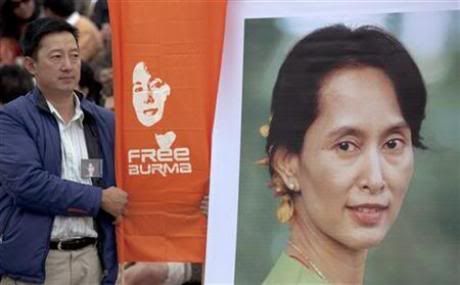
-Aug. 11: Activists holds a banner calling for the release of detained pro-democracy leader Aung San Suu Kyi outside the Burmese Embassy in Bangkok.-
European leaders sharply condemned the sentencing Tuesday of Burma's most prominent pro-democracy leader to an additional 18 months of house arrest.
Suu Kyi, the 64-year-old Nobel Peace laureate, has been in detention in Myanmar, also known as Burma, for 14 of the last 20 years, mostly under house arrest. She has now been ordered to serve an 18-month sentence for allowing an uninvited American to stay at her home.
British Prime Minister Gordon Brown decried what he called a "sham trial." Sweden, which holds the presidency of the European Union, promised tighter sanctions against Burma's leaders. Amnesty International's secretary general called the verdict "shameful."
Aung San Suu Kyi, head of Burma's National League for Democracy, was found guilty Tuesday of violating the conditions of her house arrest by allowing an uninvited American to stay at her home.
The U.S. man on trial in Myanmar alongside Aung San Suu Kyi was Monday night discharged from the hospital where he had been recovering from epileptic seizures, an official source said.
American John Yettaw's departure from Yangon General Hospital, where he spent a week undergoing treatment, means a verdict in Suu Kyi's court case could now go ahead on Tuesday morning as scheduled at Insein prison's court.
Diplomats and officials had said a judgment could be postponed once again if her co-defendant Yettaw - who sparked the case by swimming to her lakeside home in May - had remained hospitalized after suffering repeated epileptic fits.
But an official source confirmed to AFP on Monday night, on condition of anonymity, that Yettaw had been discharged from the city hospital, having been taken there from the prison a week ago.
Yettaw faces charges of abetting Suu Kyi's breach of security laws, immigration violations and a municipal charge of illegal swimming.Yettaw, 53, of Falcon, Mo., swam across a lake, entered Suu Kyi's home uninvited and asked to spend two nights before trying to secretly swim back. He told his lawyer that he swam to Suu Kyi's residence to warn her of an assassination attempt that he had seen in a vision.
The court sentenced him to three years in prison for breaching Suu Kyi's house arrest, three years in prison for an immigration violation and to another year for swimming in a restricted zone.
Yettaw was hospitalized last Monday after suffering seizures. He reportedly suffers from epilepsy, diabetes and other health problems, including post traumatic stress disorder from his service in the U.S. military.
The head of the military-ruled country ordered her to serve an additional 18-month sentence under house arrest. Suu Kyi, a 64-year-old Nobel Peace Prize, laureate has already been in detention for 14 of the last 20 years.
International criticism was swift in coming.
"This political trial had just one aim: to prevent Madame Aung San Suu Kyi from leading her fight in favor of a free and democratic Burma," he said in a statement issued in Paris.
Burma, also known as Burma, has been ruled by the military since 1962.
The current junta came to power in 1988 after crushing a pro-democracy uprising. Suu Kyi's party won 392 of 495 parliament seats in 1990 elections, but the military ignored the results. Suu Kyi became a symbol of Burma's suppressed democracy and was awarded the Nobel Peace Prize in 1991.
Irene Khan, Amnesty International's secretary general, said Suu Kyi had faced a maximum sentence of five years.
"The Burma authorities will hope that a sentence that is shorter than the maximum will be seen by the international community as an act of leniency," added Khan. "But it is not, and must not be seen as such."
She said Suu Kyi should never have been arrested in the first place.
For now, the 64-year-old Nobel Peace Prize laureate, arguably the world's most famous prisoner, will likely return to her daily meditation, listening to radio news broadcasts and waiting for the occasional censored mail, including letters from two sons she last saw a decade ago.
During her 86-day trial, diplomats and supporters were impressed by Suu Kyi's grace under pressure, rebuking those who called Yettaw a fool, sharing her birthday chocolate cake with prison guards and thanking envoys for their support.
------------
------------
VOA Burmese reporter Ronnie Nyane met John Yettaw's wife Betty Yettaw and police chief Richard Wrinkles to find out background and life of John William Yettaw, who secretly swam across the Inyar lake and got into pro-democracy leader Daw Aung San Suu Kyi's house, and currently being detained by the military regime in Burma.
------------
----------------
---------------
----------------