* Hillary Clinton 'prepared to mediate' in Falklands row
* Spanish oil company to drill near Falklands
U.S. secretary of state Hillary Clinton is due to meet with Argentina's president amid accusations of a snub to Britain over America's refusal to support the UK in the Falklands oil drilling row.
Mrs Clinton is to meet Cristina Ferndandez de Kirchner in Uruguay on March 1, Argentina's ambassador to the U.S. has announced.
Hopes are high in Argentina that Mrs Clinton will intervene on the country's behalf in the row with Britain over the disputed territory.
Respected Argentine newspaper La Nacion quoted State Department sources that claimed Mrs Clinton was 'prepared to mediate' in the row.
America's lack of support for Britain was last night blamed on the UK's decision to release sensitive U.S. intelligence on a terror suspect.
President Barack Obama was accused of being 'feeble' by failing to back London in the stand-off with Argentina over the disputed islands, despite the 'special relationship'.
Mrs Clinton and Mrs Kirchner are meeting in Uruguay as they attend the presidential inauguration there of José Mujica.
Argentina already has the support of Latin America and the Caribbean in the row with Britain, and regional leaders are expected to press the case with Mrs Clinton.
London and Buenos Aires are at odds over UK firm Desire Petroleum's decision to drill for oil 60 miles north of the Falklands.
Geologists estimate there are up to 60billion barrels of oil in the seabed.
The Argentine government has tabled a UN resolution condemning the plan. It has also secured backing from 32 South American nations supporting its claim that Britain has occupied the islands illegally since 1833.
But despite Argentina's sabrerattling, senior U.S. officials insist Washington's position on the oil drilling is neutral.
It is also 'taking no position' on the issue of sovereignty of the islands in the South Atlantic.
A senior MP and a respected foreign policy think-tank claimed Washington's stance was 'payback' for the British courts ordering the disclosure of secret CIA files on Binyam Mohamed.
Two weeks ago, the U.S. said it was 'deeply disappointed' that Foreign Secretary David Miliband had been told by Court of Appeal judges to publish closely-guarded information about the former Guantanamo Bay prisoner.
The papers detailed evidence showing MI5 knew that Mohamed, a British citizen, had been tortured by U.S. spies after he was detained in Pakistan in 2002.
This week the White House has refused to endorse the UK's historic sovereignty over the islands and its right to explore for oil in its waters.
Last night, the Henry Jackson Society, a London-based foreign affairs think-tank, said Mr Obama's stance was linked to anger at the release of the secret files.
Executive director Alan Mendoza said: 'The Obama administration's decision to ignore the democratic rights of the Falkland islanders is disgraceful.
'It can only be motivated by moral weakness in the White House or a misplaced desire to punish Britain for the Binyam Mohamed case and the disclosure of U.S. intelligence documents.
'The decision, while feeble, is unsurprising. For the past year, Mr Obama has followed a foreign policy path that punishes allies and democracies while allowing rogue authoritarian nations like Iran and North Korea to pursue their objectives.'
The criticism was echoed by Tory MP Patrick Mercer, the chairman of the Commons' terrorism sub-committee. 'The U.S. position on the Falklands certainly seems to be a warning shot which says to Britain: "Don't mess us around too much or we could make life problematic",' he said.
Last week, it was revealed that a conference to mark 60 years of UK and American defence intelligence sharing had been cancelled after the Mohamed judgment. It was to have been held at the U.S. Embassy in London.
Relations between the UK and U.S. nosedived last summer over the decision by the Scottish authorities to release the Lockerbie bomber Abdelbaset Al Megrahi back to Libya.
Yesterday it was revealed that a Spanish company is also set to begin drilling for oil near the Falklands.
Repsol is to start drilling by December some 200 miles off the Argentine coast - 'well within Argentine waters', a spokesman claimed.
Last year, Repsol bought Argentine company YPF - the biggest private oil and gas company in Latin America.
The spokesman told the BBC it will be exploring a 'few' wells some 150 miles from where the Ocean Guardian is drilling.
In 1982, 255 British and 649 Argentine soldiers died when Britain took military action to recover the islands after the Argentine invasion.
Yesterday General Sir Peter de la Billiere, a former UK commander who is vice president of the Falkland Islands Association, issued a 'hands-off' warning to Argentina.
He said the country would suffer the 'most unbearable losses' if it followed up the diplomatic skirmishes with military action.
Sir Peter said: 'We have demonstrated our intention to fulfil the islanders' wishes and support them if they are threatened.
'I can see no reason or justification or political will in the UK to do anything other than that.
'We did not lay down 255 lives just to give up and walk out a few years later.'
Last night, a Foreign Office spokesman denied there was a link between the U.S. position on the Falklands and the Mohamed case.
Argentina's accusations over the Falklands have been compared to 'the case of the lost girlfriend'.
'Argentina lost its girlfriend, and now she is going out with somebody else,' Federico Mac Dougall, an economist and political analyst at the University of Belgrano in Buenos Aires, told the New York Times..
He added: 'And together they may very well strike it rich with oil.'
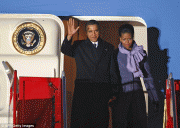
Lack of support: Barack Obama and his wife Michelle at a ceremony at the White House last night. America has not offered its support to the UK in the Falklands oil drilling row
High hopes: U.S. secretary of state Hillary Clinton, left, is due to meet with Argentine president Cristina Fernandez de Kirchner, right, in Uruguay on March 1
The row between Argentina and Britain centres on the Ocean Guardian, which is drilling for oil off the Falkland Islands
Flashback: In 1982, 255 British and 649 Argentine soldiers died when Britain took military action to recover the islands after the Argentine invasion
Sticking point: The British decision to release intelligence information regarding the torture of Binyam Mohammed, above, is said to be behind America's lack of support for the UK
Argentina's rocky relationship with Obama
Relations between Buenos Aires and Washington since Barack Obama came to power have been less than 'special'.
Argentine president Cristina Fernandez de Kirchner is said to be in Mr Obama's bad books after refusing to meet with the U.S. assistant secretary of state for the region, Arthur Valenzuela, in December of last year.
She is also the only major Latin American leader not to have met with the U.S. president since he came to power.
However hopes are high in Argentina for her meeting with Hillary Clinton in Uruguay next week.
Repealing the policy against openly gay men and lesbians in the military "would be the right thing to do," the nation's top uniformed officer said Tuesday.
Defense Secretary Robert Gates, left, and Joint Chiefs Chairman Adm. Michael Mullen, arrive on Capitol Hill on Tuesday to testify before a Senate Armed Services Committee hearing related to the "Don't Ask, Don't Tell" policy.
However, eliminating the current "don't ask, don't tell" policy will cause "some disruption in the force," Adm. Michael Mullen, chairman of the Joint Chiefs of Staff, told the Senate Armed Services Committee.
"I cannot escape being troubled by the fact that we have in place a policy which forces young men and women to lie about who they are in order to defend their fellow citizens," Mullen said.
Defense Secretary Robert Gates told the panel that he "fully supports" President Obama's decision to work with Congress to end the policy.
Several committee Republicans, led by the ranking member, Sen. John McCain of Arizona, said they were disappointed with Obama's decision and supported retaining the "don't ask, don't tell" policy. Committee Chairman Carl Levin, D-Mich., praised Mullen's personal endorsement for lifting the ban as a "profile in leadership."
McCain said, "At this moment of immense hardship for our armed services, we should not be seeking to overturn the 'don't ask, don't tell' policy."
Gates told senators the military would need nearly a year to study how it would allow gay men and lesbians to serve openly.
Pentagon general counsel Jeh Johnson and Gen. Carter Ham, commander of Army forces in Europe, will lead the group studying troops' feelings about lifting the ban on gays serving openly in the military, Gates said.
Ham, an Iraq veteran, is rare among high-ranking military officers in talking about his experiences with combat stress. In November 2008, he told USA TODAY how he struggled to cope with a 2004 attack in Mosul that killed 22 people, including 14 U.S. troops.
"That there will be some disruption in the force I cannot deny," Mullen said of lifting the ban. "That there will be legal, social and perhaps even infrastructure changes to be made certainly seem plausible."
He also cautioned that military commanders worry about the current war stress on troops and their families. "We need to move forward (with changing policy on sexual orientation) in a manner that does not add to that stress."
Mullen is the first sitting chairman of the Joint Chiefs of Staff to advocate repeal of "don't ask, don't tell," according to a statement from his office.
The policy bans openly gay people from serving in the military but also says that military officers should not ask members of the military about their sexual orientation if they are not engaging in prohibited behavior. The policy was created in 1993 after President Clinton sought to allow openly gay people to serve. Overall, records show, more than 10,900 servicemembers have been dismissed under the policy.
Mullen said allowing lesbians and gay men to serve openly is "an issue of integrity — theirs as individuals and ours as an institution. ... I also believe the great young men and women of our military can and would accommodate such a change."
The Falcon 1 rocket was created by company Space X, founded by PayPal co-founder Elon Musk. It launched a satellite into orbit. Private companies such as this could take over launching astronauts into space from Nasa
Farewell Orion? The Contellation space programme looks set to be scrapped. There had been plans to use the Orion module to ferry astronauts to the ISS, like in this artist's impression
Shuttle Atlantis crew member Randolph Bresnik works on the space station. New plans call for commercial firms to resupply the station.
Astronaut Buzz Aldrin is pictured on the Moon in 1969. It seems certain that Nasa's plan to return Man to the moon by 2020 will be scrapped
American dreams of putting another man on the Moon were dashed last night as President Obama announced a spending freeze to help combat a £1trillion U.S. budget deficit.
Nasa's plan to launch a series of new manned Moon missions was one of 120 government-funded programmes to be shelved.
The Constellation Project, started by former President George W Bush, was supposed to restore America's reputation as a pioneer in human exploration and anticipated landings on Mars by the middle of the century.
It envisaged new rockets and a new crewship called Orion to put astronauts on the lunar surface by 2020. Nasa had already spent $9.1 billion (£5billion) on the programme. The space agency will have to spend a further $2.5bn to close it completely.
But the White House said Constellation was too much like the 1960s Apollo mission and would require large budget increases just to get astronauts back on the moon by 2030.
The writing was on the wall for the space revival after Nasa announced last autumn that 'no plan compatible with the 2010 budget profile permitted human exploration to continue in any meaningful way'.
The Obama administration is hoping that private enterprise will step in to fund the Moon mission.
However, one congressman said the plan was a 'death march' for human space flight.
Unveiling his budget for next year, the president blamed the record debt on inheriting two costly wars and a financial crisis he was forced to combat with hundreds of billions of taxpayer cash.
Mr Obama said the U.S. must stop spending cash 'like Monopoly money' if it is going to bridge the growing budget gap.
He insisted his budget, which includes tax rises for the wealthy, will cut into the deficit over the next decade.
We simply cannot continue to spend as if deficits don't have consequences, as if waste doesn't matter, as if the hard-earned tax dollars of the American people can be treated like Monopoly money,' he said yesterday.
'We won't be able to bring down this deficit overnight,' he added, saying the budget included boosts for education and job creation programmes.
The projected deficit amounts to almost 11 per cent of America's gross domestic product, nearly four times the annual deficit that economists generally consider sustainable.
Republican critics seized on the grim forecast. Senator Judd Gregg, who sits on the Senate Budget Committee, said the U.S. was sinking into a 'quagmire' of debt.
President Obama outlined a dramatic new mission for NASA on Monday, getting the agency out of the rocket-launching business in favor of an aggressive expansion of research and development that would steer the agency away from the launch pad and instead put its engineers in the laboratory, where they would design futuristic vehicles capable of going beyond the moon.
As expected, his budget plan would cancel NASA's Constellation program and its goal of returning astronauts to the moon by 2020. The troubled rocket program, crippled by funding shortfalls and technical problems, ultimately would cost taxpayers at least $11.5 billion as it is, including $2.5 billion to terminate it.
Instead of pursuing Constellation, NASA would pay for commercial rocket companies to resupply the International Space Station over the next decade while its own workers develop new engines and rockets that NASA officials hope will enable a vast expansion of its future manned-space efforts.
"Imagine trips to Mars that take weeks instead of nearly a year, people fanning out across the inner solar system, exploring the moon, asteroids and Mars nearly simultaneously in a steady stream of firsts," said NASA Administrator Charlie Bolden.
It would be a decade or more, however, before NASA again sends astronauts beyond low-Earth orbit, a prospect that is certain to draw strong opposition from NASA's defenders in Congress.
One, Sen. Richard C. Shelby (R-Ala.), called the budget a "death march" for American spaceflight.
Bolden said ending Constellation was necessary to ensure NASA had the money to spend nearly $11 billion over the next five years on new technologies, including $3.1 billion to develop heavy-lift rockets that could carry new spacecraft beyond Earth orbit.
Currently, he said, the 5-year-old Constellation program is burning through billions of dollars and falling further behind schedule. The program couldn't get American astronauts back to the moon until at least 2028, he said.
"So as much as we would not like it to be the case . . . the truth is that we were not on a path to get back to the moon's surface," Bolden said.
"And as we focused so much of our effort and funding on just getting to the moon, we were neglecting investments . . . required to go beyond."
Obama's plan calls for NASA to get $19 billion in 2011 -- about $300 million more than this year's budget -- with small annual increases after that.
Hamid Karzai and Gordon Brown in Downing Street this morning.Hamid warn that Afganishtan require 15 years of help to recover and rebuild.
The Taliban have been unmoved by talk of peace overtures . Said it is war mongers meeting to deceive and continue to occupy Afganisthan.
Security, reconciliation and withdrawal of foreign forces by 2015 were key policy announcements
Whether Taliban would accept an invitation to a 'peace jirga' is a mute point.
The Afghan Taliban on Thursday dismissed the London conference on Afghanistan as a propaganda ploy and said the summit will fail to produce results, the SITE monitoring service reported.
"The war-mongering rulers under the leadership of (US President Barack) Obama and (British Prime Minister Gordon) Brown want to deceive the people of the world by holding the London conference to show that people still support them," SITE quoted an Internet statement as saying.
If the decision is taken to "once again try to prolong the military, economic, cultural and political occupation of (Afghanistan), this conference will be a mere eye-wish like other conferences."
The London conference, which aims to chart the way forward in Afghanistan, opened on Thursday with nearly 70 countries and organisations taking part.
The Taliban must deny sanctuary to Osama bin Laden before Saudi Arabia will agree to act as a mediator in any Afghan peace deal, the kingdom's foreign minister said on Thursday.
Prince Saud al-Faisal was responding to Afghan President Hamid Karzai who had called on Saudi Arabia, which has hosted talks between Afghan government and Taliban representatives in the past, to help bring peace to Afghanistan.
"Unless the Taliban give up the issue of sanctuary (to bin Laden) I don't think the negotiations with them will be possible or feasible to achieve anything," Prince Saud told reporters on the sidelines of a London conference.
"We have two conditions for Saudi Arabia's involvement: that the request comes officially from Afghanistan and the Taliban has to prove its intentions in coming to the negotiations by cutting their relations with the terrorists and proving it," he said.
"By keeping their contacts with bin Laden they won't be coming to any negotiations with a positive attitude.
POLICY CHANGE
Saudi Arabia froze ties with the Taliban in 1998 over the group's refusal to hand over bin Laden, who had been stripped of his Saudi citizenship for militant attacks in the oil-producing kingdom and activities against the al-Saud royal family.
"I think the important theme in this conference is the intention to change policy in Afghanistan, a recognition first that the settlement in Afghanistan is not going to be a military question alone but there has to be a political and economic side to the settlement," Prince Saud said.
"If peace is brought between Afghans and the terrorists are isolated then the war against the terrorists would be successful," he added.
The United States has insisted that insurgents can only be included in a political settlement if they sever all ties with al Qaeda, renounce violence and respect the Afghan constitution.
Karzai said that Afghanistan needed the support of its neighbours, particularly Pakistan, to secure peace.
Pakistan, Saudi Arabia and the United Arab Emirates were the only three countries to recognise the Taliban government before it was ousted in the U.S.-led invasion in 2001.
Asked whether Saudi Arabia shares the concern of the West and other allies that Iran's nuclear programme is aimed at building an atomic bomb and not for creating electricity as Tehran claims, Prince Saud said:
"If they are working on a peaceful nuclear programme they certainly have a strange way of showing it. All the countries that are working on a peaceful programme are not acting like Iran.
"There is one sure way of stopping that, that is to take a decision at the Security Council that no weapons of mass destruction, nuclear or otherwise will be allowed in the Middle East and that includes Israel."
Control over some of Afghanistan's provinces is to be handed over to the Afghan government by the end of 2010, according to foreign ministers attending a one-day international conference in London.
UK Foreign Minister David Miliband said on Thursday that 2010 was a "decisive" year because a new government was in place, adding that security of all provinces would be under Afghanistan leadership within five years.
Miliband also announced a new fund to allow the Afghan government to woo Taliban fighters away from the conflict.
"Today alone there have been over 140 million dollars worth of commitments for the first year of the national reintegration programme and we are committed to seeing that through," Miliband said.
In a communique published at the end of the conference that was attended by delegates from 70 countries, support was also offered for the continued growth and expansion of the Afghan National Army and police force.
Delegates agreed a target of recruiting some 171,600 soldiers and 134,000 police officers by October 2011.
But Hillary Clinton, the US secretary of state, said that plans to gradually transfer Afghan security from international to domestic forces was "not an exit strategy".
"We . . . support the NATO transition plan," Clinton said. "But I want to make clear - to Afghans, to our partners, to our citizens, and to the extremists who hope for our failure: This is not an exit strategy."
Taliban reaction
Taliban dismissed the London conference as a propaganda ploy, saying the summit would fail to produce results, according to the AFP news agency, quoting an internet statement.
"The war-mongering rulers under the leadership of [US President Barack]Obama and [British Prime Minister Gordon] Brown want to deceive the people of the world by holding the London conference to show that people still support them".
If the decision is taken to "once again try to prolong the military, economic, cultural and political occupation of [Afghanistan], this conference will be mere wishful thinking like other conferences."
The statement also dismissed a plan by Hamid Karzai, the Afghan president, to woo Taliban moderates with offers of money and jobs.
"They announce that they will provide money, employment and opportunity to have a comfortable life abroad for those mujahedeen who agree to part ways with jihad," the statement said.
"This is baseless and futile," it said. "Had the aim of the mujahedeen of the Islamic Emirate been obtainment of material goals, they would accept dominance of the invaders in the first place."
Presidential view
Earlier on Thursday, Karzai said that his country must reach out to its "disenchanted brothers" in an effort to stabilise the war ravaged nation, saying fighters who are "not part of al-Qaeda or other terror groups" must be reconciled with the government.
The Afghan leader said his government would set up a national council for peace and reconciliation, and has asked Saudi Arabia to help guide the process.
Karzai was seeking support for a $1 billion plan that would offer cash, jobs and other incentives to the Taliban and fighters in other armed groups, in an attempt to bring them back into mainstream society.
Taliban fighters have also been invited to a "peace jirga", or a traditional gathering of tribal elders, expected to be held early this year, a government spokesman confirmed.
Saudi role?
Hamid Elmi, Karzai's deputy spokesman, said: "We are using all kinds of possibilities - our neighbouring countries, the international community, the king of Saudi - to encourage the Taliban to come".
However, Saudi Arabia said on Thursday that it would only take part in Afghan peace efforts if the Taliban denies sanctuary to Osama bin Laden, the al-Qaeda leader, according to the kingdom's foreign minister.
"Unless the Taliban give up the issue of sanctuary (to bin Laden) I don't think the negotiations with them will be possible or feasible to achieve anything," Prince Saud al-Faisal told reporters on the sidelines of a London conference.
"We have two conditions: that the request comes officially from Afghanistan and the Taliban has to prove its intentions in coming to the negotiations by cutting their relations with the terrorists and proving it."
But Haroun Mir, deputy director for the centre for research and policy studies in Kabul, told Al Jazeera that Karzai's proposal could be hampered by plans to increase the number of foreign troops in Afghanistan.
"Karzai has been talking for a long time for reaching out to the Taliban.
"But ... the US military surge and additional Nato forces in Afghanistan in the coming months [will see] the intensity of fighting increase.
"I don't know how president Karzai could implement his own strategy of reaching out to the Taliban if there is increased fighting going on in Afghanistan," he said.
Secret talks
And Abdullah Abdullah, the presidential candidate who withdrew from last August's fraudulent elections, said obstacles remain to implementing such a policy.
"I don't think the Taliban at this stage are willing to enter negotiations. Also, their association with terrorist organisations, like al-Qaeda - that's the main issue at the moment - and they are working like one organisation."
Thursday's conference comes nearly a week after a meeting between Afghan government officials and members of an armed opposition group fighting alongside the Taliban.
Al Jazeera's David Chater, reporting from Kabul, said the talks were held with the group Hezb-e-Islami, in the Maldives islands, between January 23-24.
He said a Taliban leader had been due to attend the meeting but dropped out in the last minute citing health reasons.
President Karzai of Afghanistan warned today that his country's security forces would require another 15 years of Western support before they are able to sustain themselves.
Ahead of the opening of the London Conference on Afghanistan, Mr Karzai told the BBC that he foresaw a gradual reduction in support over a lengthy timeframe.
“With regard to training and equipping the Afghan security forces, five to 10 years will be enough,” he said. “With regard to sustaining them until Afghanistan is financially able to provide for our forces, the time will be extended to 10 to 15 years.”
His comments were at odds with the tone of Gordon Brown’s opening address to the conference, which sought to stress a timeframe of less than a year until Western forces begin a transition of responsibility to their Afghan counterparts.
The Communique that will end the conference, a document already leaked to The Times, forsees a gradual transfer starting late this year or early next in the more benign provinces. Afghan forces will be in the lead of the majority of provinces within three years and overall control will pass to Afghan forces within five years.
Concurrent with the military surge, led by 30,000 new US troops, the Prime Minister set out details to leaders from more than 60 countries of a complementary “civilian and political surge” that will include a drive to reconcile and reintegrate Taliban fighters.
After a bloody year for Nato forces in Afghanistan, during which 520 troops died including 108 from Britain, Mr Brown told delegates: “By the middle of next year, we have to turn the tide in the fight against the insurgency.”
Standing alongside Mr Karzai, the Prime Minister went on to detail plans that Western leaders hope will lead to the reintegration of what the Afghan President called the “disenchanted brothers” of the Taleban.
The Prime Minister detailed a new £500million fund that is to offer inducements to Taleban fighters who promise to lay down their arms and sever their ties with Al-Qaeda and other terrorist networks.
The exact nature of the proposed engagement remains unclear, with Afghan officials and some British officials appearing to push a more conciliatory line than is coming from Washington.
Speaking at the start of the conference President Karzai told leaders that he wished to “reach out to all” and asked that the Saudi leader King Abdullah act as an intermediary in a process of engagement with the Taleban leadership. Saudi Arabia, one of only three countries to recognise the original Taleban government, has played a discreet role in previous unofficial talks between the Karzai government and representatives of the Taleban
The Pentagon spokesman Geoff Morrell said yesterday that any reconciliation with the Taleban leader Mullah Mohammad Omar was "probably a bridge too far" after he gave safe haven to al-Qaeda to launch the September 11, 2001, attacks on the United States.
"He has the blood of thousands of Americans on his hands," he told reporters in Washington.
But Mark Sedwill, the former British Ambassador and newly appointed Nato civilian representative in Afghanistan, suggested that talks with the Taleban would inevitably lead to engagement with “unsavoury characters.”
"If we are going to bring conflicts like Afghanistan, civil conflicts, to an end, that means some pretty unsavoury characters have to be brought within the system," he said.
The Taleban has been dismissive of suggestions that fighters can be “bought” by the new plan and today restated on its website that the withdrawal of Western forces is a precondition to any negotiation with the leadership. However, the insurgent movement has been careful in recent months to distance itself from Al-Qaeda’s agenda stressing that it poses “no threat to the West”.
Among the measures that are to accompany the reconciliation drive as part of a concurrent “civilian surge” in Afghanistan are plans for a new training programme for some 12,000 Afghan bureaucrats, a key deficiency in a country beset by both literacy rates of less than 30 per cent and endemic corruption. Agriculture, the mainstay of the Afghan economy, is to receive another £72 million from the British taxpayer.
As the West tries to accelerate a transition to Afghan control that will provide an ultimate exit strategy, Mr Brown said that the proportion of development money channelled through the Afghan government is to be increased to 50 per cent of the total, a move matched by Afghan government commitments to clamp down on endemic corruption. The International Monitory Fund and the World Bank are to announce further debt relief for Afghanistan totalling $1.6 billion.
British police training and mentoring teams are to be doubled from April, Mr Brown said, as part of an international effort to build Afghan forces that will see the Afghan Army expanded from 134,000 this October to 171,600 by October 2011. The Afghan police are to grow in number from 109,000 in October to 134,000 by October 2011.
Global reach: Obama's first State of the Union address was watched by millions of TV viewers around the world
Oh please, sit down: But the First Lady appears slightly embarrassed as she's given a standing ovation
Mrs Obama and Kimberly Munley wave to the crowd during the address. Officer Munley, a 34-year-old mother of two, became an instant hero when she opened fire on the Fort Hood gunman during his shooting rampage at the Army base last November.Support: Michelle Obama is praised for her health initiatives in her husband's speech
Haitian Ambassador to the U.S. Raymond Joseph kisses Mrs Obama's hands as (left to right) Mark Alan Todd, acting police chief of Fort Hood, Texas; Kimberly Munley, Federal police officer from Fort Hood, Texas and Rebecca Kner, wife of Captain II Joseph Knerr of the Virginia Task Force 1 currently serving in Haiti, look on
People's man: Flanked by security, Obama signs an autograph for fan after delivering his address
Stone-faced: Republican senators (left to right) Lindsey Graham, John McCain and Charles Grassley listen to Obama's address
'I don't quit': While admitting that his administration 'deserved' the setbacks, Obama vowed not to give up on his dreams
Contemplation: Amid the roar of applause and mobbed by his colleagues, Obama seems to have quiet moment
Prepared: The president spoke for about one hour
Packed house: The president speaks to the divided congress in Washington
Positive: President Barack Obama delivers his first State of the Union address and makes a commitment to job growth
*
'I hear you, America': Obama makes job creation top priority - not health care
*
Standing ovation for Michelle Obama on her health initiatives
*
President pledges to double American exports, creating two million jobs
*
Obama flags tax credits for childcare and more aid for people with student loans
In an extraordinary admission, Barack Obama said last night that his administration ‘deserved’ the setbacks it suffered during his first year in the White House.
But the embattled president insisted he would not give up on his dreams, vowing: 'I don’t quit.’
The rare moment of candour from a sitting president came as Mr Obama tried to win over an increasingly sceptical American public in his first State of the Union address.‘Change has not come fast enough,’ he acknowledged in a long and wide-ranging speech before a packed joint session of US Congress and a prime time audience of millions.
He said he accepted ‘my share of the blame’ for not adequately explaining his plans to the public.
And, coming in the wake of last week’s humbling defeat to the Republicans in a special election to replace the late Democrat Senator Edward Kennedy, Mr Obama didn’t try and gloss over criticism he has faced over his health care reforms and heavy spending on economic bail out plans.
Our administration has had some political setbacks this year,’ he said, ‘and some of them were well-deserved.’
‘I campaigned on the promise of change – ‘change we can believe in,’ the slogan went.’ And right now, I know that there are many Americans who aren’t sure if they still believe we can change, or at least that I can deliver it.
‘But remember this,’ he added. ‘I never suggested that change would be easy, or that I can do it alone.
He chided both political parties for the partisan bickering that has dogged his efforts to make good on many of his campaign promises.
‘Let’s try common sense,’ he said, adding that leaders in Washington face a ‘deficit of trust.’
Positioning himself as a champion of the middle class, Mr Obama adopted a relaxed tone at times, joking at one point that the bank bail out was ‘about as popular as root canal.’
He also kept watching wife Michelle happy by earning her two standing ovations with praise for her health initiatives.
But the majority of his 70-minute speech concentrated on the very serious subjects of jobs and the economy.
There were no sweeping new initiatives, but Mr Obama sought to repackage his existing priorities, such as health care reforms and clean energy legislation, by promoting their beneficial impact on creating new jobs.
Critics saw last week’s Senate seat defeat as a referendum on the administration’s health care overhaul, but – while it did take him more than 20 minutes to broach the subject – the president insisted he was not giving up the fight.
He appealed to lawmakers to take another look at the controversial plan to offer government-run alternatives to the private health insurers that dominate the American health system.
‘Do not walk away from reform,’ he appealed to Republicans. 'Not now. Not when we are so close. Let’s find a way to come together and finish the job for the American people.’
But he was quickly back to the overriding theme of his speech, which sought to find the populist groove missing since hjs campaign days.
‘Jobs must be our number one focus in 2010. People are out of work. They are hurting. They need our help,’ he said.
'I do not accept second-place for the United States of America. As hard as it may be, as uncomfortable and contentious as the debates may be, it's time to get serious about fixing the problems that are hampering our growth.'
Mr Obama compared the U.S. to other nations: 'Washington has been telling us to wait for decades, even as the problems have grown worse. Meanwhile, China's not waiting to revamp its economy. Germany's not waiting. India's not waiting.'
He set a goal of doubling exports over the next five years, an increase he claimed would create two million jobs and, as he promised earlier in the week, he proposed a series of programmes aimed at helping improve the lot of America’s disgruntled middle class.
They included doubling tax credits for childcare and more aid for people struggling with student loans.
Mr Obama looked to change the conversation from how his presidency is stalling — over the messy health care debate, a limping economy and the missteps that led to Christmas Day's barely averted terrorist disaster — to how he is seizing the reins.
He spoke to a nation gloomy over double-digit unemployment and federal deficits soaring to almost £1 trillion, and to fellow Democrats dispirited about the fallen standing of a president they hoped would carry them through this autumn's midterm elections.
Republicans applauded the president when he entered the chamber, and even craned their necks and welcomed Michelle Obama when she took her seat. But the warm feelings of bipartisanship disappeared early.
Democrats jumped to their feet and roared when Mr Obama said he wanted to impose a new fee on banks, while Republicans sat stone-faced. Democrats stood and applauded when Mr Obama mentioned the economic stimulus package passed last February. Republicans just stared.
On national security, the president proclaimed some success, saying that ‘far more’ al Qaeda terrorists were killed under his watch last year than in 2008.
Hoping to salve growing disappointment in a key constituency, Mr Obama said he would work with Congress ‘this year’ to repeal the ban on gays and lesbians serving openly in the military.
But in a concession to concern about the move among Republicans and on his own party's right flank, Mr Obama neither made a commitment to suspend the practice in the interim nor issued a firm deadline for action.
Declaring that ‘I know the anxieties’ of Americans' struggling to pay the bills while big banks get bailouts and bonuses, Mr Obama prodded Congress to enact a second stimulus package ‘without delay,’ specifying it should contain a range of measures to help small businesses and funding for infrastructure projects.
Acknowledging frustration at the government's habit of spending more than it has, he said he would veto any bills that do not adhere to his demand for a three-year freeze on some domestic
In the Republican response to Mr Obama's speech, Virginia Governor Bob McDonnell showed no sign of his party capitulating to the president.
In fact, the choice of McDonnell to represent Republicans was symbolic, meant to showcase recent election victories by him and others.
In a remarkable shift from past addresses, and notable for a president whose candidacy first caught fire over Iraq war opposition, foreign policy took a relative back seat. It came behind the economy and was largely devoid of new policy.
And Mr Obama made no mention of three of the toughest challenges he faced in his first year: failing to close the terrorist prison compound at Guantanamo Bay, Cuba, failing to get Israel and the Palestinians to resume peace negotiations, and struggling with the al Qaeda havens in Pakistan that are at the core of the terrorist threat to America.
The president is keeping to the tradition of taking his themes on the road.
He will travel to Florida today to announce £5 billion in grants for high-speed rail development, to Maryland tomorrow to a House Republican retreat, and to New Hampshire next Tuesday to talk about job creation.
Citing a "deficit of trust" in government by the American people, President Obama's first State of the Union address urged Congress to erode the influence of special interests and work together to confront the nation's most pressing problems.
In the nationally televised speech Wednesday night to a joint session of Congress, Obama sought to reassure Americans angry and nervous about the pace of economic recovery that his government understands the challenges and would act boldly to meet them.
Obama called for a new political climate of "common sense" approaches that invest in the American people without building "a mountain of debt."
"We have to recognize that we face more than a deficit of dollars right now. We face a deficit of trust -- deep and corrosive doubts about how Washington works that have been growing for years," Obama said.
Key areas where Obama wants to build that trust include: the economy, education, energy, health care and national security.
Democrats applauded the remarks of their party's leader."He outlined a road map that, if followed with bipartisan support in Congress, can reduce our deficit, rebuild our economy and create a new foundation of prosperity for American families and businesses," said Sen. Tom Harkin, D-Iowa.
"It was a serious speech -- reached out to Republicans," said Rep. Steny Hoyer, D-Maryland, the House majority leader.
Republicans, however, were skeptical of Obama's ability to change the partisan atmosphere in Washington.
"Real bipartisanship requires more than just lip service; it demands both sides coming together in a real and meaningful way. It's time for the administration to abandon this big-government agenda and start working in a meaningful way with Republicans to find common-sense solutions to move the country forward," said Sen. Orrin Hatch, R-Utah.
"I would have liked to have seen him emphasize reaching out to the other side of the aisle and bringing us together," said Sen. George Voinovich, R-Ohio.
Analysts, too, were mixed in their reactions to what Obama had to say Wednesday night.
CNN political contributor John Avlon said Obama was targeting independents with his remarks, but questioned his success.
"They still hear The Who's 'Won't Get Fooled Again' in the back of their minds," Avlon said.
Democratic strategist James Carville said Obama made progress. "He picked up a first down tonight," Carville said.
And a post-speech opinion poll shows a divided public.
A CNN/Opinion Research Corp. survey indicated that 48 percent of speech watchers had a very positive reaction, with three in 10 saying they had a somewhat positive response and 21 percent with a negative response.
The 48 percent who indicated they had a very positive response is down 20 points from the 68 percent of speech watchers who felt the same way a year ago about the president's February 24 primetime address to a joint session of Congress.
"Wednesday night's State of the Union audience is more Democratic than the nation as a whole, but speech-watchers were less Democratic this year than they were last year," said Keating Holland, CNN polling director. "That may be one reason why the number who gave his speech a 'very positive' rating is lower this year. But part of the reason also may be that speech-watchers didn't necessarily hear a new agenda and aren't confident that the president can improve health care or lower the deficit."
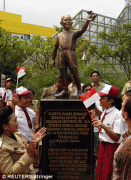
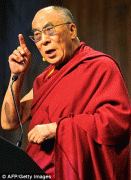
Tribute: A bronze statue of the US President as a boy was unveiled in Jakarta today (left). Obama lived in the region as a boy. Meanwhile, the Dalai Lama (right) believes the decision to award the President with the Nobel Peace Prize is 'a little early'
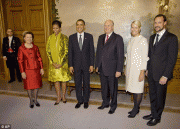
Ceremonial: Obama and his wife pose with, from left: Queen Sonja of Norway, King Harald of Norway, Crown Princess Mette-Marit of Norway and Crown Prince Haakon of Norway
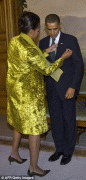
Straighten up: Mrs Obama straightens her husband's lapels ahead of the ceremony Honour: New Nobel Peace Prize laureate Obama and his First Lady Michelle arrive for the ceremony in Oslo's City Hall
Controversy: The President's accolade comes days after he announced he was sending 30,000 more US troops to Afghanistan
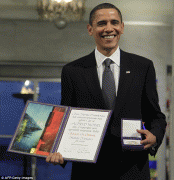
Accolade: Barack Obama accepts the Nobel Peace Prize in Oslo today
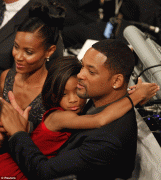
Rapt: Will and Jada Smith hung onto the President's every word, but daughter Willow seemed to be getting weary
Faces in the crowd: Hollywood actor Will Smith with his wife Jada and their daughter Willow cheered on their President
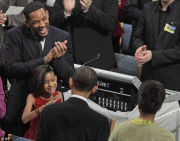
Alert again: The little girl perked up as she met Obama following his speech
Jetting in: The Obamas arrive at Oslo International Airport this morning
Ceremony: The President takes part in a Nobel Peace Prize signing event in Oslo today
President Obama turned the Nobel Peace Prize ceremony today into a professorial address on why and when the United States was prepared to use force. There was, he admitted in the Oslo City Hall, some controversy over granting the ultimate peace accolade to the commander-in-chief of an army that was engaged in two wars.
The audience, a strange hotchpotch of Hollywood celebrities, pale Scandinavian politicians and rural Norwegians in folk costume, shifted uneasily when he talked about the necessity for bloodshed. Although the Nobel prize was established by the inventor of dynamite its laureates try to avoid dwelling on death.
“Some will kill,” Mr Obama said of the US soldiers under his command. “Some will be killed.”
He was intent on using the Nobel speech to discuss the costs of armed conflict and to examine “the relationship between war and peace, and our effort to replace one with the other”.
For all of his initial tension, his unusually uncoordinated movements, Mr Obama ended up more at ease in the City Hall than when he gave his other “meaning of war” speech to West Point cadets earlier this month. On that occasion, he struggled to find the language to persuade future officers that bearing arms in Afghanistan was a good cause. At the Nobel ceremony his task was simpler: to convince his huge television audience that the US was committed to multilateralism, to strengthening the United Nations and to nuclear disarmament; and that this was not a sign of weak resolve. The White House was not being governed by a pro-European patsy.
“It is also incumbent on all of us to insist that nations like Iran and North Korea do not game the system,” he said, making clear that he wanted international co-operation on stricter sanctions. “Those who claim to respect international law cannot avert their eyes when those laws are flouted. Those who care for their own security cannot ignore the danger of an arms race in the Middle East or East Asia.”
Mr Obama was on familiar terrain: in the land of rules. The Nordic audience clearly lapped it up and by the end of the day had almost forgiven him for snubbing King Harald by avoiding the traditional Nobel salmon lunch with the monarch. Wanting to avoid any sign of premature triumphalism, the White House had shrunk a ceremony that normally stretches to three days into a crisp 24 hours.
There is a pre-Christmas coziness to the Peace prize; it is chosen by five former politicians, often befriended, sometimes neighbours. This year the committee was chaired by the former Labour Prime Minister Thorbjøorn Jagland, and four women, the majority of whom had strong leftist credentials and a determination to reward the United States for shedding the legacy of President Bush. That fact that they were considering Mr Obama’s name as early as February was irrelevant. What counted was character, intention, a commitment to dialogue — and a rapid de-Bushisation of transatlantic relations. That was enough for the Nobel judges but it left Mr Obama beached, having to de-code and justify why he had accepted a prize that he had not yet earned.
Hence the truncated visit. A year’s worth of Norwegian social life crammed into a single white-tie banquet. Ms Obama had packed a dancing gown but the word was that there would be no serious waltzing on a day when her husband wanted to demonstrate his commitment to the seriousness of war.
“We can understand that there will be war and still strive for peace,” he said, thus parrying the critics who had pointed to the irony of the peace prize being handed to the architect of a future military surge in Afghanistan. The intellectual core of the speech was dedicated to setting out under what circumstances a war could be considered just, and what had to be done to create a stable rather than illusory peace. It was now essential, he said, to think deeply about the conduct of war. That was why, he said, he had started to close down Guantánamo Bay prison. “We lose ourselves when we compromise the very ideals that we fight to defend,” he said, earning applause and very un-Nobellian whoop from the Hollywood benches.
Kristian Berg Harpviken, the head of the International Peace Research Institute in Oslo, told The Times: “There seems to be a reassessment underway as to how wars should be fought.”
Mr Obama seemingly wishes to develop the ideas about humane warfare that were first mooted during the war in Kosovo. “But there are problems,” said Dr Harpviken. “What is left of our protective mission if large numbers of civilians get killed? And is the price of avoiding US troop casualties, the greater exposure of Afghan soldiers?”
Mr Obama frequently referred to civilian losses in his speech, and he stressed that humanitarian intervention remained a justification for force. “Inaction tears at our conscience and can lead to more costly intervention later.” As he prepared for his Nobel banquet, about 6,000 demonstrators gathered close to the venerable 19th century Grand Hotel taken over by the White House.
What was striking was the fact that war protesters were outnumbered by climate change protesters. That balance might have been the result of watching Mr Obama on one of the large scale screens in the Norwegian capital. Or it might have been the eerie bright shining light that glowed over parts of the country just ahead of his visit. Not a UFO apparently, despite tabloid reporting, but probably a Russian rocket releasing fuel into the atmosphere. Whatever the cause, it seemed to make Norwegians more receptive to a finely tuned lecture on threat and opportunity, on war and peace.
Barack Obama was today awarded with the Nobel Peace Prize – just nine days after pledging to send 30,000 more US troops into war in Afghanistan.
In his acceptance speech, the President acknowledged the ‘hard truth’ that violent conflict won’t be eradicated ‘in our lifetimes’, and appealed to the international community to help him ‘reach for the world that ought to be.’
Of the controversy surrounding his prize, Obama reminded the audience he was ‘only at the start of my labours on the world stage.’
He added: ‘But perhaps the most profound issue surrounding my receipt of this prize is the fact that I am the Commander-in-Chief of a nation in the midst of two wars.
‘…I am responsible for the deployment of thousands of young Americans to battle in a distant land. Some will kill. Some will be killed.
‘And so I come here with an acute sense of the cost of armed conflict - filled with difficult questions about the relationship between war and peace, and our effort to replace one with the other.’
'I face the world as it is,' Obama said, refusing to renounce war for his nation or under his leadership, saying that he is obliged to protect and defend the United States.
'A nonviolent movement could not have halted Hitler's armies. Negotiations cannot convince al-Qaida's leaders to lay down their arms,' Obama said.
'To say that force is sometimes necessary is not a call to cynicism, it is a recognition of history.'
The President also insisted his goal is to advance US interests, halt the spread of nuclear weapons, address climate change and stabilise Afghanistan.
He said the criticism of his award may recede if he achieves his goals, but added that proving doubters wrong ‘is not really my concern.’
‘If I’m not successful, then all the praise in the world won’t disguise the fact,’ he added.
Obama's humility was in evidence ahead of his speech today when he commented: 'I have no doubt that there are others who may be more deserving.'
He ended his delivery with a rousing message of hope: 'We can acknowledge that oppression will always be with us, and still strive for justice. We can admit the intractability of deprivation, and still strive for dignity.
'We can understand that there will be war, and still strive for peace. We can do that - for that is the story of human progress; that is the hope of all the world; and at this moment of challenge, that must be our work here on Earth.'
Obama's accolade came as the Dalai Lama revealed his opinion that the award comes 'a little early'.
The Dalai Lama won his Nobel prize 20 years ago for his peaceful opposition to Chinese rule in Tibet.
He told Sky News: ‘I think if you are realistic, it may have been a little early but it doesn’t matter, I know Obama is a very able person.’
The Tibetan leader also warned President Obama against relying too much on his advisers.
He said: ‘Sometimes these individual persons rely on different advice from different people so like former President Bush junior, as a human being I really love him, really wonderful person, very honest, very truthful.
‘But I think due to his advisers’ views, some of the policies have been a disaster.’
Of Obama, the Dalai Lama added: ‘I think the Nobel Peace Prize gives him more encouragement and also gives him more moral responsibility.’
The peace award comes just over a week after Obama announced he was sending 30,000 more troops to the war in Afghanistan.
Indeed, Fidel Castro has denounced Obama’s acceptance of the prize as a ‘cynical act’ for this very reason.
The 83-year-old former Cuban leader described the President’s speech on December 1 where he announced the additional troops as giving him the ‘impression of listening to George W Bush.’
Meanwhile, a few dozen anti-war protesters gathered behind wire fences close to the venue today.
Dressed in black hoods and waving banners, the demonstrators banged drums and chanted anti-war slogans.
'The Afghan people are playing the price,' some shouted.
Protesters have plastered posters around the city, featuring an Obama campaign poster altered with skepticism to say, 'Change?'
Greenpeace and anti-war activists planned larger demonstrations later.
The list of Nobel peace laureates over the last 100 years includes transformative figures and giants on the world stage.
They include heroes of the president, such as Martin Luther King Jr and Nelson Mandela, and others he has long admired, such as George Marshall, who launched a postwar recovery plan for Europe.
'The president understands and again will also recognize that he doesn't belong in the same discussion as Mandela and Mother Teresa,' White House spokesman Robert Gibbs said while discussing the president's speech yesterday.
The Nobel panel cited Obama's work toward freeing the world of nuclear weapons, combating global warming, embracing international institutions and leading based on values shared by most of the people around the world.
On that front, he was deemed nothing less than 'the world's leading spokesman.'
The Nobel honour comes with a $1.4million prize.
The White House says Obama will give that to charities, but he has not yet decided which ones.
Other recipients of this year’s Nobel prizes include George E Smith, a scientist who escaped suicide bombers, and a writer who endured years of prosecution in communist Romania.
Romanian-born author Herta Mueller will receive the Nobel literature award for her critical depiction of life behind the Iron Curtain - work drawn largely from her personal experiences.
Mueller's mother spent five years in a communist gulag, and the writer herself was tormented by the Securitate secret police because she refused to become their informant. ------------
Older Americans who buy health insurance on their own could pay nearly 50% more in premiums under the Senate Finance Committee bill compared with other versions pending in Congress, an independent study says.
Americans between 55 and 64 could be charged an average of $8,650 a year for insurance under the Finance Committee bill compared with $5,930 under a separate bill approved in July by the Senate health committee, according to a report by the Urban Institute and the Robert Wood Johnson Foundation.
The discrepancy would not affect people who get insurance from Medicare or through work. It would apply to older Americans who buy coverage in the individual market or who are currently uninsured — about 6 million people between 55 and 64, Kaiser Family Foundation data show.
The Finance Committee is scheduled to vote Tuesday on its bill, which would cost $829 billion over 10 years and would cover 29 million uninsured Americans. The bill would require nearly everyone to buy a health insurance policy.
Determining how much insurance companies can consider age when setting premium prices could become a sticking point if the committee passes the bill. Democratic leaders will then have to merge the finance version with the health committee's bill, which is more generous to older people.
David Sloane, AARP's chief lobbyist asks, "Why is it more acceptable to discriminate against older people?" AARP was formerly known as the American Association of Retired Persons.
Families with two people ages 45 to 64 could be charged an average of $11,939 under the finance bill compared with $9,662 under other versions of the bill, according to the report.
Younger Americans, on the other hand, could pay less. The report found that single adults between 18 and 24 would pay $2,163 a year on average under the finance bill compared with $2,965 under legislation approved in July by the Senate health committee and bills pending in the House.
"This intergenerational issue is where the tension comes in," said Linda Blumberg, senior fellow at the Urban Institute and lead author of the study.
In a July letter, the industry trade group, America's Health Insurance Plans, asked Congress to allow them to charge older Americans five times more than younger ones — which the Urban Institute study says is close to the current industry practice. The finance bill would let insurers charge older adults four times more while the health committee and House versions of the bill set a 2-1 ratio, which is favored by AARP.
Representatives for the AARP and the insurance industry said they would be closely watching the merging process.
Robert Zirkelbach, a spokesman for America's Health Insurance Plans said that individuals under 35 who are less likely to use insurance could wind up subsidizing coverage for everyone else if lawmakers favor older people.
Blumberg said because younger Americans earn less on average they would receive larger federal subsidies to offset the premiums. Individuals earning between $32,490 and $43,320, for instance, would get subsidies to cover premiums that exceed 12% of their income.
President Obama’s speech to the AFL-CIO yesterday was part of an aggressive new effort to sell his health care overhaul to the public.
President Obama touched on Pittsburgh's labor history at the AFL-CIO convention.
Obama spoke for less than half an hour in front of several thousand people at the David Lawrence Convention Center for the AFL-CIO, a national and international network of labor unions. Its annual convention also featured Sens. Bob Casey,D-Pa., and Arlen Specter, D-Pa.
Sen. Arlen Specter is joined by President Obama at the Pennsylvania Convention Center in Philadelphia.Obama's appearance came nearly five months after Specter, a five-term incumbent, bolted from the Republican Party and became a Democrat, in part to avoid a looming GOP primary rematch against former congressman Pat Toomey. Instead, Specter faces a tough fight on the political left from Rep. Joe Sestak (D-Pa.) for the Democratic nomination."Arlen is not someone who came to Washington to fight for a particular ideology," said Obama, at the Philadelphia Convention Center. "He came to fight for the working men and women of Pennsylvania. That's why you should send him back for another six years, because you know he's going to fight for you."
------ President Obama said his administration has "stopped the economic free fall
President Obama told the AFL-CIO yesterday that his administration has “stopped our economic free fall’’ and is determined to seal a recovery while revitalizing America’s middle class.Obama spoke for less than half an hour in front of several thousand people at the David Lawrence Convention Center for the AFL-CIO, a national and international network of labor unions. Its annual convention also featured Sens. Bob Casey,D-Pa., and Arlen Specter, D-Pa.
Telling the labor federation’s convention that the administration is a fierce supporter of workers’ rights and a defender of unions, Obama also challenged union members to stand with him on the hard-fought push for an overhaul of the health care system.
“One of the fundamental reasons I ran for president was to stand up for working families,’’ Obama said on a day of campaign-style, populist events designed to appeal to politically active union members, who helped put him in office and whose support is crucial to his domestic agenda.
“When our middle class succeeds, that’s when the United States of America succeeds. That’s what we’re fighting for,’’ he said.
The appearances were part of Obama’s aggressive new effort to sell his health care overhaul, following a speech last week to Congress and a slew of interviews and appearances the White House has arranged.
Earlier yesterday, he toured a General Motors plant in Lordstown, Ohio, and claimed credit for an improving economy.
Pledging to stand firm with autoworkers, Obama told them his administration had no choice but to intervene and prevent the collapse of automakers. He told GM employees that their company has retooled itself and is heading back to a solid business, in part, because of its workforce.
“Your survival and the success of our economy depended on making sure that we got the US auto industry back on its feet,’’ Obama said, standing near a production line where compact Chevrolet Cobalts are produced.
He said those small cars were among the most popular under his temporary “cash for clunkers’’ program, which offered drivers up to $4,500 to buy fuel-efficient autos.
While Obama acknowledged that recovery would not be simple or swift, he said the nation cannot allow towns like this one - a major employer in a region that has seen steel furnaces go cold as globalization moved jobs abroad - to crack under the economic pressure.
“As long as you’ve still got an ounce of fight left in you, I’ve got a ton of fight left in me,’’ he vowed. “I’ve said it before: I’m skinny, but I’m tough.’’