Showing posts with label missile. Show all posts

Wednesday, June 15, 2011

US Navy intercepted North Korean ship sending missile material to Myanmar


The guided-missile destroyer USS McCampbell transits the western Pacific Ocean during combat system ship qualification trials in this US Navy handout photo dated May 26, 2010.

The US Navy intercepted a North Korean ship suspected of carrying missile parts to Myanmar two weeks ago, media reports and a US official said yesterday.

The New York Times reported late on Sunday, citing senior American officials, that a North Korean cargo ship was forced to return home after a standoff at sea and several days of diplomatic pressure from Washington and Asian nations.

State Department spokesman Mark Toner confirmed the interception, but declined to comment on the cargo or destination of the North Korean vessel.

“We talked directly with the North Koreans to stress the importance of not engaging in proliferation-related transfers,” he said.

“We learned that the ship, the vessel, changed course at sea, and we believe it returned to North Korea,” said Toner.

UN sanctions imposed on North Korea after it conducted nuclear tests in 2006 and 2009 include a ban on trade in nuclear and missile technology with North Korea. A UN resolution adopted last year authorised UN member states to inspect North Korean sea, air and land cargo.

According to the Times, the destroyer USS McCampbell caught up with the cargo ship M/V Light south of Shanghai on May 26 after American officials began tracking the vessel, which was believed to have been involved in previous illegal shipments.

The destroyer asked to board the vessel under authority given by Belize, but the North Koreans refused, Toner said.

“The ship’s master refusing us permission to board it, as well as the fact that it turned around and headed back to North Korea, speaks to ... some of our concerns about its cargo,” he said.

Tuesday, May 17, 2011

Iran denies missile technology exchange with N.Korea


An undated handout picture shows the Iranian supersonic ballistic missile, Persian Gulf, launching during a war-game in an unknown location in Iran.

Iran’s Foreign Ministry denied today a UN report that Tehran had exchanged missile technology with North Korea, a move which could be a violation of Security Council sanctions.

Iran and North Korea are both under UN sanctions over their nuclear ambitions. Iran says its nuclear programme is aimed at peaceful purposes mainly to generate electricity.

The report, obtained by Reuters over the weekend, said North Korea appeared to have been exchanging ballistic missile technology and expertise with Iran in violation of Security Council sanctions.

Iran has announced a string of achievements in its missile technology in the past years.


Saturday, February 5, 2011

US, Russia cap ‘reset’ in ties with START treaty

Clinton and Lavrov exchange documents formally, bringing into force the landmark nuclear arms reduction pact START during the 47th Conference on Security Policy in Munich today, February 5, 2011

The United States and Russia formally inaugurated their new START nuclear arms treaty today, capping two years of work to “reset” the sometimes strained ties between the former Cold War enemies.

US Secretary of State Hillary Clinton and Russian Foreign Minister Sergei Lavrov exchanged the final START documents at the Munich security conference, where two years ago US Vice-President Joe Biden launched the Obama administration’s push for better relations with Moscow.

“Two years ago we all laughed about the translation of the ceremonial ‘reset’ button I gave to the foreign minister,” Clinton said, referring to a diplomatic gaffe in which she presented Lavrov with an oversized button on which “reset” was mistranslated into the Russian for “overcharge”.

“But when it came to the translation that mattered most, we turned words into action to reach a milestone in our strategic partnership.”


U.S. threatened to take military action against China over arms race in space

* WikiLeaks documents reveal battle for supremacy above the Earth in 2007
* Both superpowers destroyed their own satellites with missile strikes in show of strength

The U.S. warned China it could take military action in response to Beijing’s use of space missiles, it has emerged.

Leaked diplomatic documents reveal that the U.S. shot down one of its own satellites to demonstrate its ballistic power after China had destroyed its own weather satellite.

And despite being threatened with military action in 2007 by then U.S. Secretary of State Condoleezza Rice, China carried out another missile test only last year.

The military standoff has been likened to the ‘star wars’ strategic missile plan conceived by Ronald Reagan in the 1980s.

According to diplomatic cables obtained by WikiLeaks and published by the Daily Telegraph, China and the U.S. jostled for position behind closed doors over the issue of missile defence.

China shot down a weather satellite stationed 530 miles above the earth in January 2007, sending over 2,000 pieces of space debris into orbit.

The strike was the first anti-satellite test since 1985 but despite widespread international criticism of China’s actions, then-Foreign Ministry spokesman Liu Jinchao stressed: ‘There’s no need to feel threatened by this.’


Cause for conflict: China and the U.S. engaged in a military standoff over space missile tests


The field of conflict: An artist's impression of a weather satellite, similar to that shot out of the sky by China with a missile


Wednesday, December 22, 2010

US Senate close to approving Russia arms treaty

Missile defence sticking point with Republicans

President Barack Obama wrapped up enough support yesterday to win Senate approval for a strategic nuclear arms pact with Russia later this week, a key step in his drive to improve ties with Moscow and curb atomic weapons proliferation.

The new START treaty cleared a procedural hurdle in the US Senate by a vote of 67-28 as 11 Republicans joined Democrats in a decision to limit further debate. The treaty will move to a final vote today after lawmakers deal with a rash of last-minute amendments.

Obama’s Democrats need a two-thirds majority in the 100-member Senate for final approval of the treaty. Senator John Kerry, who led floor debate as chairman of the Foreign Relations Committee, said he expected 70 senators to ultimately vote in favour of the accord.


Wednesday, October 6, 2010

British Embassy Attack in Yemen

Foreign Secretary William Hague has condemned the "shameful" rocket attack on a convoy carrying the deputy British ambassador to Yemen.

Fionna Gibb escaped unhurt from the blast in the capital Sana'a, which injured one of her colleagues.

It is the second time in six months that British officials have been targeted in the country.

Tim Torlot, the then British ambassador to Yemen, was unharmed when a suicide bomber wearing a school uniform detonated an explosives belt in April.


Rocket fired at British embassy vehicle in Yemen

A rocket attack in the Yemeni capital Sanaa today targeted a vehicle carrying the deputy chief of the British mission in Yemen and a gunman opened fire at an Austrian-owned oil and gas firm, killing a Frenchman.

The shootings could be one of a number of high profile al Qaeda attacks targeting Yemen’s government, which earlier this year declared war on the group’s Yemeni arm after it claimed a failed attack on a US-bound airliner in December.

A police vehicle is seen at the scene of a rocket attack that targeted a vehicle carrying the deputy chief of the British mission in Sanaa October 6, 2010.


Wednesday, August 25, 2010

Iran shows missile, says is friend to neighbours


ran showed off an improved domestically made missile today, the latest in a string of announcements about new military hardware it hopes will dissuade enemies from attacking.

The United States and Israel both say they do not rule out bombing Iran to prevent it getting nuclear weapons. Tehran, which started fuelling its first nuclear power station on Saturday, says its atomic programme is peaceful.

State television showed a test-firing of the nine-metre-long (30-ft) missile it said was a new version of the Fateh-110 weapon with an improved range of 250 km and better precision than previous models.

In recent days Iran has also publicised new mini-submarines, armed speed boats and a prototype long-range bomber drone. Defence Minister Ahmad Vahidi said neighbouring countries had nothing to fear from Tehran’s improved defences.


Monday, August 23, 2010

Iran unveils long-range drone to counter ‘aggressors’


Iran unveiled a prototype long-range unmanned bomber today, the latest in a stream of announcements of new Iranian-made military hardware as tension mounts over its nuclear programme.

On a stage in front of military officials, President Mahmoud Ahmadinejad pulled a sheet away from the aircraft, called the Karrar, which Iran says is its first long-range drone.

With the United States and Israel saying they do not rule out a military strike to stop Iran getting a nuclear bomb, the Islamic Republic has showed off new mini-submarines, a surface-to-surface missile and announced plans to launch high altitude satellites over the next three years.

Iran test-fires a surface-to-air missile near Tehran. It will soon add a long-range bomber drone to its military capabilities.


Tuesday, August 3, 2010

Rockets hit Israel and Jordan resorts


Wreckage of cars damaged by a rocket attack is seen at a hotel area in the Jordan's Red Sea city of Aqaba, August 2, 2010.

Rockets from Egypt’s Sinai, where Islamist militants have operated in the past, hit Israel’s and Jordan’s Red Sea port resorts yesterday, killing a Jordanian civilian and injuring three others, Jordanian and Israeli police said.

A Jordanian interior ministry source said one of the four injured when a rocket exploded near a five-star hotel in Aqaba, later died from his injuries.


Monday, August 2, 2010

One killed and three injured after rockets fired into Israeli port of Eilat


Photobucket
Attack: Four people were injured after five rockets were fired at the Israeli Red Sea resort of Eilat this morning

One person has been killed and at least three people have been injured after several rockets were fired into Israel's southern port of Eilat this morning.

Five rockets are believed to have been fired from a location in Egypt during the attack.

Two of the missiles are believed to have overshot their targets and landed in the Red Sea, while another one struck the nearby Jordanian port of Aqaba.


Friday, May 21, 2010

Investigation concludes North Korean missile sunk the Cheonan killing 46-Clinton: North Korea Must Face Consequences-Korean Ship Sinking Controversy Could Derail Nuclear Progress-Cautious White House Reacts to Warship Sinking-NKorea Warns of War if Punished for Ship Sinking

THE EVIDENCE AGAINST THE NORTH

* Fragments recovered from the waters near the Koreas' maritime border indicate the torpedo came from communist North Korea.
* Pieces recovered at the sinking site 'perfectly match' the schematics of the torpedo included in introductory brochures provided to foreign countries by North Korea for export purposes.
* A serial number on a torpedo fragment also was consistent with markings from a North Korean torpedo that South Korea obtained years earlier.
* Investigators also confirmed that several small North Korean submarines and a mother ship supporting them left a North Korean naval base on the western coast two to three days ago prior to the attack, and returned to port two to three days after the attack.
* All submarines from neighbouring countries were either in or near their respective home bases at the time of the incident.


Friday, April 30, 2010

South Korea honors sailors killed in ship sinking-South Korea's Lee talks security risks with Chinese leader

Photobucket
Choi Won-il, 2nd left, captain of the sunken South Korean naval ship Cheonan, and the survivors holding portraits of the victims pass by family members during a funeral ceremony at a navy base at Pyeongtaek, south of Seoul Thursday, April 29, 2010. South Korea honored 46 sailors Thursday with a tearful military funeral a month after a blast sank their warship, and officials vowed retaliation for those responsible as speculation mounted that North Korea may have torpedoed the vessel.

Photobucket
South Korean President Lee Myung-bak salutes in front of portraits of the deceased sailors from the sunken South Korean naval ship Cheonan during a funeral ceremony at a navy base at Pyeongtaek, south of Seoul Thursday, April 29, 2010. South Korea honored 46 sailors Thursday with a tearful military funeral a month after a blast sank their warship, and officials vowed retaliation for those responsible as speculation mounted that North Korea may have torpedoed the vessel.

Photobucket
South Korean mourners leave after the memorial ceremony for the deceased sailors from the sunken South Korean naval ship Cheonan during a memorial service at Seoul City Hall Plaza in Seoul, South Korea, Thursday, April 29, 2010. South Korea honored 46 sailors Thursday with a solemn military funeral a month after their warship sank near waters disputed with rival North Korea.

South Korean President Lee Myung-bak held talks with his Chinese counterpart Hu Jintao in Shanghai on Friday that touched on security risks caused by the North's suspected attack on a warship from the South.

China, the reclusive and impoverished North's biggest benefactor with the most influence in Pyongyang, wants to prevent further tensions that increase the chances of war but is not about to punish its neighbor, analysts said.

"The bottom line is that Pyongyang knows that Beijing will not forsake them even if they behave in this provocative manner," said Peter Beck, a specialist in Korean affairs at Stanford University.

Lee, who met Hu on the sidelines of the World Expo in Shanghai, has signaled Seoul will not retaliate with force, calming investor concerns in Asia's fourth largest economy.

"I want to address the tragic loss of your country's warship," Hu told Lee. "To those who died and to their families, please let them know we grieve with them."

South Korea lost 46 sailors when their ship was struck last month by what is believed to be a North Korean torpedo. If confirmed, it would be one of the deadliest strikes by Pyongyang since the end of the 1950-53 Korean War.


Monday, April 26, 2010

SKorean minister: Torpedo likely sank warship-Torpedo 'one of most likely' causes for sunk S.Korea ship

Photobucket
Graphic showing disputed maritime border

Photobucket
Defence Minister Kim Tae-Young said a torpedo was "one of the most likely things to be blamed"

Photobucket
South Korean Prime Minister Chung Un-chan, left, arrives to hold a press conference as Defence Minister Kim Tae-young follows him at the government complex in Seoul, South Korea, Sunday, April 25, 2010. Chung said that South Korea will take a "stern" action against anyone responsible for a mysterious blast that sank a South Korean warship near the border with North Korea, as the country starts a funeral for dozens of dead navy sailors.

Photobucket
Members of the South Korean special warfare command salute in front of the portraits of the deceased sailors from the sunken South Korean naval ship Cheonan during a memorial service at Seoul City Hall Plaza in South Korea, Sunday, April 25, 2010. The defense minister says that a torpedo attack likely has torn apart and sank a South Korean warship that went down near the tense border with North Korea last month.

Photobucket
Family members of victims of the sunken South Korean naval ship Cheonan participate in a memorial service for the 46 dead and missing sailors at the Second Fleet Command in Pyeongtaek in South Korea, Sunday, April 25, 2010. The defense minister says that a torpedo attack likely has torn apart and sank the South Korean warship that went down near the tense border with North Korea last month.

Photobucket
South Korean honor guard soldiers walk by the portraits of the deceased sailors from the sunken South Korean naval ship Cheonan during a memorial service at Seoul City Hall Plaza in South Korea, Sunday, April 25, 2010. The defense minister says that a torpedo attack likely has torn apart and sank a South Korean warship that went down near the tense border with North Korea last month.

Photobucket
A South Korean family pay a silent tribute in front of the portraits of the deceased sailors from the sunken South Korean naval ship Cheonan during a memorial service at Seoul City Hall Plaza in South Korea, Sunday, April 25, 2010. The defense minister says that a torpedo attack likely has torn apart and sank a South Korean warship that went down near the tense border with North Korea last month.

Photobucket


An explosion from a torpedo likely sank a South Korean warship that went down near the tense border with North Korea last month, the South's defense minister said Sunday amid growing speculation Pyongyang may be behind the blast.

Defense Minister Kim Tae-young said the most likely cause of the disaster was a torpedo exploding near the ship, with the force of the underwater blast ripping the vessel apart. Investigators who examined salvaged wreckage separately announced Sunday that a close-range, external explosion likely sank it.

"Basically, I think the bubble jet effect caused by a heavy torpedo is the most likely cause" for the blast, Kim told reporters.

Kim, however, did not speculate on who may have fired it and said an investigation was ongoing and it's still too early to determine the cause.


Friday, April 23, 2010

South Korea Won't Retaliate Alone For Ship Sinking-North Korea torpedoed South's navy ship

Photobucket

Photobucket

Photobucket


South Korea's military believes a torpedo fired from a North Korean submarine sank its navy ship last month, based on intelligence gathered jointly with the United States, a news report said on Thursday.

The Yonhap news report appears to be the clearest sign yet that Seoul blames Pyongyang for what would be one of the deadliest incidents between the rivals since the end of the 1950-53 Korean War. It puts more political pressure on President Lee Myung-bak, but analysts do not see it triggering a war.


Thursday, April 22, 2010

'All options' open if Syria gives Hezbollah missiles: US- Syria missile reports deeply troubling

Photobucket
Hezbollah fighters parade during a ceremony in the southern suburbs of Beirut in 2009

Photobucket
Two Iraqi Scud missiles in a truck trailer in 2003

The United States said Wednesday it considered "all options" on the table if Syria is found to have supplied Scud missiles to Hezbollah, posing a major threat for Israel.

Jeffrey Feltman, the assistant secretary of state for the Middle East, said the United States would have "really, really serious concern" if Syria delivered such high-grade weapons to the Lebanese Shiite militia.

"If these reports turn out to be true, we're going to have to review the full range of tools that are available for us in order to make Syria reverse what would be an incendiary, provocative action," Feltman said.

"The United States has shown in the past that we are able to act," he told a congressional hearing. "I expect that all options are going to be on the table looking at this."


North Korea torpedoed South's navy ship-Navy 'Was Warned of N.Korean Human Torpedoes'

Photobucket
Tension in the Korean Peninsula is expected to heighten as a local newspaper says that the South Korean military intelligence submitted a report to President Lee Myung-bak saying that North Korea was responsible for the sinking of a Navy ship that killed 46 sailors. South Korean newspaper Yonhap said in a report that the strengthening of North Korea’s guerrilla warfare was the basis for the South’s suspicion that the Cheonan was hit by a submarine torpedo.

Earlier this week, Defense Minister Kim Tae-young also said in a report to Parliament that North Korea was the suspect in the tragedy. A South Korean investigator also claimed that “external explosion” probably caused the Cheonan to break on March 26.

North Korea has denied any involvement in the sinking, accusing instead South Korean President Lee of using the issue to bolster his party ahead of a coming local elections. Political analysts believe that it is highly unlikely that the South will react violently regardless if it was proven that the North fired at the Cheonan for fear of scaring investors.


Photobucket
The North is reportedly operating a brigade of suicide attack squads each in its East Sea and West Sea fleets. But it is still unclear whether the Navy corvette Cheonan was sunk by a North Korean human torpedo on March 26.

South Korea's military believes a torpedo fired from a North Korean submarine sank its navy ship last month, based on intelligence gathered jointly with the United States, a news report said on Thursday.

The Yonhap news report appears to be the clearest sign yet that Seoul blames Pyongyang for what would be one of the deadliest incidents between the rivals since the end of the 1950-53 Korean War. It puts more political pressure on President Lee Myung-bak, but analysts do not see it triggering a war.

The military's intelligence arm sent the report of "certain" North Korean involvement to the presidential Blue House soon after the incident, Yonhap quoted a high-ranking military source as saying.

Lee's government has come under criticism for what many see as its overly cautious handling of possible links to North Korea. It has called for a thorough investigation of the sinking, thought to have killed 46 sailors.


Saturday, April 17, 2010

North Korea denies it sank South's navy ship


Salvage team members and rescue workers put a part of a sunken naval vessel on a barge after they lifted it with a giant crane, off Baengnyeongdo island near the maritime border with North Korea, northwest of Seoul April 15, 2010.


South Korean Defence Minister Kim Tae-Young raised the possibility that a mine or torpedo may have hit the Cheonan


North Korea on Saturday denied involvement in the recent sinking of a South Korean warship that left 38 sailors confirmed dead and eight others still missing, claiming such suspicions have been fabricated by the South Korean government.

There has been growing speculation in the South that the ship had been hit by a North Korean torpedo, killing 46 sailors and raising fears it could trigger conflict on the divided peninsula.

South Korea, which has already brought some of the wreck to the surface, has said the blast that sank the vessel was caused by an external explosion.


Sunday, April 4, 2010

Foreign Office 'concerned' as Israeli warplanes take retribution on Gaza with up to 13 air strikes

Fears of another Gaza war were growing last night after Israeli warplanes carried out air strikes in retaliation for renewed Hamas rocket attacks.

Israeli aircraft launched 13 air strikes inside the Gaza Strip early yesterday, destroying what its army claimed were weapons factories.

More than 40 rockets and mortars have been fired into Israel since the start of the year, killing one man.
Ismail Haniya, Hamas's prime minister, called on the international community to intervene to avoid a possible escalation in the region. He said three Palestinian children were hurt by flying glass during the air strikes.

'We are contacting the other Palestinian factions in order to reach an internal consensus as to the measures we may take in order to protect our people and strengthen our unity,' he said.

The violence is the most serious since the end of Israel's assault on Gaza in January last year.
Palestinians and human rights groups say more than 1,400 died in the conflict, while Israel puts the figure at 1,166. Thirteen Israelis, including three civilians, were killed.

A spokesman for the Foreign Office urged an end to the violence. 'We are concerned by today's strikes and the escalation of violence in Gaza and southern Israel over the past week,' he said. 'We call on all parties to show restraint.'

However, Silvan Shalom, Israel's deputy prime minister, said its army was prepared for a major assault if Palestinian rocket fire from Gaza did not stop.

Another rocket fired at midday yesterday landed in an open area near the Israeli port city of Ashkelon. No one was hurt in the attack.

Last week, two Israeli soldiers and two Palestinian gunmen were killed in a firefight as the gunmen attempted to plant explosives near the Gaza border - the most serious incident since last year's war.
Israeli leaders said their patience was wearing thin over the rocket attacks, insisting that incidents have doubled since the same period last year.

Mr Shalom also warned that, if the rockets continued, another military offensive was imminent.

'If this rocket fire against Israel does not stop, it seems we will have to raise the level of our activity and step up our actions against Hamas,' he said.

'We won't allow frightened children to again be raised in bomb shelters and so, in the end, it will force us to launch another military operation.

'I hope we can avoid it, but it is one of the options we have, and if we don't have a choice, we will use it in the near future.'

Israel said that it held Hamas responsible for all fire coming from the besieged enclave, while Hamas insisted it was trying to calm the situation.

Khaled Mashaal, the group's politburo chief, said Hamas wanted to 'continue with the calm, and is uninterested in an escalation of violence'.

He added that it would take 'the proper steps to prevent rocket attacks'.

Photobucket
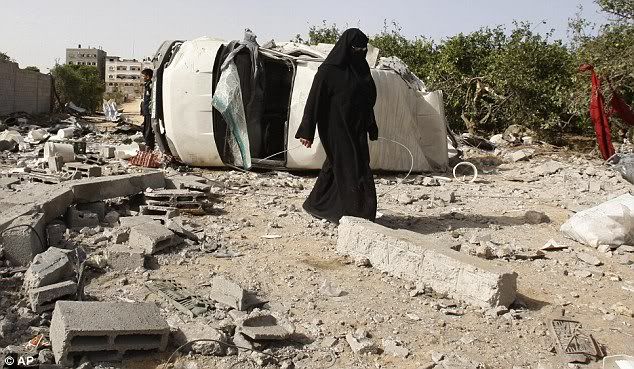
Air strikes: A Palestinian woman walks among the ruins of an air strike on Gaza City yesterday
Photobucket
Conflict: More of the destruction at what Hamas claims is a cheese factory after the Israeli strike

Photobucket


Photobucket
Restraint: The Foreign Office has expressed its 'concern' after strikes caused damage in the Gaza Strip yesterday, above

PhotobucketPhotobucket
Retribution: Two of the three children wounded by flying glass in the Israeli air strike are rushed to hospital


Militants to 'moderators': Who are Hamas?

The news that Hamas is coming under increased pressure from more extreme Islamic groups is worrying.

In Arabic, 'hamas' means 'zeal'. The group has three factions - social, political and military. It is the social arm that has inspired such support for the Palestinian movement in the Gaza Strip - but it is the military arm that has incited the hatred of Israel and condemnation of the group as 'terrorists'.

Hamas grew out of the Muslim Brotherhood in Egypt, gaining a foothold in Gaza and the West Bank with social and charitable work in the 1960s.

It became a formal organisation in 1987 after the first Palestinian intifada. Its first suicide bombing was launched in 1993.

In 2006, Hamas won the Palestinian Authority's general legislative elections, democratically defeating Fatah's Mahmoud Abbas. Since then it has failed to unite around a cohesive programme, largely due to tensions between leaders.

The group's charter calls for the destruction of Israel and the establishment of a Palestinian state.

In 2009 its overall leader Khaled Meshaal, in exile in Syria, said Hamas was willing to cooperate with the U.S. on an Arab-Israeli solution - including a Palestinian state based on the 1967 borders.

But the proposal fell apart as Hamas continued to refuse to recognise Israel, a necessary step for it to be included in the peace talks.

Nevertheless, Hamas has pulled back on its militancy, ending rocket attacks in the wake of Operation Cast Lead last year. So the news that other, even more extreme groups are putting pressure on it to fight again is not reassuring.


Tuesday, March 2, 2010

President Obama 'to slash America's nuclear arsenal by thousands'


A major rethink of America's nuclear strategy could mean the end of production of bunkerbusters, such as this 5000lb GBU-37 at a military base in Missouri
President Obama is set to announce plans for drastic reductions in America's nuclear arsenal.

Officials say thousands of weapons would be cut from their stockpile as part of a major rethink on U.S. nuclear strategy.

It is understood that the review would lead to America halting production of any new weapons with nuclear capability.
These include 'bunkerbuster' bombs that were ordered into development by the Bush administration.

Nuclear weapons at U.S. bases in Europe, including Germany, Belgium, Turkey, the Netherlands and Italy, could also be withdrawn.

America has not confirmed or denied whether bases in Britain are equipped with nuclear weapons.
Another part of the review would allow Russia and China access to military bases in the U.S. to show that nuclear weapons are not in use.

However one suggestion under discussion, that the U.S. declares it would never use nuclear weapons, has been ruled out by the president, who has spoken before of his dream of a world free from nuclear weapons.

Mr Obama's new strategy, which some right-wing critics have described as 'naive and dangerous', will be contained in a document called the Nuclear Posture Review.

Senior administration officials said it would cancel several initiatives set in motion by former president George W Bush, most notably the development of 'bunker busters' which Pentagon chiefs said could be used to strike hidden targets, such as the nuclear facilities in North Korea and Iran.

Aides said Mr Obama believes he cannot urge other countries not to seek new weapons while the U.S. continues its own developments.


Today Top Recent Posts Here.


Blogger Widgets
Related Posts with Thumbnails

Entertainment News