
Thursday, January 28, 2010

Pictured: The little girl who had eight limbs and was worshipped as a deity starts school


8 limbs8 limbs
As she was: Lakshmi as a baby, with her conjoined twin still attached


8 limbs

Brave: Lakshmi Tatma, dressed in her school uniform and standing proudly on her own two feet, smiles at her home in Jodhpur earlier this month
8 limbs

Miracle recovery: Lakshmi plays with her younger sister Saraswati as her mum Poonam looks on at their home this month

8 limbs

Daddy's girl: Lakshmi and her dad Shambu at their home this month. Lakshmi's parents are still fearful for her future, despite the success of the operation


She was born with a unique body - eight limbs and two torsos fused at the hips.

Now Lakshmi Tatma, the Indian toddler whose plight touched the world, has grown up and started school.

Two years after a ground-breaking operation to separate her from a parasitic twin, Lakshmi is a lively and bubbly four-year-old.

She loves playing cricket with her older brother, has a tendency to boss around her newfound friends and remains firmly a daddy's girl.

'When I think of the way she was, never in a million years would Lakshmi have been able to go to school or have the life she does today,' said her mother Poonam, 26.

'All the things she's capable of now were impossible two years ago.

'I often try to think what she might be like today if she hadn't had the operation - she couldn't even sit up before and now she runs around like other children.'

Born in a dusty farming village in India's poorest state, Lakshmi was revered as a deity and worshipped from birth.

Villagers, who believed she was the reincarnation of the Hindu goddess of wealth and fertility, would seek her blessing daily and leave gifts at her bedside.

But Lakshmi's resemblance to her mythological namesake came at a terrible price. She could not walk, stand, or even sit.

The little girl was joined to a headless parasitic twin that had stopped developing in her mother's womb. Doctors were convinced she could not have survived into adulthood.

Now fully recovered from the 27-hour operation to save her, Lakshmi is almost unrecognisable from her former self.

Beneath the surface, however, lurk a series of medical problems that threaten her future and will require years of surgery.

Six months after the complex operation to remove Lakshmi's parasitic twin, doctors discovered she had developed scoliosis, or a curvature of the spine.

Without a complex operation to correct her spine doctors have warned her back will be forced into increasingly severe deformities as she grows, possibly leaving her disabled.

Separately, Lakshmi requires an operation to 'detether' her spine after it was discovered she was born with abnormal tissue connecting the spinal cord to her nervous system.

In a further operation orthopaedic surgeons must perform a procedure to 'close her hips', which are set too far apart and result in an unusual 'gaited' walk.
Finally, plastic surgeons will need to find a way to create buttocks for Lakshmi, which did not form in the womb because of the unique way she was connected to her parasitic twin. In the same operation surgeons will have to fix related problems with her bladder and intestines.

'Lakshmi has come such a long, long way but we're very scared for the future,' said her mother Poonam.

'At one time we never imagined she would look so healthy, so we are very grateful for all the help we've had.

'But we can't bear the thought that all this help could be undone if we can't find a way to get the extra operations she needs.

'The charity that looks after her cares for 500 other children as well. It does not have the funds to pay for these operations and we have no money either.

'The hospital that operated on her before has promised to help but they cannot correct her spine because it is such a specialised operation.

'All we want is for her to be a normal child. She has had her operation but even now she can't walk or move normally. Her feet don't come together properly and when she walks it hurts.'

Despite the threat to her future, Lakshmi's life today is a world away from the circumstances of her birth.
Born to impoverished parents in the frequently lawless state of Bihar, in India's volatile northeast, Lakshmi faced an uncertain future until a wealthy doctor heard of her plight and offered to operate on her for free.

Orthopaedic surgeon Dr Sharan Patil, owner of the Sparsh Hospital in Bangalore 2,000 miles south, travelled to Lakshmi's remote village in 2007 to meet the child and offer her parents the chance of a lifetime.

After more than a month planning the separation, Dr Patil's team attempted the first operation of its kind in the world.

Hundreds of journalists camped outside the hospital throughout the 27-hour surgery.

Lakshmi's fame, having spread from her tiny village around the world, prompted Sucheta Kriplani Shiksha Niketan (SKSN), a charitable school looking after disabled children in the desert state of Rajasthan, to offer her parents a place to live and the chance of an education for Lakshmi and her brother Mithilesh.

Dr Bhairoon Singh Bhati, the secretary of SKSN, said: 'Lakshmi is a special case for us. She's a very challenging case because you can never tell from her medical history when she might next fall ill.

'Her scoliosis is an example of the problems Lakshmi faces because we had no way of knowing she would develop a curvature of the spine.

'Similarly, despite all the problems she still faces we have no way of knowing what may crop up in the future.

'The biggest difficulty caring for Lakshmi is that she's a unique case - there's never been a child like her before so we have nothing to refer back to.'

Under Dr Bhati's guidance Lakshmi has started school, joining her elder brother as the only members of their family to ever receive an education.

Her father Shambu, 28, said: 'I believe with all my heart that Lakshmi is indeed a goddess. The operation removed her extra legs so that she can lead a normal life but she is not a normal child.

'She's special, I think anything is possible for her. I'd like her to be educated so she can become a teacher. Then she can pass on what she knows to other children.'


Teenage girl who survived on just bath water is pulled alive from Haiti rubble after FIFTEEN DAYS


HaitiEarthquake
People walk through the former Petionville golf course which has been turned into a makeshift camp
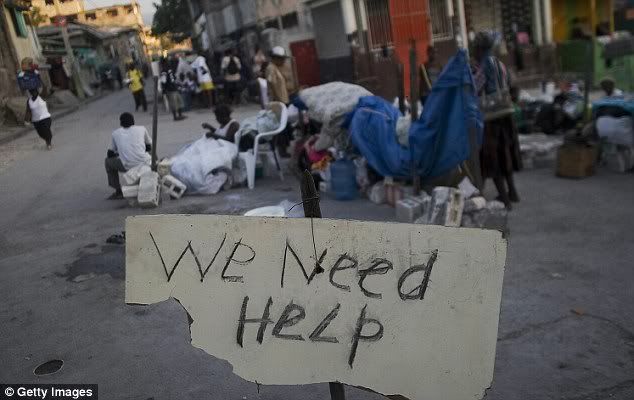

HaitiEarthquake

A sign written by displaced Haitians entreating for help is seen January 27, 2010 in Port-au-Prince
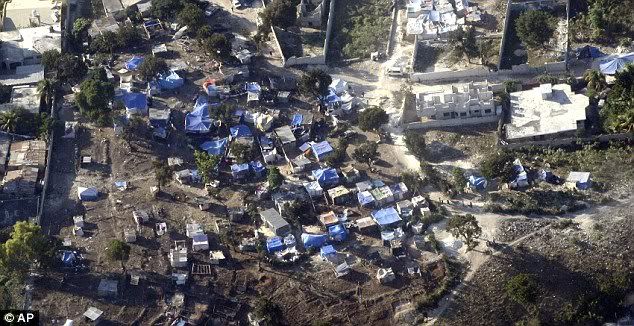
HaitiEarthquake

An aerial view shows one of the many tent cities seen in Port-au-Prince. Aid agencies have had great trouble reaching many of the homeless
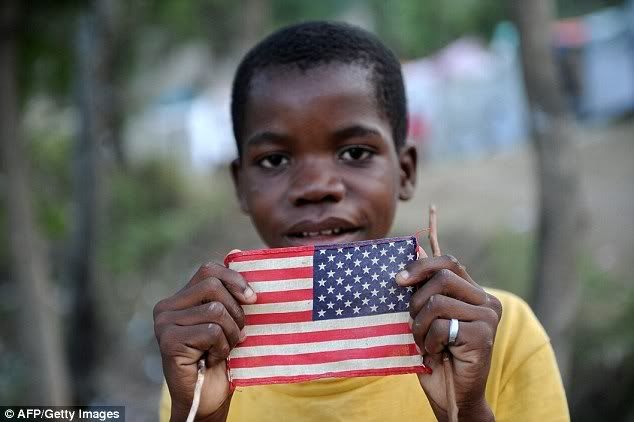
HaitiEarthquake

A holds up a US flag at the former Petionville golf course which has been turned into a makeshift camp in Port-au-Prince
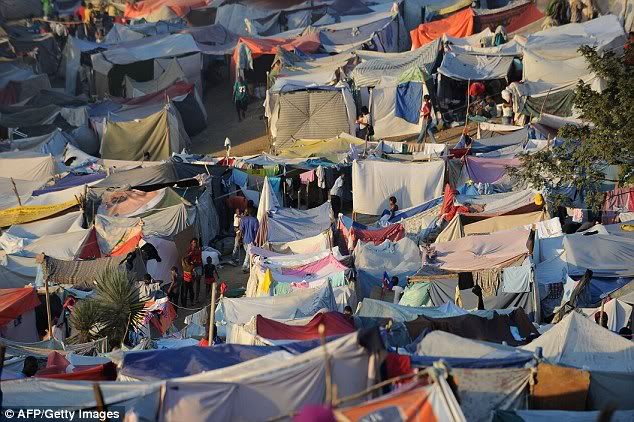

HaitiEarthquake


HaitiEarthquake

A U.S. Army soldier operated earth moving machinery as he helps clear central Port-au-Prince. According to reports approximately 250,000 structures have at least partially collapsed from the earthquake

HaitiEarthquake

The earthquake-damaged remains of the National Cathedral are seen in central Port-au-Prince
HaitiEarthquake

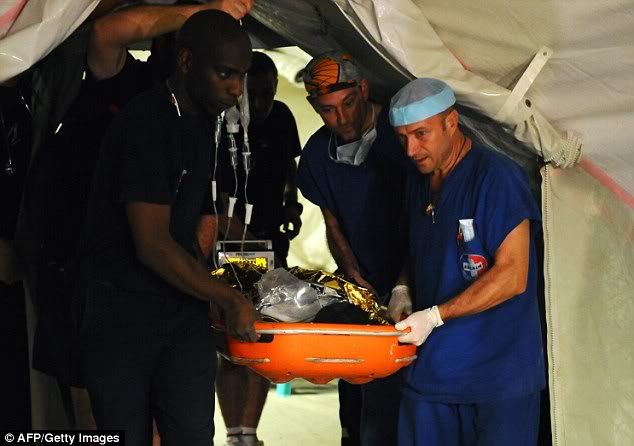
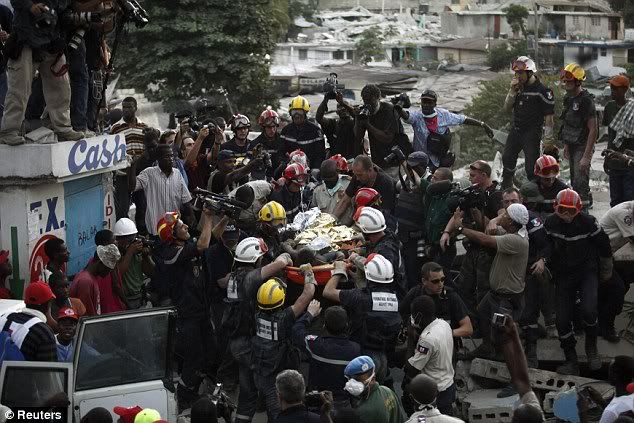
French medics carry a girl who was found alive in the rubble at the French hospital in Port-au-Prince
HaitiEarthquake
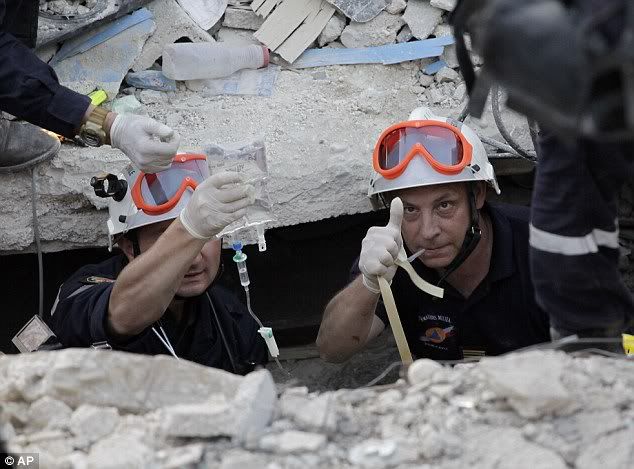
Saved: A French search and rescue team gestures after locating Darlene from the rubble. The official search for survivors was called off days ago

HaitiEarthquake

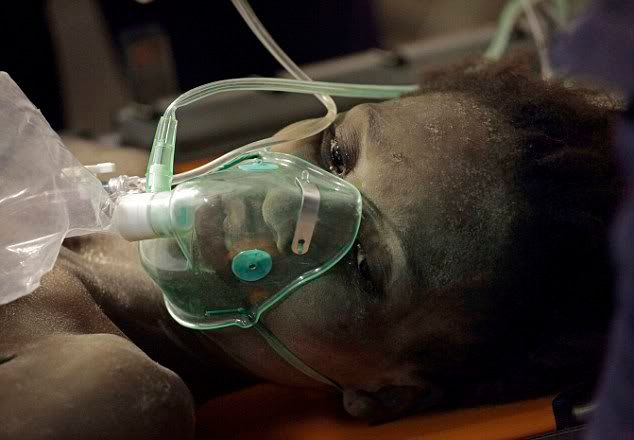
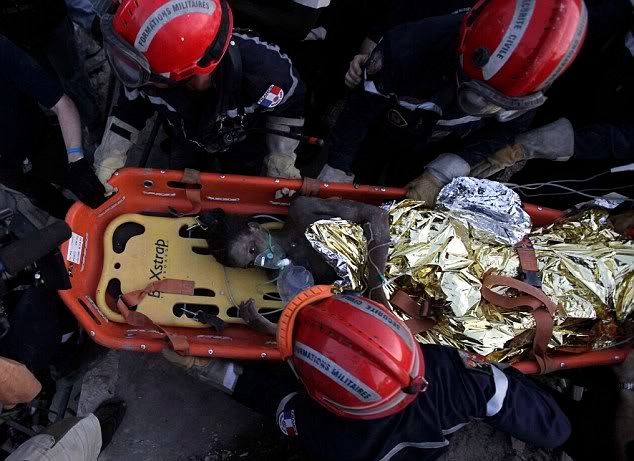
Survivor: Darlene Etienne, 17, was pulled alive from the rubble of a house in Port-au-Prince 15 days after the devastating earthquake
HaitiEarthquake
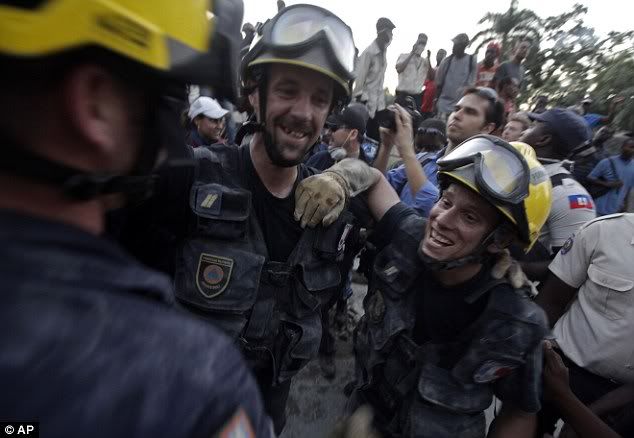
Exhausted but jubilant: Members of the French search and rescue team react after pulling Darlene from a building alive

HaitiEarthquake

French Ambassador Didier le Bret praised the rescue team, which has kept looking for survivors for days after the Haitian government officially called off the search
HaitiEarthquake
Safe at last: French Search and Rescue workers pull out Darlene Etienne from a building in Port-au-Prince

HaitiEarthquake

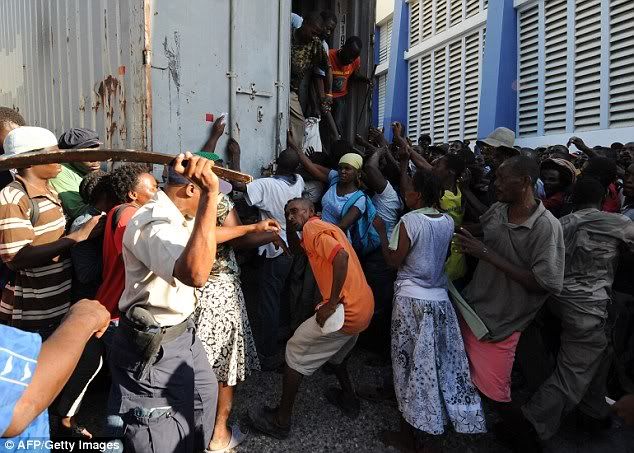
A policeman trys to control a crowd of Haitians at an aid distribution point in Port-au-Prince
HaitiEarthquake

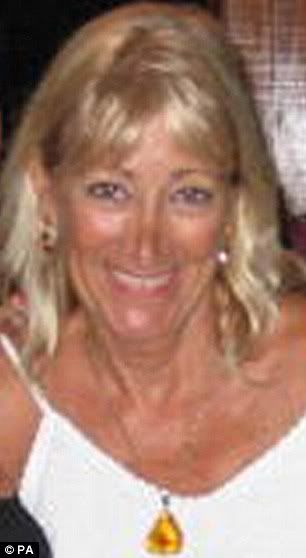
Dead: Ann Barnes, 59, was on the second floor of a building when the powerful earthquake struck


A teenage girl was pulled alive from the rubble in Port-au-Prince, 15 days after the Haitian earthquake.

Darlene Etienne, 17, was just moments from death when she was save by French rescue workers from of a home near the destroyed St. Gerard University.

The teenagers was rushed to a French military field hospital and then to the French military hospital ship Sirroco, suffering from severe dehydration and a broken left leg.
She's alive!' said paramedic Paul Francois-Valette, who accompanied her into the hospital.

Authorities say it is rare for anyone to survive more than 72 hours without water, little alone more than two weeks.

But Etienne may have had some access to water from a bathroom of the collapsed home, and rescuers said she mumbled something about having a little Coca-Cola with her in the rubble.

Her family said Etienne had just started studying when the disaster struck, trapping dozens of students and staff in the rubble of school buildings, hostels and nearby homes.

'We thought she was dead,' her cousin, Jocelyn A. St. Jules, said in a telephone call.

Then - half a month after the earthquake - neighbours on Wednesday heard a voice weakly calling from the rubble of a private home down the road from the collapsed university.

They called authorities, who brought in the French civil response team.
Rescuer Claude Fuilla then walked along the dangerously crumbled roof, heard her voice and saw a little bit of dust-covered black hair in the rubble. Clearing away some debris, he managed to reach the young woman and see she was alive - barely.

'She couldn't really talk to us or say how long she'd been there but I think she'd been there since the earthquake. I don't think she could have survived even a few more hours,' Fuilla said.

Digging out a hole big enough to give her oxygen and water, they found she had a very weak pulse.

Within 45 minutes they managed to remove her, covered in dust.

Fuilla said she was rescued from what appeared to be the porch area of the house, but a neighbour said he believed it was the shower room, where she might have had access to water.

'It's exceptional. She spoke to us in a very little voice, she was extremely weak,' Fuilla said.

'Before we stabilised her she was extremely dehydrated and weak she had a very low blood pressure.'

Another rescuer, French Lt. Col. Christophe Renou, said he had no idea how she had managed to cling to life for so long: 'Definitely she's been here for 15 days. She wasn't hurt but she was very, very weak.'

Renou said his team would probably return today with radar equipment to look for any other possible survivors.

French Ambassador Didier le Bret praised the persistence of the French rescue team, which has kept looking for survivors for days after the Haitian government officially called off the search.

'They are so stubborn because they should not have been working anymore because, officially, the rescue phase is over.

'But they felt that some lives still are to be saved, so we did not say that they should leave the country,' he said.

'To be honest we thought that the last miracle we had a couple of days ago ... would be the last miracle because the chances are so very, very slight.

'But it seems that beyond the miracle, there was another miracle.'

The last previous confirmed rescue of someone trapped by the initial quake occurred Saturday, 11 days later, when French rescuers extricated a man from the ruins of a hotel grocery store.
A man pulled from the rubble of a shop on Tuesday and treated by the U.S. military for severe dehydration and a broken leg said he had been trapped during an aftershock.

At least 135 people have been unearthed by rescue teams since the quake on January 12.

Yesterday the Foreign Office confirmed that a second Briton had been killed in the disaster.
Ann Barnes, 59, originally from Leigh-on-Sea, Essex, is believed to have been on the second floor of a building when the 7.0 magnitude tremor struck.

United Nations worker Frederick Wooldridge, 41, from Kent, was the first Briton to be confirmed dead after perishing with dozens of his colleagues.

Ms Barnes had no children and was not married but had a French partner on the island.

She was a personal assistant to the UN police commissioner and had worked for the UN for more than 20 years.

Her cousin, Christine Hart, 69, from Hornchurch, Essex, said she had refused to give up hope.

'The United Nations confirmed that the body is Ann, it is the news we feared most.'

She added: 'There is nothing I can say, her sister wants to be quiet about things too.'

Ms Barnes was thought to be in the second floor of the United Nations building when it collapsed.

Her partner Bruno has been clawing through the rubble with his bare hands since she vanished.

Mrs Hart added: 'He hasn't left the site. He went home to see what had happened to their house. The house was gone, but he got their dog.'Meanwhile, food from the world's aid agencies still isn't getting to enough hungry Haitians.

The newly homeless of the rubble-strewn Bizoton slum say they haven't gotten food, water or help with shelter in the two weeks since the earthquake.

'If it rains now, that's it,' Wilson St. Ellis, 50, a father of eight, said yesterday amid plastic sheets stretched here and there as flimsy shields against the elements.

Where donated rice, beans or ready-to-eat meals are being distributed, crowds quickly become unruly, with young men pushing ahead and grabbing food bags from women and the weak.

UN peacekeepers fire pepper spray and Haitian police swing sticks to restore control.

'These people are just hungry,' UN spokesman Vincenzo Pugliese said of the thousands thronging food distribution points, where he said UN peacekeepers were reinforcing security.

Food remains scarce for many of the neediest survivors despite the efforts of the United Nations, the U.S. military and dozens of international aid groups.
Relief experts say the scale of this disaster and Haiti's poor infrastructure are presenting unprecedented challenges, but Haitian leaders complain coordination has been poor.

'Many mistakes have to be rectified in order to bring help to the people who need it,' President Rene Preval complained to reporters.

In a bid to improve food distribution, representatives of the UN, the US, the Haitian government and private aid groups met on Wednesday.

Afterwards Donal Reilly of Catholic Relief Services said they decided to divide Port-au-Prince into zones, designating a major aid agency to be responsible for delivering UN food to each sector.

The UN World Food Program (WFP) says it has reached 450,000 people, but it urgently appealed to governments for more cash for Haiti supplies - £500 million to feed 2 million people through until December - more than quadruple the £100 million already pledged.

The food agency says rising tensions and security incidents - 'including people rushing distribution points for food' - have hampered deliveries.
But since the massive relief effort's first days, other problems have also delayed aid - blocked and congested roads, shortages of trucks, a crippled seaport and an overloaded Port-au-Prince airport.

'The unblocking of the logistical bottlenecks is an absolute priority,' the European Commission said, describing a seven-day backlog of 1,000 relief flights seeking permission to land at the single-runway airport.

The senior US officer in Haiti said Haitian families simply cannot rely on any particular location for rations.

Food is 'flooding' into the city, Lt. Gen. Ken Keen told reporters, 'but it's being delivered pretty much in terms of where we can get to and where we can distribute it,' not always in locations that are 'sustained every day.'

At some regular distribution points, such as near the Champs de Mars, the central plaza where thousands of homeless are living, daily food handouts have drawn crowds of frantic people. Desperation boiled over earlier this week and Uruguayan peacekeepers retreated as young men rushed forward to grab US-donated bags of beans and rice.

A pregnant woman collapsed and was trampled.

Elsewhere as well, the strong have preyed on the weak, prying donated food from their arms.

'These things should be done is a systematic way, not a random way,' said Dr. Eddy Delalue, who runs a Haitian relief group, Operation Hope.

'It's survival of the fittest: The strongest guy gets it.'

At one squatter settlement Julia Jean-Francois, 25, clutching a grocery bag filled with small packets of donated water, told of her encounter with food robbers.

'I lost all the rice, beans and oil that were distributed last week. A group of young men shoved me and grabbed the bags and ran away,' said Jean-Francois, whose mother was killed in the quake.

An hour later, she said, one of the men returned and offered to sell her the same food for the equivalent of £12.

She refused, relying instead on a communal kitchen she formed with homeless neighbours.
She said Haitian police patrolling nearby did nothing while people were robbed. 'We complained, and they got into their truck and left,' she said.

As she spoke, a gang of youths pushed into a queue of people waiting for water, shoving an elderly woman, who screamed and swung her bucket at their heads.

Port-au-Prince street vendors can be seen openly selling US-donated rice by the cupful from bags marked 'not for resale.'

Fears of official corruption surrounding the food aid also are surfacing.

Paul Coroleuski of the US-based Convoy of Hope, which has distributed aid in Haiti for three years, said he has more than 100 tons of food in a Port-au-Prince warehouse ready to hand out, but it has been delayed for days by Haitian officials who say they will take over distribution.

Private agencies like his worry that Haitian officials 'will do what they always have done, which is the government takes care of the government and the people are secondary,' he said.

Haitian officials denied the government plans to take over food distribution from private agencies.

Coroleuski's frustration and distrust of the government is echoed in Port-au-Prince's streets.

'If they turn it over to the Haitian government, they would take it all for themselves,' said Muller Bellegarde, 30, as he waited for food in the unrelenting tropical sun.

Haitians remember that when the government took charge of delivering international aid to the city of Gonaives after deadly hurricane floods in 2008, much of it ended up sold on the black market.


Afghan conference a propaganda ploy: Taliban-Saudi Arabia sets firm conditions for Afghan role


Afganisthan
Hamid Karzai and Gordon Brown in Downing Street this morning.Hamid warn that Afganishtan require 15 years of help to recover and rebuild.

Afganisthan
The Taliban have been unmoved by talk of peace overtures . Said it is war mongers meeting to deceive and continue to occupy Afganisthan.


Afganisthan
Security, reconciliation and withdrawal of foreign forces by 2015 were key policy announcements


Afganisthan
Whether Taliban would accept an invitation to a 'peace jirga' is a mute point.


The Afghan Taliban on Thursday dismissed the London conference on Afghanistan as a propaganda ploy and said the summit will fail to produce results, the SITE monitoring service reported.

"The war-mongering rulers under the leadership of (US President Barack) Obama and (British Prime Minister Gordon) Brown want to deceive the people of the world by holding the London conference to show that people still support them," SITE quoted an Internet statement as saying.

If the decision is taken to "once again try to prolong the military, economic, cultural and political occupation of (Afghanistan), this conference will be a mere eye-wish like other conferences."

The London conference, which aims to chart the way forward in Afghanistan, opened on Thursday with nearly 70 countries and organisations taking part.

The Taliban must deny sanctuary to Osama bin Laden before Saudi Arabia will agree to act as a mediator in any Afghan peace deal, the kingdom's foreign minister said on Thursday.

Prince Saud al-Faisal was responding to Afghan President Hamid Karzai who had called on Saudi Arabia, which has hosted talks between Afghan government and Taliban representatives in the past, to help bring peace to Afghanistan.

"Unless the Taliban give up the issue of sanctuary (to bin Laden) I don't think the negotiations with them will be possible or feasible to achieve anything," Prince Saud told reporters on the sidelines of a London conference.

"We have two conditions for Saudi Arabia's involvement: that the request comes officially from Afghanistan and the Taliban has to prove its intentions in coming to the negotiations by cutting their relations with the terrorists and proving it," he said.

"By keeping their contacts with bin Laden they won't be coming to any negotiations with a positive attitude.

POLICY CHANGE

Saudi Arabia froze ties with the Taliban in 1998 over the group's refusal to hand over bin Laden, who had been stripped of his Saudi citizenship for militant attacks in the oil-producing kingdom and activities against the al-Saud royal family.

"I think the important theme in this conference is the intention to change policy in Afghanistan, a recognition first that the settlement in Afghanistan is not going to be a military question alone but there has to be a political and economic side to the settlement," Prince Saud said.

"If peace is brought between Afghans and the terrorists are isolated then the war against the terrorists would be successful," he added.

The United States has insisted that insurgents can only be included in a political settlement if they sever all ties with al Qaeda, renounce violence and respect the Afghan constitution.

Karzai said that Afghanistan needed the support of its neighbours, particularly Pakistan, to secure peace.

Pakistan, Saudi Arabia and the United Arab Emirates were the only three countries to recognise the Taliban government before it was ousted in the U.S.-led invasion in 2001.

Asked whether Saudi Arabia shares the concern of the West and other allies that Iran's nuclear programme is aimed at building an atomic bomb and not for creating electricity as Tehran claims, Prince Saud said:

"If they are working on a peaceful nuclear programme they certainly have a strange way of showing it. All the countries that are working on a peaceful programme are not acting like Iran.

"There is one sure way of stopping that, that is to take a decision at the Security Council that no weapons of mass destruction, nuclear or otherwise will be allowed in the Middle East and that includes Israel."


Control over some of Afghanistan's provinces is to be handed over to the Afghan government by the end of 2010, according to foreign ministers attending a one-day international conference in London.

UK Foreign Minister David Miliband said on Thursday that 2010 was a "decisive" year because a new government was in place, adding that security of all provinces would be under Afghanistan leadership within five years.

Miliband also announced a new fund to allow the Afghan government to woo Taliban fighters away from the conflict.

"Today alone there have been over 140 million dollars worth of commitments for the first year of the national reintegration programme and we are committed to seeing that through," Miliband said.

In a communique published at the end of the conference that was attended by delegates from 70 countries, support was also offered for the continued growth and expansion of the Afghan National Army and police force.

Delegates agreed a target of recruiting some 171,600 soldiers and 134,000 police officers by October 2011.

But Hillary Clinton, the US secretary of state, said that plans to gradually transfer Afghan security from international to domestic forces was "not an exit strategy".

"We . . . support the NATO transition plan," Clinton said. "But I want to make clear - to Afghans, to our partners, to our citizens, and to the extremists who hope for our failure: This is not an exit strategy."

Taliban reaction

Taliban dismissed the London conference as a propaganda ploy, saying the summit would fail to produce results, according to the AFP news agency, quoting an internet statement.

"The war-mongering rulers under the leadership of [US President Barack]Obama and [British Prime Minister Gordon] Brown want to deceive the people of the world by holding the London conference to show that people still support them".

If the decision is taken to "once again try to prolong the military, economic, cultural and political occupation of [Afghanistan], this conference will be mere wishful thinking like other conferences."

The statement also dismissed a plan by Hamid Karzai, the Afghan president, to woo Taliban moderates with offers of money and jobs.

"They announce that they will provide money, employment and opportunity to have a comfortable life abroad for those mujahedeen who agree to part ways with jihad," the statement said.

"This is baseless and futile," it said. "Had the aim of the mujahedeen of the Islamic Emirate been obtainment of material goals, they would accept dominance of the invaders in the first place."

Presidential view

Earlier on Thursday, Karzai said that his country must reach out to its "disenchanted brothers" in an effort to stabilise the war ravaged nation, saying fighters who are "not part of al-Qaeda or other terror groups" must be reconciled with the government.

The Afghan leader said his government would set up a national council for peace and reconciliation, and has asked Saudi Arabia to help guide the process.

Karzai was seeking support for a $1 billion plan that would offer cash, jobs and other incentives to the Taliban and fighters in other armed groups, in an attempt to bring them back into mainstream society.

Taliban fighters have also been invited to a "peace jirga", or a traditional gathering of tribal elders, expected to be held early this year, a government spokesman confirmed.

Saudi role?

Hamid Elmi, Karzai's deputy spokesman, said: "We are using all kinds of possibilities - our neighbouring countries, the international community, the king of Saudi - to encourage the Taliban to come".


However, Saudi Arabia said on Thursday that it would only take part in Afghan peace efforts if the Taliban denies sanctuary to Osama bin Laden, the al-Qaeda leader, according to the kingdom's foreign minister.

"Unless the Taliban give up the issue of sanctuary (to bin Laden) I don't think the negotiations with them will be possible or feasible to achieve anything," Prince Saud al-Faisal told reporters on the sidelines of a London conference.

"We have two conditions: that the request comes officially from Afghanistan and the Taliban has to prove its intentions in coming to the negotiations by cutting their relations with the terrorists and proving it."

But Haroun Mir, deputy director for the centre for research and policy studies in Kabul, told Al Jazeera that Karzai's proposal could be hampered by plans to increase the number of foreign troops in Afghanistan.

"Karzai has been talking for a long time for reaching out to the Taliban.

"But ... the US military surge and additional Nato forces in Afghanistan in the coming months [will see] the intensity of fighting increase.

"I don't know how president Karzai could implement his own strategy of reaching out to the Taliban if there is increased fighting going on in Afghanistan," he said.

Secret talks

And Abdullah Abdullah, the presidential candidate who withdrew from last August's fraudulent elections, said obstacles remain to implementing such a policy.

"I don't think the Taliban at this stage are willing to enter negotiations. Also, their association with terrorist organisations, like al-Qaeda - that's the main issue at the moment - and they are working like one organisation."

Thursday's conference comes nearly a week after a meeting between Afghan government officials and members of an armed opposition group fighting alongside the Taliban.

Al Jazeera's David Chater, reporting from Kabul, said the talks were held with the group Hezb-e-Islami, in the Maldives islands, between January 23-24.

He said a Taliban leader had been due to attend the meeting but dropped out in the last minute citing health reasons.

President Karzai of Afghanistan warned today that his country's security forces would require another 15 years of Western support before they are able to sustain themselves.

Ahead of the opening of the London Conference on Afghanistan, Mr Karzai told the BBC that he foresaw a gradual reduction in support over a lengthy timeframe.

“With regard to training and equipping the Afghan security forces, five to 10 years will be enough,” he said. “With regard to sustaining them until Afghanistan is financially able to provide for our forces, the time will be extended to 10 to 15 years.”

His comments were at odds with the tone of Gordon Brown’s opening address to the conference, which sought to stress a timeframe of less than a year until Western forces begin a transition of responsibility to their Afghan counterparts.


The Communique that will end the conference, a document already leaked to The Times, forsees a gradual transfer starting late this year or early next in the more benign provinces. Afghan forces will be in the lead of the majority of provinces within three years and overall control will pass to Afghan forces within five years.

Concurrent with the military surge, led by 30,000 new US troops, the Prime Minister set out details to leaders from more than 60 countries of a complementary “civilian and political surge” that will include a drive to reconcile and reintegrate Taliban fighters.

After a bloody year for Nato forces in Afghanistan, during which 520 troops died including 108 from Britain, Mr Brown told delegates: “By the middle of next year, we have to turn the tide in the fight against the insurgency.”

Standing alongside Mr Karzai, the Prime Minister went on to detail plans that Western leaders hope will lead to the reintegration of what the Afghan President called the “disenchanted brothers” of the Taleban.

The Prime Minister detailed a new £500million fund that is to offer inducements to Taleban fighters who promise to lay down their arms and sever their ties with Al-Qaeda and other terrorist networks.

The exact nature of the proposed engagement remains unclear, with Afghan officials and some British officials appearing to push a more conciliatory line than is coming from Washington.

Speaking at the start of the conference President Karzai told leaders that he wished to “reach out to all” and asked that the Saudi leader King Abdullah act as an intermediary in a process of engagement with the Taleban leadership. Saudi Arabia, one of only three countries to recognise the original Taleban government, has played a discreet role in previous unofficial talks between the Karzai government and representatives of the Taleban

The Pentagon spokesman Geoff Morrell said yesterday that any reconciliation with the Taleban leader Mullah Mohammad Omar was "probably a bridge too far" after he gave safe haven to al-Qaeda to launch the September 11, 2001, attacks on the United States.

"He has the blood of thousands of Americans on his hands," he told reporters in Washington.

But Mark Sedwill, the former British Ambassador and newly appointed Nato civilian representative in Afghanistan, suggested that talks with the Taleban would inevitably lead to engagement with “unsavoury characters.”

"If we are going to bring conflicts like Afghanistan, civil conflicts, to an end, that means some pretty unsavoury characters have to be brought within the system," he said.

The Taleban has been dismissive of suggestions that fighters can be “bought” by the new plan and today restated on its website that the withdrawal of Western forces is a precondition to any negotiation with the leadership. However, the insurgent movement has been careful in recent months to distance itself from Al-Qaeda’s agenda stressing that it poses “no threat to the West”.

Among the measures that are to accompany the reconciliation drive as part of a concurrent “civilian surge” in Afghanistan are plans for a new training programme for some 12,000 Afghan bureaucrats, a key deficiency in a country beset by both literacy rates of less than 30 per cent and endemic corruption. Agriculture, the mainstay of the Afghan economy, is to receive another £72 million from the British taxpayer.

As the West tries to accelerate a transition to Afghan control that will provide an ultimate exit strategy, Mr Brown said that the proportion of development money channelled through the Afghan government is to be increased to 50 per cent of the total, a move matched by Afghan government commitments to clamp down on endemic corruption. The International Monitory Fund and the World Bank are to announce further debt relief for Afghanistan totalling $1.6 billion.

British police training and mentoring teams are to be doubled from April, Mr Brown said, as part of an international effort to build Afghan forces that will see the Afghan Army expanded from 134,000 this October to 171,600 by October 2011. The Afghan police are to grow in number from 109,000 in October to 134,000 by October 2011.


-----

-----

------

-------

--------

------

Mussolini iPhone app becomes the second-most downloaded item in Italy - 1,000 a day for 59p


BenitoMussolini
iMussolini: Benito Mussolini in an undated photo. An iPhone app featuring the fascist dictator has become the second most popular app in Italy

BenitoMussolini

Controversial: An image from the screen of an iPhone using the app.  iPhone Italy says the app is a historical tool and not political commentary


An iPhone application containing 100 of Fascist dictator Benito Mussolini's speeches has become the second most downloaded item in Italy, it emerged today.

The application, called iMussolini, is available on Apple’s on line store for 79 euro cents (59p).

According to Italy' Apple iTunes store, it has been downloaded more than a hugely popular video game based on blockbuster film Avatar.

It is second only to an X-ray machine app that 'allows you to see your friends naked'.

Created by Luigi Marino, a 25-year-old businessman from Naples, the Mussolini application has jumped from 55 downloads a day to more than 1,000.

It contains speeches and video from 1914 before Mussolini came to power and on into 1938 at the height of his rule.

The application is illustrated with a traditional profile black and white photograph of il Duce with the words words 'iMussolini - the man who changed the history of our country.'

On the review page it adds:'After just three days in the Apple Store apps site iMussolini has reached second place in the top 100 paid for downloads.'

It adds that a 'new version is being prepared with all the content of the Fascist era,' calling the app 'an unmissable bargain'.
It also asks downloaders not to 'leave comments praising Fascism'.

Technically praising Fascism or making the Fascist straight-arm Roman salute is illegal in Italy.

But Mussolini's home town of Predappio has become a shrine to neo-Fascists with thousands of visitors every year.

Creator Mr Marino from Naples, who keeps 70 per cent of proceeds from downloads, said: 'I would like to thank all the numerous people who have downloaded the application but I would ask them not to post comments in praise of Fascism.

'This was a delicate phase of our history and the application offers people the chance to examine and listen for themselves to what Mussolini said. It is not an application that eulogises Fascism or Mussolini.

'I am amazed at the amount of downloads and I am aware that there have been complaints to Apple but as I say it is not an application in praise of Mussolini but simply a tool of history.'

When the application was launched iPhone's Italian website was inundated with comments both pro and against.

One said: 'At last, a serious application,' while another said: 'Numerous enemies. much honour.'

Negative comments included 'iPhone Italia should be ashamed of themselves', while another read: 'I can't believe it. I feel sick'.

Today iPhone Italia had closed the comments page down.

Instead it published a statement which read: 'The comments posted do no represent the views of iPhone Italia and any which expressed a political viewpoint have been removed.

'The application is not a political item but one of history and concerns a person who wrote an important page in our history.'

Flavio Arzarello, of the Young Italian Communists, said: 'We have written a letter to Apple in Milan asking them that this disgraceful application be removed at once.'

Today no-one was available for comment at Apple's Milan office.


Get Benito Mussolini's stuffs
My Rise And FallThe Doctrine of FascismBenito Mussolini: The First Fascist (Library of World Biography Series)Benito: The Rise and Fall of MussoliniMy Autobiography: With "The Political and Social Doctrine of Fascism" (Dover Books on History, Political and Social Science)Mussolini: The Rise and Fall of Il Duce


State of the Union: Highlights, reactions, analyses


Obama

Global reach: Obama's first State of the Union address was watched by millions of TV viewers around the world

Obama
Oh please, sit down: But the First Lady appears slightly embarrassed as she's given a standing ovation

Obama
Mrs Obama and Kimberly Munley wave to the crowd during the address. Officer Munley, a 34-year-old mother of two, became an instant hero when she opened fire on the Fort Hood gunman during his shooting rampage at the Army base last November.Support: Michelle Obama is praised for her health initiatives in her husband's speech


Obama

People's man: Flanked by security, Obama signs an autograph for fan after delivering his address

Obama
Stone-faced: Republican senators (left to right) Lindsey Graham, John McCain and Charles Grassley listen to Obama's address


Obama

'I don't quit': While admitting that his administration 'deserved' the setbacks, Obama vowed not to give up on his dreams


Obama

Contemplation: Amid the roar of applause and mobbed by his colleagues, Obama seems to have quiet moment


Obama

Prepared: The president spoke for about one hour


Obama
Packed house: The president speaks to the divided congress in Washington


Positive: President Barack Obama delivers his first State of the Union address and makes a commitment to job growth


*

'I hear you, America': Obama makes job creation top priority - not health care
*

Standing ovation for Michelle Obama on her health initiatives
*

President pledges to double American exports, creating two million jobs
*

Obama flags tax credits for childcare and more aid for people with student loans

In an extraordinary admission, Barack Obama said last night that his administration ‘deserved’ the setbacks it suffered during his first year in the White House.

But the embattled president insisted he would not give up on his dreams, vowing: 'I don’t quit.’

The rare moment of candour from a sitting president came as Mr Obama tried to win over an increasingly sceptical American public in his first State of the Union address.‘Change has not come fast enough,’ he acknowledged in a long and wide-ranging speech before a packed joint session of US Congress and a prime time audience of millions.

He said he accepted ‘my share of the blame’ for not adequately explaining his plans to the public.

And, coming in the wake of last week’s humbling defeat to the Republicans in a special election to replace the late Democrat Senator Edward Kennedy, Mr Obama didn’t try and gloss over criticism he has faced over his health care reforms and heavy spending on economic bail out plans.
Our administration has had some political setbacks this year,’ he said, ‘and some of them were well-deserved.’

‘I campaigned on the promise of change – ‘change we can believe in,’ the slogan went.’ And right now, I know that there are many Americans who aren’t sure if they still believe we can change, or at least that I can deliver it.

‘But remember this,’ he added. ‘I never suggested that change would be easy, or that I can do it alone.
He chided both political parties for the partisan bickering that has dogged his efforts to make good on many of his campaign promises.

‘Let’s try common sense,’ he said, adding that leaders in Washington face a ‘deficit of trust.’

Positioning himself as a champion of the middle class, Mr Obama adopted a relaxed tone at times, joking at one point that the bank bail out was ‘about as popular as root canal.’

He also kept watching wife Michelle happy by earning her two standing ovations with praise for her health initiatives.

But the majority of his 70-minute speech concentrated on the very serious subjects of jobs and the economy.

There were no sweeping new initiatives, but Mr Obama sought to repackage his existing priorities, such as health care reforms and clean energy legislation, by promoting their beneficial impact on creating new jobs.
Critics saw last week’s Senate seat defeat as a referendum on the administration’s health care overhaul, but – while it did take him more than 20 minutes to broach the subject – the president insisted he was not giving up the fight.

He appealed to lawmakers to take another look at the controversial plan to offer government-run alternatives to the private health insurers that dominate the American health system.

‘Do not walk away from reform,’ he appealed to Republicans. 'Not now. Not when we are so close. Let’s find a way to come together and finish the job for the American people.’

But he was quickly back to the overriding theme of his speech, which sought to find the populist groove missing since hjs campaign days.

‘Jobs must be our number one focus in 2010. People are out of work. They are hurting. They need our help,’ he said.
'I do not accept second-place for the United States of America. As hard as it may be, as uncomfortable and contentious as the debates may be, it's time to get serious about fixing the problems that are hampering our growth.'

Mr Obama compared the U.S. to other nations: 'Washington has been telling us to wait for decades, even as the problems have grown worse. Meanwhile, China's not waiting to revamp its economy. Germany's not waiting. India's not waiting.'

He set a goal of doubling exports over the next five years, an increase he claimed would create two million jobs and, as he promised earlier in the week, he proposed a series of programmes aimed at helping improve the lot of America’s disgruntled middle class.

They included doubling tax credits for childcare and more aid for people struggling with student loans.

Mr Obama looked to change the conversation from how his presidency is stalling — over the messy health care debate, a limping economy and the missteps that led to Christmas Day's barely averted terrorist disaster — to how he is seizing the reins.
He spoke to a nation gloomy over double-digit unemployment and federal deficits soaring to almost £1 trillion, and to fellow Democrats dispirited about the fallen standing of a president they hoped would carry them through this autumn's midterm elections.

Republicans applauded the president when he entered the chamber, and even craned their necks and welcomed Michelle Obama when she took her seat. But the warm feelings of bipartisanship disappeared early.

Democrats jumped to their feet and roared when Mr Obama said he wanted to impose a new fee on banks, while Republicans sat stone-faced. Democrats stood and applauded when Mr Obama mentioned the economic stimulus package passed last February. Republicans just stared.

On national security, the president proclaimed some success, saying that ‘far more’ al Qaeda terrorists were killed under his watch last year than in 2008.

Hoping to salve growing disappointment in a key constituency, Mr Obama said he would work with Congress ‘this year’ to repeal the ban on gays and lesbians serving openly in the military.

But in a concession to concern about the move among Republicans and on his own party's right flank, Mr Obama neither made a commitment to suspend the practice in the interim nor issued a firm deadline for action.
Declaring that ‘I know the anxieties’ of Americans' struggling to pay the bills while big banks get bailouts and bonuses, Mr Obama prodded Congress to enact a second stimulus package ‘without delay,’ specifying it should contain a range of measures to help small businesses and funding for infrastructure projects.

Acknowledging frustration at the government's habit of spending more than it has, he said he would veto any bills that do not adhere to his demand for a three-year freeze on some domestic

In the Republican response to Mr Obama's speech, Virginia Governor Bob McDonnell showed no sign of his party capitulating to the president.

In fact, the choice of McDonnell to represent Republicans was symbolic, meant to showcase recent election victories by him and others.

In a remarkable shift from past addresses, and notable for a president whose candidacy first caught fire over Iraq war opposition, foreign policy took a relative back seat. It came behind the economy and was largely devoid of new policy.

And Mr Obama made no mention of three of the toughest challenges he faced in his first year: failing to close the terrorist prison compound at Guantanamo Bay, Cuba, failing to get Israel and the Palestinians to resume peace negotiations, and struggling with the al Qaeda havens in Pakistan that are at the core of the terrorist threat to America.

The president is keeping to the tradition of taking his themes on the road.

He will travel to Florida today to announce £5 billion in grants for high-speed rail development, to Maryland tomorrow to a House Republican retreat, and to New Hampshire next Tuesday to talk about job creation.


Citing a "deficit of trust" in government by the American people, President Obama's first State of the Union address urged Congress to erode the influence of special interests and work together to confront the nation's most pressing problems.

In the nationally televised speech Wednesday night to a joint session of Congress, Obama sought to reassure Americans angry and nervous about the pace of economic recovery that his government understands the challenges and would act boldly to meet them.

Obama called for a new political climate of "common sense" approaches that invest in the American people without building "a mountain of debt."


"We have to recognize that we face more than a deficit of dollars right now. We face a deficit of trust -- deep and corrosive doubts about how Washington works that have been growing for years," Obama said.

Key areas where Obama wants to build that trust include: the economy, education, energy, health care and national security.

Democrats applauded the remarks of their party's leader."He outlined a road map that, if followed with bipartisan support in Congress, can reduce our deficit, rebuild our economy and create a new foundation of prosperity for American families and businesses," said Sen. Tom Harkin, D-Iowa.

"It was a serious speech -- reached out to Republicans," said Rep. Steny Hoyer, D-Maryland, the House majority leader.

Republicans, however, were skeptical of Obama's ability to change the partisan atmosphere in Washington.

"Real bipartisanship requires more than just lip service; it demands both sides coming together in a real and meaningful way. It's time for the administration to abandon this big-government agenda and start working in a meaningful way with Republicans to find common-sense solutions to move the country forward," said Sen. Orrin Hatch, R-Utah.

"I would have liked to have seen him emphasize reaching out to the other side of the aisle and bringing us together," said Sen. George Voinovich, R-Ohio.

Analysts, too, were mixed in their reactions to what Obama had to say Wednesday night.

CNN political contributor John Avlon said Obama was targeting independents with his remarks, but questioned his success.

"They still hear The Who's 'Won't Get Fooled Again' in the back of their minds," Avlon said.

Democratic strategist James Carville said Obama made progress. "He picked up a first down tonight," Carville said.

And a post-speech opinion poll shows a divided public.

A CNN/Opinion Research Corp. survey indicated that 48 percent of speech watchers had a very positive reaction, with three in 10 saying they had a somewhat positive response and 21 percent with a negative response.

The 48 percent who indicated they had a very positive response is down 20 points from the 68 percent of speech watchers who felt the same way a year ago about the president's February 24 primetime address to a joint session of Congress.

"Wednesday night's State of the Union audience is more Democratic than the nation as a whole, but speech-watchers were less Democratic this year than they were last year," said Keating Holland, CNN polling director. "That may be one reason why the number who gave his speech a 'very positive' rating is lower this year. But part of the reason also may be that speech-watchers didn't necessarily hear a new agenda and aren't confident that the president can improve health care or lower the deficit."


--------

-------

--------

---------

Today Top Recent Posts Here.


Blogger Widgets
Related Posts with Thumbnails

Entertainment News